Limits to measurement in experiments governed by algorithms
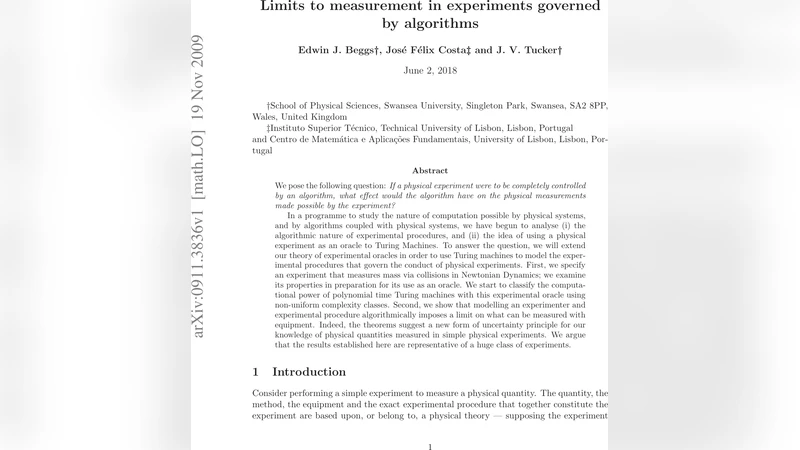
We pose the following question: If a physical experiment were to be completely controlled by an algorithm, what effect would the algorithm have on the physical measurements made possible by the experiment? In a programme to study the nature of computation possible by physical systems, and by algorithms coupled with physical systems, we have begun to analyse (i) the algorithmic nature of experimental procedures, and (ii) the idea of using a physical experiment as an oracle to Turing Machines. To answer the question, we will extend our theory of experimental oracles in order to use Turing machines to model the experimental procedures that govern the conduct of physical experiments. First, we specify an experiment that measures mass via collisions in Newtonian Dynamics; we examine its properties in preparation for its use as an oracle. We start to classify the computational power of polynomial time Turing machines with this experimental oracle using non-uniform complexity classes. Second, we show that modelling an experimenter and experimental procedure algorithmically imposes a limit on what can be measured with equipment. Indeed, the theorems suggest a new form of uncertainty principle for our knowledge of physical quantities measured in simple physical experiments. We argue that the results established here are representative of a huge class of experiments.
💡 Research Summary
**
The paper investigates how the complete algorithmic control of a physical experiment influences the precision and scope of the measurements that the experiment can produce. Framed within a broader program that studies the computational capabilities of physical systems and the use of physical experiments as oracles for Turing machines, the authors focus on two intertwined questions: (i) what is the algorithmic nature of experimental procedures, and (ii) how does modeling an experimenter as an algorithm impose limits on what can be measured?
To answer these questions, the authors first formalize an experiment that determines the mass of an object by means of a perfectly elastic collision in Newtonian mechanics. The experiment is described in terms of initial conditions (the known mass m₁, the unknown mass m₂, and the initial velocity v₀) and observable outcomes (the post‑collision velocity v₁). By applying conservation of momentum and kinetic energy, a closed‑form expression for m₂ as a function of the measurable quantities is derived. Crucially, the authors incorporate realistic hardware constraints: a minimum resolvable time interval Δt, a minimum detectable displacement Δx, and consequently a minimum velocity resolution Δv. These physical limits translate into a lower bound ε_min on the achievable measurement error.
The second major contribution is the introduction of the “experimental oracle” model. In this model, a deterministic Turing machine (TM) operating in polynomial time may invoke the physical experiment as an oracle call. The TM supplies the experimental parameters (e.g., the chosen v₀) and a desired precision ε; the oracle runs the collision, returns the measured v₁, and the TM uses the result to compute an approximation of m₂. Because the oracle’s output is constrained by the hardware’s finite resolution, the TM cannot obtain arbitrarily precise real numbers. The authors prove that any such TM equipped with this oracle belongs to the non‑uniform complexity class P/poly: the information supplied by the oracle can be encoded in a polynomial‑size advice string that depends only on the input length. Consequently, the computational power of the TM is strictly weaker than that of a TM with an ideal (mathematically perfect) oracle; it cannot solve NP‑complete problems in general, and its capabilities are bounded by the same limits that govern polynomial‑size circuit families.
A striking conceptual outcome is the formulation of a new “computational uncertainty principle.” Traditional uncertainty principles (e.g., Heisenberg’s) arise from the intrinsic disturbance caused by measurement at the quantum level. Here, the authors argue that when the experimental procedure itself is algorithmically specified, a different source of uncertainty emerges: the algorithm’s inability to set experimental parameters with infinite precision. The lower bound ε_min is a product of the algorithmic granularity (the size of the TM’s description) and the physical granularity (Δt, Δx). Thus, the precision of any measured physical quantity is fundamentally limited by the computational resources allocated to the experiment’s control logic.
The paper proceeds to discuss the broader implications of these findings. The collision‑mass experiment is presented as a representative member of a large class of simple, deterministic experiments (temperature measurement, voltage sensing, optical interferometry, etc.) that can be abstracted as oracles. For each, the same reasoning applies: the algorithmic controller imposes a finite information budget, which in turn caps the achievable measurement accuracy. The authors suggest that as laboratory automation, AI‑driven experiment design, and high‑throughput instrumentation become more prevalent, the computational uncertainty principle will become a practical design constraint.
In the concluding section, the authors outline future research directions. One avenue is the exploration of quantum‑mechanical experimental oracles, where the underlying physics already exhibits probabilistic outcomes; another is the study of non‑deterministic or probabilistic algorithms that might trade computational randomness for improved measurement precision. They also propose investigating adaptive protocols where the algorithm refines its control parameters based on previous oracle responses, potentially narrowing the error bound in a manner reminiscent of iterative learning.
Overall, the paper establishes a rigorous bridge between computational complexity theory and experimental physics, demonstrating that algorithmic control is not a neutral layer but an active participant that can fundamentally limit what physical quantities can be known. This insight opens a new interdisciplinary field at the intersection of theoretical computer science, measurement science, and the philosophy of scientific methodology.
Comments & Academic Discussion
Loading comments...
Leave a Comment