Properties of distance functions on convex surfaces and applications
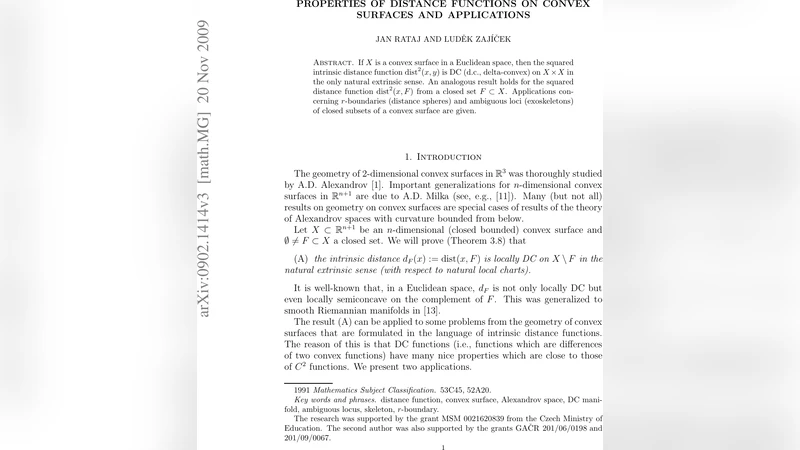
If $X$ is a convex surface in a Euclidean space, then the squared intrinsic distance function $\dist^2(x,y)$ is DC (d.c., delta-convex) on $X\times X$ in the only natural extrinsic sense. An analogous result holds for the squared distance function $\dist^2(x,F)$ from a closed set $F \subset X$. Applications concerning $r$-boundaries (distance spheres) and the ambiguous locus (exoskeleton) of a closed subset of a convex surface are given.
💡 Research Summary
The paper investigates intrinsic distance functions on convex surfaces embedded in Euclidean space and establishes that their squared versions are delta‑convex (DC) in the most natural extrinsic sense. A convex surface (X\subset\mathbb{R}^n) is the boundary of a compact convex body; its intrinsic metric is defined by the length of geodesics lying on (X). The authors first show that for any fixed point (y\in X) the map (x\mapsto \operatorname{dist}_X^2(x,y)) can be written locally as the difference of two convex functions. The proof exploits the fact that the second fundamental form of a convex surface is non‑negative, which guarantees that the squared distance behaves like a convex function when projected onto a supporting tangent plane. By varying (y) and using a uniform control on the curvature, they extend the representation to the full two‑variable function ((x,y)\mapsto \operatorname{dist}_X^2(x,y)), thereby proving that it is a DC function on the product space (X\times X).
The second main result concerns the distance from a closed subset (F\subset X). The function \
Comments & Academic Discussion
Loading comments...
Leave a Comment