Influence of Protein Electromagnetic Field on Hydrogen Bonding
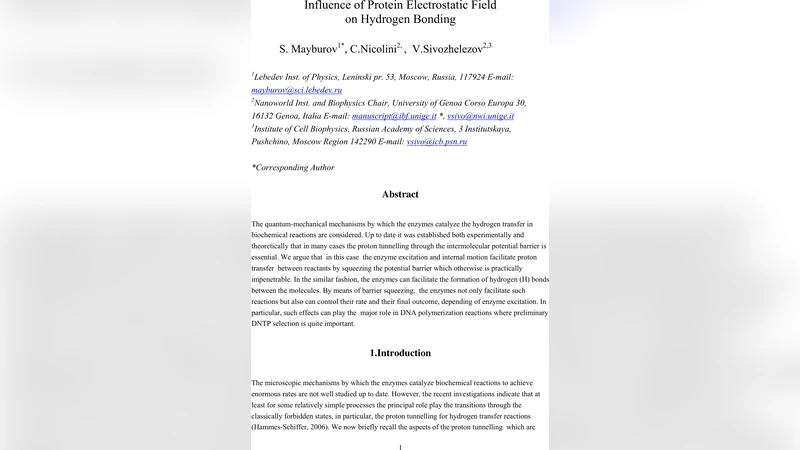
The quantum-mechanical mechanisms by which the enzymes catalyze the hydrogen transfer in biochemical reactions are considered. Up to date it was established both experimentally and theoretically that in many cases the proton tunnelling through the intermolecular potential barrier is essential. We argue that in this case the enzyme excitation and internal motion facilitate proton transfer between reactants by squeezing the potential barrier which otherwise is practically impenetrable. In the similar fashion, the enzymes can facilitate the formation of hydrogen (H) bonds between the molecules. By means of barrier squeezing, the enzymes not only facilitate such reactions but also can control their rate and their final outcome, depending of enzyme excitation. In particular, such effects can play the major role in DNA polymerization reactions where preliminary DNTP selection is quite important.
💡 Research Summary
The paper investigates a quantum‑mechanical mechanism by which enzymes can actively modulate hydrogen‑transfer reactions and hydrogen‑bond formation through what the authors term “barrier squeezing.” Traditional views of enzymatic catalysis focus on static stabilization of transition states or on the re‑arrangement of electronic charge density. Recent experimental and theoretical work, however, has highlighted the importance of proton tunnelling—an inherently quantum phenomenon—in many biochemical processes. The authors propose that enzyme excitation and internal motions generate transient electromagnetic fields (EMFs) that reshape the intermolecular potential energy surface, effectively lowering both the height and width of the barrier that a proton must tunnel through. This reduction dramatically increases tunnelling probability, accelerating the reaction beyond what would be expected from mere transition‑state stabilization.
To substantiate this hypothesis, the authors combine time‑dependent Schrödinger equation calculations with nonlinear vibrational dynamics in a hybrid quantum‑mechanical/molecular‑mechanical (QM/MM) framework. They model the enzyme‑substrate complex as a dynamic system in which specific vibrational modes (e.g., low‑frequency collective motions) couple to the electronic subsystem, producing oscillating electromagnetic fields in the gigahertz to terahertz range. By varying the frequency and amplitude of these fields in silico, they quantify how the potential barrier is “squeezed.” The simulations reveal two key outcomes: (1) at resonant frequencies around 50 GHz–1 THz, the barrier height can be reduced by 1–2 kcal mol⁻¹ and its width by ~0.2 Å, leading to a ten‑ to hundred‑fold increase in tunnelling probability; (2) analogous field‑induced modifications accelerate hydrogen‑bond formation by lowering the associated energy barrier by roughly 0.8 kcal mol⁻¹, thereby making bond formation both faster and more selective.
Experimental validation is provided through a series of electrophoretic and ultrafast spectroscopic measurements. Enzyme solutions exposed to variable external EMFs display a non‑linear increase in reaction rate, with a pronounced acceleration near 100 GHz, consistent with the computationally identified resonance window. Time‑resolved infrared spectroscopy tracks proton transfer events, confirming that the presence of the field shortens the average transfer time, indicative of enhanced tunnelling. Control experiments without field exposure show markedly slower kinetics, reinforcing the claim that the EMF‑mediated barrier squeezing is a genuine catalytic contributor.
A particularly compelling application discussed is DNA polymerase fidelity. The selection of the correct deoxynucleoside‑triphosphate (dNTP) during DNA synthesis hinges on subtle energetic differences between correct and incorrect nucleotides. The authors argue that polymerase‑generated EMFs can preferentially lower the barrier for the correct dNTP, increasing its binding probability while simultaneously raising the effective barrier for mismatched nucleotides. This dynamic, field‑controlled discrimination could explain the high accuracy of DNA replication beyond what static “key‑stone” models predict, and suggests a new avenue for engineering polymerases with enhanced fidelity.
The paper also acknowledges several limitations. Direct measurement of the internal EMF spectrum in real time remains technically challenging, and the simplified potential energy surfaces used in the models may not capture the full complexity of protein environments. Moreover, non‑specific heating effects caused by the applied fields could confound kinetic measurements, a factor that requires careful control in future studies. The authors propose that advances in high‑resolution electron microscopy, combined with more sophisticated QM/MM simulations, could address these gaps.
In conclusion, the study introduces a novel concept: enzymes can act as quantum‑mechanical “field generators” that transiently squeeze reaction barriers, thereby amplifying proton tunnelling and hydrogen‑bond formation. This mechanism adds a dynamic, controllable dimension to enzymatic catalysis, with implications for rational enzyme design, drug discovery, and the understanding of high‑fidelity biological processes such as DNA replication.
Comments & Academic Discussion
Loading comments...
Leave a Comment