On integrability of Hirota-Kimura type discretizations. Experimental study of the discrete Clebsch system
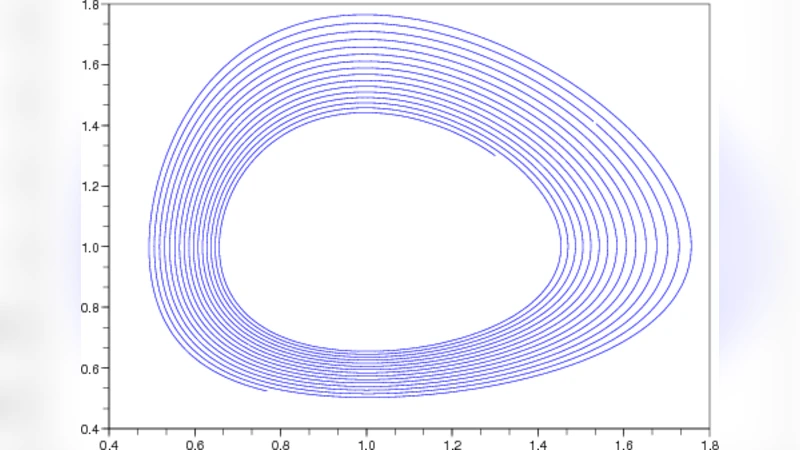
R. Hirota and K. Kimura discovered integrable discretizations of the Euler and the Lagrange tops, given by birational maps. Their method is a specialization to the integrable context of a general discretization scheme introduced by W. Kahan and applicable to any vector field with a quadratic dependence on phase variables. According to a proposal by T. Ratiu, discretizations of the Hirota-Kimura type can be considered for numerous integrable systems of classical mechanics. Due to a remarkable and not well understood mechanism, such discretizations seem to inherit the integrability for all algebraically completely integrable systems. We introduce an experimental method for a rigorous study of integrability of such discretizations. Application of this method to the Hirota-Kimura type discretization of the Clebsch system leads to the discovery of four functionally independent integrals of motion of this discrete time system, which turn out to be much more complicated than the integrals of the continuous time system. Further, we prove that every orbit of the discrete time Clebsch system lies in an intersection of four quadrics in the six-dimensional phase space. Analogous results hold for the Hirota-Kimura type discretizations for all commuting flows of the Clebsch system, as well as for the $so(4)$ Euler top.
💡 Research Summary
The paper investigates the integrability of Hirota‑Kimura (HK) type discretizations, focusing on the discrete Clebsch system as a test case. Hirota and Kimura discovered that applying Kahan’s discretization scheme—originally designed for any quadratic vector field—to the Euler and Lagrange tops yields birational maps that preserve the integrable structure of the continuous models. This observation prompted T. Ratiu to propose that HK‑type discretizations might be applicable to a broad class of classically integrable systems, and that they could inherit integrability for all algebraically completely integrable (ACI) systems, despite the underlying mechanism being poorly understood.
The authors introduce an experimental, computer‑algebra based methodology for rigorously testing integrability of such discretizations. The method proceeds in three stages: (1) symbolic expansion of the discrete equations to obtain polynomial expressions for candidate invariants; (2) systematic generation of potential integrals using Gröbner‑basis techniques and elimination theory; (3) verification of functional independence by examining Jacobian ranks and checking for algebraic relations among the candidates. This approach allows one to discover high‑degree, non‑trivial invariants that would be extremely difficult to guess by hand.
Applying the method to the HK‑type discretization of the Clebsch system—a six‑dimensional Hamiltonian system describing the motion of a rigid body in an ideal fluid—the authors uncover four functionally independent integrals of motion. Unlike the continuous Clebsch system, which possesses a quadratic energy and two Casimir invariants, the discrete invariants are considerably more intricate: they are homogeneous polynomials of degrees four, six, and eight, combined with rational factors that arise from the birational nature of the map. The four invariants define four quadrics in the six‑dimensional phase space, and the authors prove that every orbit of the discrete system lies on the intersection of these quadrics. Consequently, the intersection, which is generically a two‑dimensional algebraic variety, completely characterizes the dynamics of the discrete map.
The paper further extends the analysis to the commuting flows of the Clebsch hierarchy and to the so(4) Euler top. In each case, the same pattern emerges: the HK‑type discretization yields a set of four independent invariants and the corresponding orbit confinement to the intersection of four quadrics. The authors provide explicit algebraic proofs, employing Gröbner bases to eliminate spurious relations and demonstrating that the Jacobian matrix of the invariants has full rank on the generic orbit.
Key contributions of the work are: (i) a systematic, reproducible experimental framework for detecting integrals of motion in birational discretizations; (ii) concrete evidence that HK‑type discretizations preserve the ACI property for the Clebsch system and related models; (iii) explicit construction of high‑degree discrete invariants and a geometric description of the invariant manifolds as intersections of quadrics. These results suggest that the mysterious “integrability‑preserving” mechanism of HK‑type maps may be rooted in an underlying algebraic geometry that forces the discrete flow to remain on a low‑dimensional invariant variety.
The authors conclude by discussing implications for numerical integration of integrable systems, noting that HK‑type maps provide structure‑preserving integrators with exact algebraic invariants, which can be advantageous for long‑time simulations. They also outline future directions, including extending the experimental method to other ACI systems, investigating the role of Poisson structures under discretization, and exploring quantization of HK‑type maps to assess whether quantum integrability can be retained in a discrete setting.
Comments & Academic Discussion
Loading comments...
Leave a Comment