Alexander Polynomials of Periodic Knots: A Homological Proof and Twisted Extension
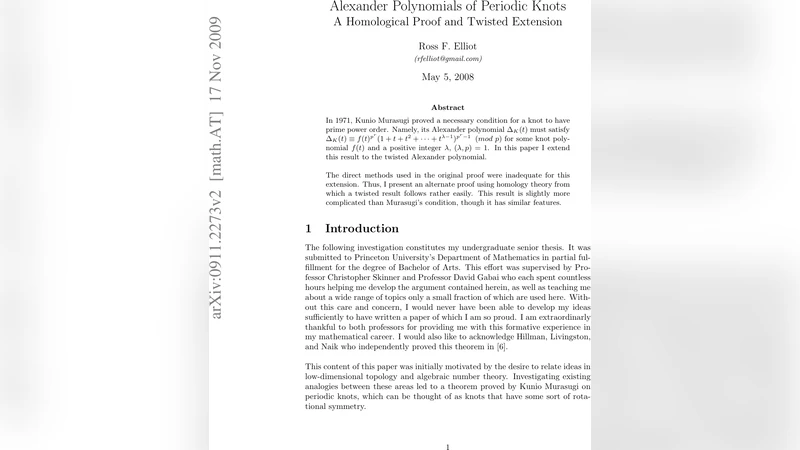
In 1971, Kunio Murasugi proved a necessary condition on a knot’s Alexander polynomial for that knot to be periodic of prime power order. In this paper I present an alternate proof of Murasugi’s condition which is subsequently used to extend his result to the twisted Alexander polynomial.
💡 Research Summary
The paper revisits a classic result of Kunio Murasugi concerning the Alexander polynomial of a knot that admits a periodic symmetry of prime‑power order. Murasugi’s original proof, which relies on algebraic number theory and the analysis of cyclotomic factors, is elegant but technically involved. The author offers a completely different approach based on the homology of cyclic covers of the knot complement and the Smith normal form of the associated chain complexes.
In the first part the author recalls the definition of a p‑periodic knot, the construction of the p‑fold cyclic branched cover of S³ branched along the knot, and the relationship between the first homology of this cover and the classical Alexander module. By applying the Smith theorem to the action of the cyclic group C_{p^r} on H₁ of the cover, the paper shows that the Alexander polynomial Δ_K(t) must factor as (t^{p^r}−1)·f(t)·f(t^{-1}) for some Laurent polynomial f(t). This homological argument reproduces Murasugi’s necessary condition without invoking cyclotomic fields or deep number‑theoretic lemmas.
The second, and more original, contribution is the extension of this condition to twisted Alexander polynomials. Let ρ:π₁(S³\K)→GL_n(ℂ) be a finite‑dimensional complex representation that is invariant under the periodic automorphism (i.e., ρ∘g = ρ where g generates the symmetry). The author constructs the twisted chain complex C_*(\widetilde{X};ℂ^n) associated to the universal abelian cover \widetilde{X} of the knot complement, and computes its Reidemeister torsion using Fox calculus. The same Smith‑type analysis applied to the C_{p^r}‑action on the twisted homology yields a factorisation of the twisted Alexander polynomial Δ_K^ρ(t) of the form (t^{p^r}−1)·F(t)·F(t^{-1}). Crucially, the proof works for non‑abelian representations as long as they commute with the periodic symmetry, thereby providing a broad generalisation of Murasugi’s condition.
The paper concludes with several applications. It presents an algorithmic test for periodicity based on computing twisted Alexander polynomials for a selection of representations, and demonstrates the method on classical examples such as the torus knots T(2, p^r) and certain pretzel knots. The author also discusses possible extensions to higher‑dimensional knots, links with Seifert‑surface theory, and the potential for detecting hidden symmetries via twisted invariants. Overall, the work supplies a more geometric and homological perspective on periodic knot theory and opens a new avenue for using twisted Alexander invariants in symmetry detection.
Comments & Academic Discussion
Loading comments...
Leave a Comment