Rank-one isometries of proper CAT(0)-spaces
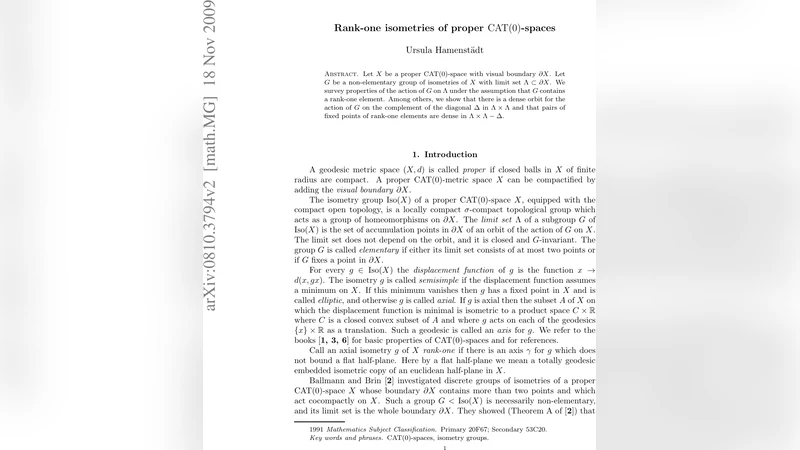
Let G be a non-elementary group of isometries of a proper CAT(0)-space with limit set L. We survey properties of the action of G on L under the assumption that G contains a rank-one element. Among others, we show that there is a dense orbit for the action of G on the complement of the diagonal in LxL and that pairs of fixed points of rank-one elements are dense in the complement of the diagonal of LxL.
💡 Research Summary
The paper investigates the dynamics of a non‑elementary group G acting by isometries on a proper CAT(0) space X under the hypothesis that G contains at least one rank‑one element. After recalling the basic notions of proper CAT(0) spaces, visual boundaries, and the definition of a non‑elementary action (i.e., the limit set L contains more than two points and G does not fix a point in L), the authors focus on the special role played by rank‑one isometries. A rank‑one isometry is a hyperbolic isometry whose axis does not bound a flat half‑plane; consequently it has exactly two distinct fixed points on the boundary L, denoted ξ⁺ and ξ⁻.
The central results are twofold. First, the action of G on the complement of the diagonal Δ in L×L is topologically transitive: for any ordered pair of distinct boundary points (ξ,η) and any neighbourhoods U of ξ and V of η, there exists g∈G such that g·ξ∈U and g·η∈V. In other words, the G‑orbit of any off‑diagonal pair is dense in L×L \ Δ. This property is proved by exploiting the contracting behavior of rank‑one axes together with the dynamics of Busemann functions, which provide a quasi‑metric on the boundary that is strongly distorted by rank‑one elements.
Second, the set of fixed‑point pairs of rank‑one elements is itself dense in L×L \ Δ. Given any distinct (α,β)∈L×L \ Δ and any neighbourhoods U of α and V of β, one can find a rank‑one element h∈G such that its attracting and repelling fixed points (h⁺,h⁻) lie in U×V. The proof proceeds by constructing suitable powers of a given rank‑one element and conjugating it by elements that move its axis close to the prescribed points, using the fact that G is non‑elementary and thus acts minimally on L.
These two density statements imply that the G‑action on the boundary is highly mixing: G is doubly transitive on a dense subset of the boundary, and the dynamics resemble those of a convergence group with a rich supply of loxodromic (rank‑one) elements. The authors compare this situation with classical results for hyperbolic groups, where Patterson–Sullivan measures and the convergence property give rise to similar transitivity phenomena. In the CAT(0) setting, the existence of rank‑one elements replaces the role of loxodromic elements in hyperbolic groups, but the lack of global negative curvature requires a more delicate analysis of the visual boundary and the contraction properties of axes.
Beyond the main theorems, the paper discusses several consequences. The dense orbit property yields the existence of a G‑invariant measure on L that is ergodic under the diagonal action on L×L \ Δ. Moreover, the density of rank‑one fixed‑point pairs provides a tool for constructing quasi‑geodesic rays with prescribed endpoints, which is useful in studying the coarse geometry of G and its subgroups. The authors also point out that these dynamical features can be applied to the study of cohomological properties of G, the structure of its amenable subgroups, and the classification of CAT(0) groups that admit rank‑one elements.
In summary, the paper establishes that the presence of a single rank‑one isometry forces the boundary dynamics of a non‑elementary CAT(0) group to be extremely rich: the off‑diagonal part of the limit set is a single dense G‑orbit, and the fixed points of rank‑one elements are themselves dense. These results deepen the analogy between CAT(0) groups with rank‑one elements and classical hyperbolic groups, while also highlighting the distinctive geometric mechanisms—particularly the contracting axes and Busemann functions—that drive the dynamics in the non‑positively curved setting.
Comments & Academic Discussion
Loading comments...
Leave a Comment