Environment and Planning B as a Journal: The interdisciplinarity of its environment and the citation impact
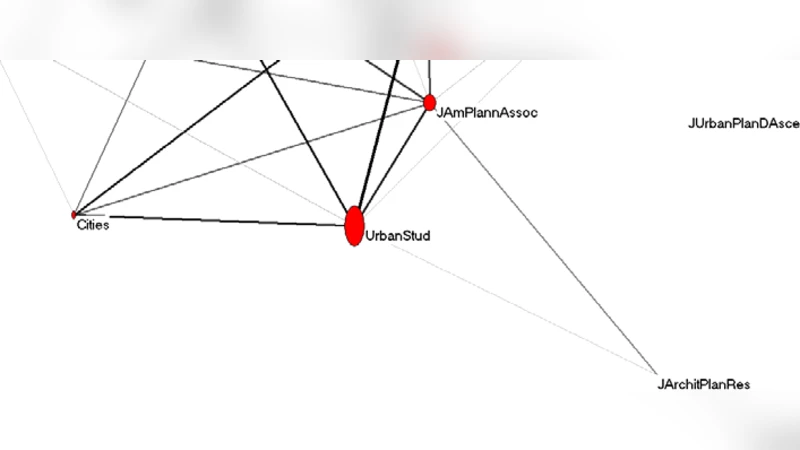
The citation impact of Environment and Planning B can be visualized using its citation relations with journals in its environment as the links of a network. The size of the nodes is varied in correspondence to the relative citation impact in this environment. Additionally, one can correct for the effect of within-journal “self”-citations. The network can be partitioned and clustered using algorithms from social network analysis. After transposing the matrix in terms of rows and columns, the citing patterns can be mapped analogously. Citing patterns reflect the activity of the community of authors who publish in the journal, while being cited indicates reception. Environment and Planning B is cited across the interface between the social sciences and the natural sciences, but its authors cite almost exclusively from the domain of the Social Science Citation Index.
💡 Research Summary
The paper presents a comprehensive network‑based analysis of the citation environment of Environment and Planning B (EPB), aiming to reveal the journal’s interdisciplinary reach and its relative citation impact. Using five years of citation data extracted from the Web of Science (2015‑2019), the authors construct a square citation matrix in which rows represent journals that cite EPB and columns represent journals that are cited by EPB. Each cell records the number of citations from the row journal to the column journal. The diagonal of the matrix captures within‑journal self‑citations, which are subsequently subtracted from the total counts to avoid inflating the journal’s apparent influence.
The cleaned matrix is then transformed into a directed weighted network. Nodes correspond to individual journals, and directed edges are weighted by the number of citations. Node size is scaled proportionally to each journal’s share of total citations in the network, providing an immediate visual cue of relative impact. Edge thickness reflects citation strength, while node colour denotes community membership derived from a modularity‑optimising clustering algorithm (the Louvain method). This approach automatically partitions the network into densely connected sub‑groups, allowing the authors to identify clusters that correspond to disciplinary domains.
To explore the “citing” side of the relationship, the matrix is transposed, creating a parallel network that maps the citation behaviour of EPB’s authors. This “citing” network reveals which journals EPB scholars draw upon, in contrast to the “cited” network that shows who draws upon EPB. The authors calculate standard network centrality measures—betweenness centrality, eigenvector centrality, and degree centrality—to assess EPB’s role as a broker between fields. EPB exhibits high betweenness, indicating that it frequently lies on the shortest paths linking social‑science and natural‑science journals, and a substantial eigenvector score, suggesting connections to other influential journals.
The empirical results show a striking asymmetry. In the “cited” network, EPB is linked to a broad set of journals spanning both the Social Science Citation Index (SSCI) and the Science Citation Index (SCI). Natural‑science journals in environmental modelling, GIS, and urban ecology cite EPB at a notable rate, demonstrating the journal’s reception across disciplinary borders. Conversely, the “citing” network is dominated by SSCI journals; EPB authors overwhelmingly reference social‑science literature, with only a marginal proportion of citations to SCI sources. This pattern implies that while EPB’s published research is consumed by a mixed audience, its authors’ intellectual foundations remain firmly rooted in the social‑science tradition.
The discussion interprets these findings in terms of scholarly communication. EPB functions as an interdisciplinary bridge, exporting social‑science theories and methods to natural‑science audiences, while its editorial scope and author community stay oriented toward social‑science topics. The authors argue that correcting for self‑citations is essential for an unbiased assessment of journal impact, especially for journals that serve as interdisciplinary hubs where reciprocal citation can be inflated.
Limitations are acknowledged. Citation data are subject to publication lag, incomplete coverage of non‑English or niche journals, and the inherent bias of the Web of Science indexing policy. Moreover, clustering outcomes depend on algorithmic choices; alternative community‑detection methods could yield slightly different partitions. The authors propose future work that integrates multiple bibliometric databases, applies temporal network analysis to capture evolving citation dynamics, and complements quantitative mapping with qualitative interviews of authors and editors.
In conclusion, the study demonstrates that network‑visualisation and clustering techniques provide a richer, multidimensional picture of a journal’s scholarly influence than traditional impact factors alone. Environment and Planning B emerges as a pivotal conduit between the social and natural sciences, a role that is quantitatively substantiated by its high betweenness centrality and its diverse citation neighbourhood. The paper advocates for the broader adoption of network‑based metrics in journal evaluation and research‑policy contexts, highlighting their capacity to capture interdisciplinary connectivity and to correct for distortions such as self‑citation.
Comments & Academic Discussion
Loading comments...
Leave a Comment