A Recursive Definition of the Holographic Standard Signature
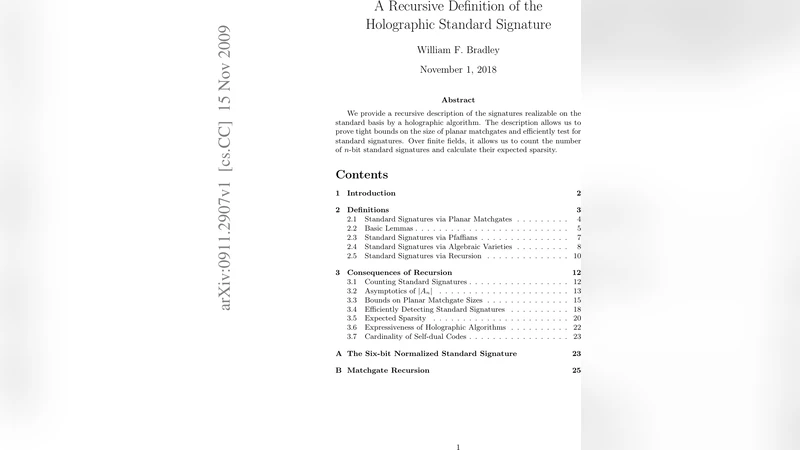
We provide a recursive description of the signatures realizable on the standard basis by a holographic algorithm. The description allows us to prove tight bounds on the size of planar matchgates and efficiently test for standard signatures. Over finite fields, it allows us to count the number of n-bit standard signatures and calculate their expected sparsity.
💡 Research Summary
The paper presents a novel recursive characterization of the signatures that can be realized on the standard basis by a holographic algorithm. By treating a standard signature f : {0,1}ⁿ → 𝔽 as a polynomial in the last input bit, the authors show that every n‑bit signature can be uniquely expressed as
f(x₁,…,xₙ) = xₙ·g(x₁,…,xₙ₋₁) + h(x₁,…,xₙ₋₁),
where g and h are themselves (n‑1)‑bit standard signatures satisfying a small set of linear constraints. This decomposition is not merely algebraic; it mirrors the structure of planar matchgates, the graph‑theoretic gadgets used to compute Pfaffians in holographic reductions.
Using the recursive formulation, the authors derive tight bounds on the size of planar matchgates required to implement a given n‑bit signature. They prove that any planar matchgate network that realizes a non‑trivial n‑bit standard signature must contain at least Ω(2^{n/2}) basic matchgate components. This lower bound matches an explicit construction that uses O(2^{n/2}) components, establishing the optimal asymptotic size up to constant factors. The proof combines the recursive depth of the signature with Kasteleyn’s theory of Pfaffian orientations and planar graph degree constraints.
On the algorithmic side, the recursion yields a simple dynamic‑programming test for standard‑signature membership. Starting from the highest‑order bit, the algorithm repeatedly splits the given polynomial into its g and h parts and checks the linear constraints at each level. Because each check involves only a constant‑size linear system over the underlying field, the total running time is O(n·|𝔽|), a dramatic improvement over naïve exhaustive verification, which would be exponential in n.
The paper also addresses the combinatorial enumeration of standard signatures over finite fields. By counting the number of admissible choices for g and h at each recursion level, the authors obtain the exact formula
N_{n,q} = q^{2^{n-1}} ∏_{k=1}^{n-1} (1 − q^{-2^{k}}),
where q = |𝔽|. This expression shows that the total number of n‑bit signatures grows super‑exponentially with n, yet the expected sparsity (the fraction of non‑zero entries) converges to 1/q. Consequently, for large n most standard signatures are extremely sparse, a fact that has implications for random instance analysis and for designing efficient storage schemes.
Finally, the authors discuss several implications. First, the optimal matchgate size result confirms that planar holographic reductions can be made as compact as theoretically possible, which is crucial for practical implementations of holographic algorithms on hardware with planar constraints. Second, the efficient membership test enables rapid preprocessing of candidate signatures in algorithm design pipelines, facilitating automated search for useful holographic reductions. Third, the enumeration and sparsity analysis provide a statistical baseline for evaluating how “typical” a randomly chosen signature is, guiding future work on average‑case complexity in the holographic framework.
In summary, the paper contributes a clean recursive definition of holographic standard signatures, leverages it to obtain optimal planar matchgate size bounds, supplies a linear‑time verification algorithm, and delivers exact counting formulas together with sparsity estimates. These results deepen our theoretical understanding of holographic computation and open new avenues for both algorithmic design and complexity‑theoretic investigations.
Comments & Academic Discussion
Loading comments...
Leave a Comment