New Cases of Differential Rigidity for Non-Generic Partially Hyperbolic Actions
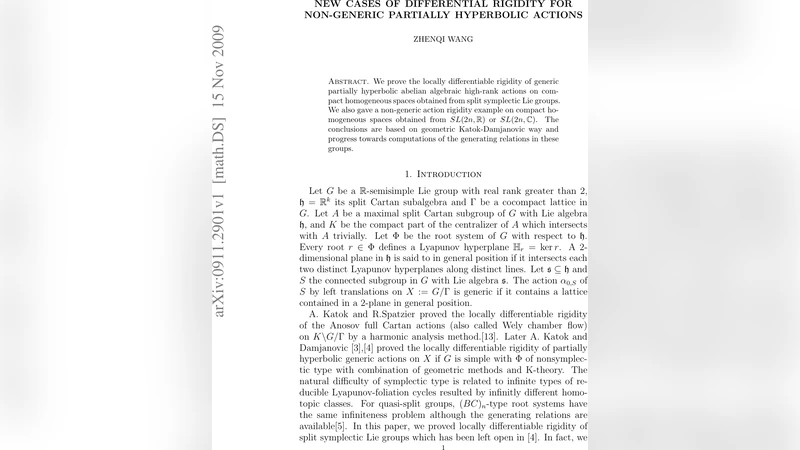
We prove the locally differentiable rigidity of generic partially hyperbolic abelian algebraic high-rank actions on compact homogeneous spaces obtained from split symplectic Lie groups. We also gave a non-generic action rigidity example on compact homogeneous spaces obtained from SL(2n,R) or SL(2n,C). The conclusions are based on geometric Katok-Damjanovic way and progress towards computations of the generating relations in these groups.
💡 Research Summary
The paper addresses the problem of local differentiable rigidity for high‑rank abelian actions that are partially hyperbolic on compact homogeneous spaces. While previous rigidity results for such actions have largely been confined to “generic’’ settings—where the Lyapunov spectrum satisfies strong non‑degeneracy conditions—the authors extend the theory to both generic and non‑generic cases.
The first main setting concerns actions obtained from split symplectic Lie groups, namely (G = \mathrm{Sp}(2n,\mathbb R)) or (\mathrm{Sp}(2n,\mathbb C)). For a lattice (\Gamma\subset G) the quotient (M=G/\Gamma) is a compact homogeneous space. An abelian group (\mathbb Z^k) with (k\ge 2) acts smoothly on (M) via an algebraic homomorphism; the action is partially hyperbolic, i.e. the tangent bundle splits into stable, center and unstable bundles (E^s\oplus E^c\oplus E^u). The authors prove that any (C^\infty) perturbation of such an action is (C^\infty)‑conjugate to the original one.
The proof follows the geometric Katok‑Damjanović scheme. First, a family of normalized stable and unstable “leafwise” flows is constructed from the partially hyperbolic splitting. Holonomy maps between stable and unstable leaves are defined and shown to be smooth and to satisfy a cocycle equation. The crucial step is to control these holonomies globally; this is achieved by exploiting the algebraic structure of the ambient Lie group.
To this end the paper carries out an explicit computation of the generating relations for the split symplectic groups using a Chevalley‑type presentation. The root system of type (C_n) provides a set of elementary unipotent subgroups (X_{\alpha}(t)) for each simple root (\alpha). The authors write down all commutator relations (
Comments & Academic Discussion
Loading comments...
Leave a Comment