A non-commutative generalization of Stone duality
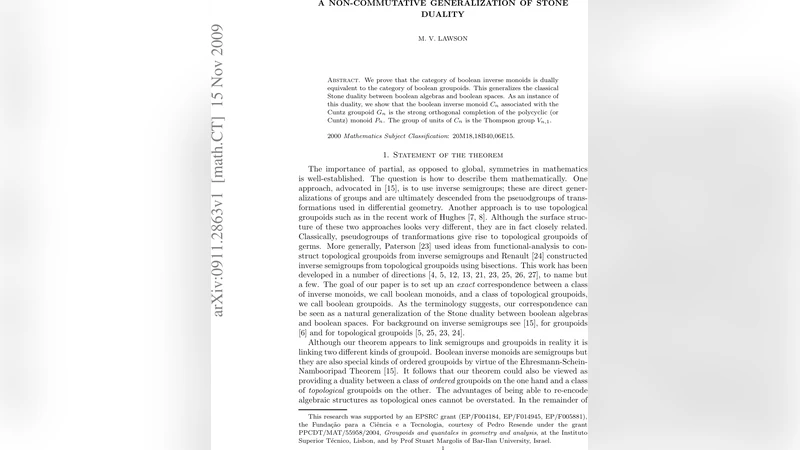
We prove that the category of boolean inverse monoids is dually equivalent to the category of boolean groupoids. This generalizes the classical Stone duality between boolean algebras and boolean spaces. As an instance of this duality, we show that the boolean inverse monoid associated with the Cuntz groupoid is the strong orthogonal completion of the polycyclic (or Cuntz) monoid and so its group of units is a Thompson group.
💡 Research Summary
The paper establishes a dual equivalence between the category of Boolean inverse monoids and the category of Boolean groupoids, thereby extending classical Stone duality from the commutative setting of Boolean algebras and Boolean spaces to a non‑commutative framework. A Boolean inverse monoid is a (generally non‑commutative) inverse monoid whose idempotent set forms a Boolean algebra; a Boolean groupoid is a topological groupoid whose space of identities and space of arrows are both Boolean spaces and whose structure maps respect the Boolean operations.
The authors first develop the necessary algebraic background. They recall that an inverse monoid is a semigroup in which each element a has a unique inverse a⁻¹ satisfying a = a a⁻¹ a and a⁻¹ = a⁻¹ a a⁻¹. Adding the Boolean condition means that the set of idempotents E(M) is a Boolean algebra, and that the natural partial order a ≤ b (iff a = e b for some idempotent e) interacts nicely with the Boolean operations. This yields a rich internal logic that mirrors the clopen subsets of a Stone space.
Next, they define Boolean groupoids. A groupoid G consists of a set of objects G⁰ and a set of arrows G¹ together with source, target, multiplication, and inversion maps. The Boolean requirement forces G⁰ and G¹ to be zero‑dimensional compact Hausdorff spaces (i.e., Stone spaces) and demands that the source, target, and multiplication maps be continuous and preserve clopen sets. Consequently, the collection of compact open bisections of G forms a Boolean inverse monoid under the natural product of bisections.
The central theorem constructs two contravariant functors that are inverse to each other up to natural isomorphism. Given a Boolean inverse monoid M, one considers its spectrum Spec(M), the set of prime (or ultrafilter) idempotent filters, equipped with the Stone topology. The arrows of the associated groupoid G(M) are pairs of filters (F, G) such that there exists an element a ∈ M with domain filter F = a⁻¹a·F and range filter G = a a⁻¹·F. The topology on G(M) is generated by sets of the form { (F, G) | a ∈ M, a ∈ F } which are compact and open. Conversely, starting from a Boolean groupoid G, the set of compact open bisections B(G) becomes a Boolean inverse monoid under pointwise multiplication; the idempotents correspond to compact open subsets of G⁰. The two constructions are shown to be mutually inverse, establishing a categorical duality that generalizes Stone’s original correspondence.
To illustrate the power of the theory, the authors treat the Cuntz groupoid Gₙ, a well‑studied étale groupoid arising from the Cuntz C*-algebra Oₙ. They identify the Boolean inverse monoid associated with Gₙ as the strong orthogonal completion of the polycyclic monoid Pₙ (also called the Cuntz monoid). The strong orthogonal completion is a process that adjoins all possible finite orthogonal joins to a given inverse monoid while preserving the Boolean structure on idempotents. The resulting monoid Mₙ is Boolean, and its group of units (the invertible elements) is shown to be isomorphic to Thompson’s group F. This recovers a known connection between the Cuntz algebra, the polycyclic monoid, and Thompson’s groups, but now situated within the broader Stone‑type duality framework.
The paper concludes by discussing several implications. The duality provides a systematic method for passing between algebraic data (inverse monoids) and topological/dynamical data (groupoids), which is particularly valuable in the study of étale groupoids, C*-algebras, and tiling spaces. Moreover, the strong orthogonal completion offers a new tool for constructing Boolean inverse monoids from more elementary inverse monoids, potentially leading to further examples where the unit group recovers interesting groups such as higher‑dimensional Thompson groups or diagram groups. The authors suggest that future work could explore extensions to non‑Hausdorff groupoids, connections with quantales, and applications to the classification of C*-algebras via their underlying inverse semigroup structures.
Comments & Academic Discussion
Loading comments...
Leave a Comment