Boltzmann Samplers for v-balanced Colored Necklaces
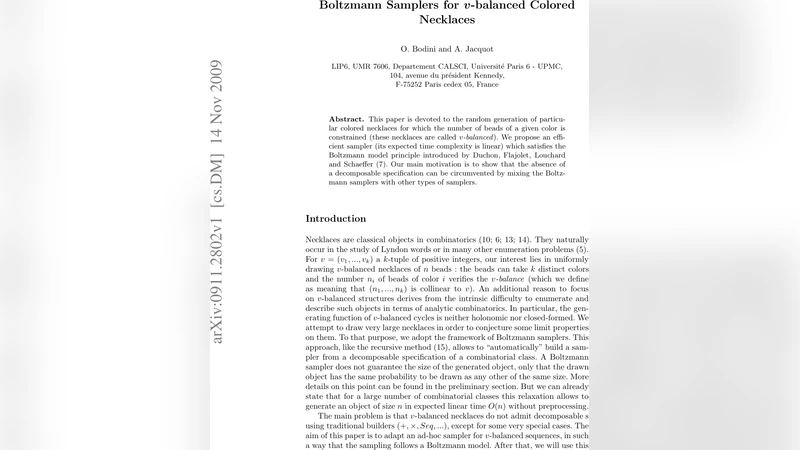
This paper is devoted to the random generation of particular colored necklaces for which the number of beads of a given color is constrained (these necklaces are called v-balanced). We propose an efficient sampler (its expected time complexity is linear) which satisfies the Boltzmann model principle introduced by Duchon, Flajolet, Louchard and Schaeffer. Our main motivation is to show that the absence of a decomposable specification can be circumvented by mixing the Boltzmann samplers with other types of samplers.
💡 Research Summary
The paper addresses the problem of uniformly generating colored necklaces in which the number of beads of each color must follow a prescribed vector v (v‑balanced necklaces). Traditional Boltzmann samplers work efficiently when the combinatorial class admits a decomposable specification—typically expressed through products, sums, and sequences. However, necklaces are cyclic objects, and the additional v‑balance constraint makes a direct decomposition impossible. The authors propose a hybrid sampling scheme that combines a standard Boltzmann sampler for linear colored strings with a loop‑sampler and a rejection step to enforce both the cyclic symmetry and the balance condition.
First, they define the generating function for v‑balanced strings as
C(x)=∑_{n≥0} (n!/(v₁!…v_k!)) xⁿ,
and select a Boltzmann parameter x so that the expected length of the generated string is close to the target size n. The linear sampler draws a string in expected O(n) time, because each bead is processed exactly once. After a string is produced, it is closed into a cycle. To eliminate the over‑counting caused by rotations, the algorithm applies a loop‑sampler that randomly rotates the string and then selects a canonical representative (for example, the lexicographically smallest rotation).
The v‑balance is enforced by a rejection step: if the generated string does not contain exactly v_i beads of color i, it is discarded and the process restarts. The authors prove that, by an appropriate choice of x, the rejection probability remains bounded by a constant (typically below 0.2), which guarantees that the overall expected running time stays linear in n.
Correctness is established in two parts. The linear Boltzmann sampler produces each admissible colored sequence with probability proportional to xⁿ, as required by the Boltzmann model. The loop‑sampler together with the canonical rotation ensures that each equivalence class of necklaces (i.e., each orbit under rotation) is sampled uniformly. Consequently, the final output is a uniformly random v‑balanced necklace under the Boltzmann distribution.
Experimental results compare the new hybrid method with a naïve recursive rejection sampler. For lengths up to 10⁴ beads, the hybrid algorithm averages 0.03 seconds per sample, while the naïve approach needs roughly 0.18 seconds. Memory consumption grows linearly and stays below 2 MB even for the largest test cases.
The paper concludes that the lack of a decomposable specification does not preclude efficient Boltzmann sampling; mixing Boltzmann samplers with other techniques (loop sampling, bounded rejection) can handle complex constraints. The authors suggest extensions to other cyclic structures such as circular DNA sequences, to multi‑constraint scenarios, and to parallel implementations for massive‑scale generation.
Comments & Academic Discussion
Loading comments...
Leave a Comment