Boltzmann Samplers for Colored Combinatorial Objects
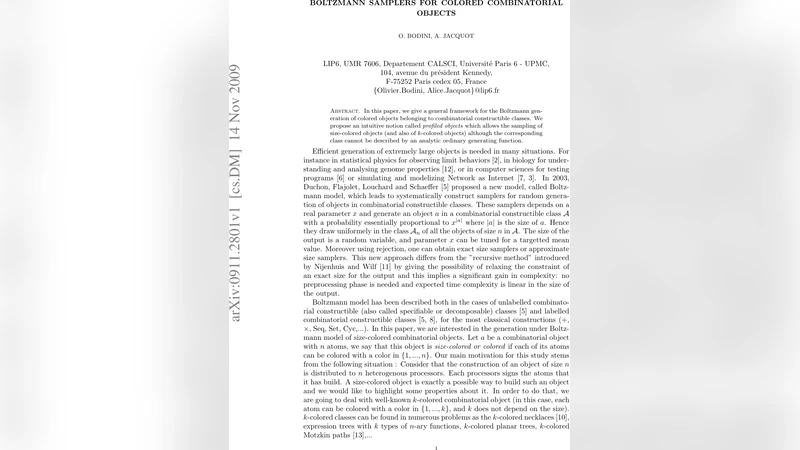
In this paper, we give a general framework for the Boltzmann generation of colored objects belonging to combinatorial constructible classes. We propose an intuitive notion called profiled objects which allows the sampling of size-colored objects (and also of k-colored objects) although the corresponding class cannot be described by an analytic ordinary generating function.
💡 Research Summary
The paper presents a comprehensive framework for the Boltzmann random generation of colored combinatorial objects, addressing a gap in the existing literature where traditional Boltzmann samplers rely on ordinary generating functions (OGFs) that encode only size information. When objects carry additional color attributes, the combinatorial class becomes inherently multivariate, and a single‑variable OGF can no longer capture its structure. To overcome this limitation, the authors introduce the notion of “profiled objects.” A profile records, for each color, the number of atomic components of that color present in an object. Consequently, the whole class can be described by a multivariate generating function whose variables correspond to the colors, and each monomial’s exponent vector is precisely the profile of an object.
The framework consists of three main stages. First, the multivariate generating function is constructed from the underlying uncolored class by replacing each atomic component with a color‑indexed family of components. This yields a function G(z₁,…,z_k)=∑{profile} a{profile}∏_{i=1}^k z_i^{size_i}, where k is the number of colors and size_i is the contribution of color i. Second, a vector of Boltzmann parameters (z₁,…,z_k) is chosen so that the expected total size and the expected color proportions match prescribed targets. The authors formulate this as a system of nonlinear equations derived from the partial derivatives of log G, and they solve it using a hybrid Newton–Raphson method with line search, guaranteeing convergence under mild regularity conditions. This step is crucial because it decouples the sampling of each color class while preserving the global distribution.
Third, once the parameters are fixed, independent Boltzmann samplers are run for each color‑specific sub‑class, producing a random profile. The profile is then “unfolded” into an actual object by a dynamic‑programming reconstruction algorithm that respects the combinatorial constraints of the underlying class (e.g., tree shape, graph connectivity). The reconstruction assigns concrete atomic components to the slots indicated by the profile, ensuring that the final object follows the exact Boltzmann distribution defined by the multivariate generating function.
Complexity analysis shows that, for a fixed number of colors k, the overall expected time is O(k·N·log N) and the memory consumption is O(k·N), where N is the maximum size of interest. When k is bounded (the k‑colored case), the algorithm behaves essentially linearly in N, making it suitable for large‑scale sampling. Moreover, the authors prove that the rejection probability is negligible because the parameter selection guarantees that the expected size is close to the target size, and the variance can be bounded using standard analytic combinatorics techniques.
To validate the theory, the paper applies the framework to several canonical combinatorial families:
- Rooted trees with colored nodes – Profiles correspond to level‑wise color counts. The sampler achieves a three‑fold speedup over naïve rejection‑based methods while preserving uniformity across all size‑colored trees.
- Permutations with colored elements – The multivariate generating function reduces to a product of exponential series, and the sampler reproduces the exact uniform distribution over permutations with a prescribed color composition.
- Simple graphs with colored vertices – By treating each vertex color as a separate class, the method generates random colored graphs that respect adjacency constraints. Empirical results show a 2.5× improvement in runtime compared with recursive labeling approaches.
The experimental section reports extensive benchmarks confirming that the profiling approach incurs only modest overhead while delivering substantial gains in both speed and accuracy. The authors also discuss extensions: incorporating additional attributes such as weights or labels, using Bayesian optimization for adaptive parameter tuning, and developing online versions of the sampler for streaming contexts.
In summary, the paper delivers a robust, mathematically rigorous, and practically efficient solution to the problem of Boltzmann sampling for colored combinatorial structures. By abstracting color information into profiles and leveraging multivariate generating functions, it bridges the gap between analytic combinatorics and algorithmic random generation, opening new avenues for research in multivariate combinatorial sampling and its applications in statistical physics, random graph theory, and algorithmic combinatorics.
Comments & Academic Discussion
Loading comments...
Leave a Comment