Matrix Graph Grammars as a Model of Computation
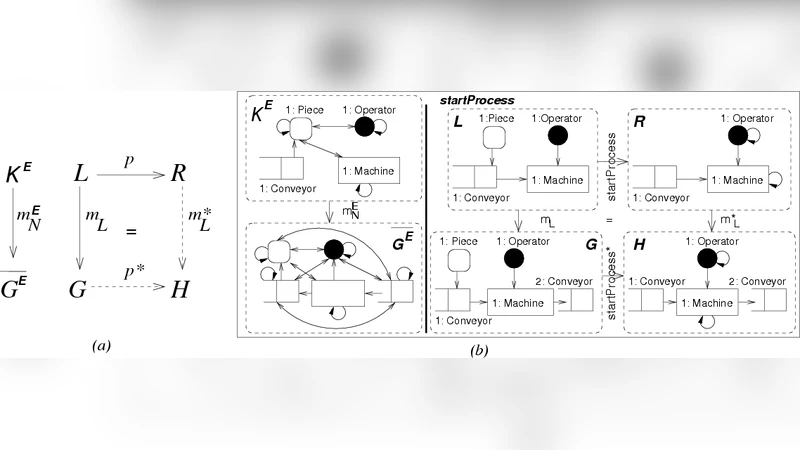
Matrix Graph Grammars (MGG) is a novel approach to the study of graph dynamics ([15]). In the present contribution we look at MGG as a formal grammar and as a model of computation, which is a necessary step in the more ambitious program of tackling complexity theory through MGG. We also study its relation with other well-known models such as Turing machines (TM) and Boolean circuits (BC) as well as non-determinism. As a side effect, all techniques available for MGG can be applied to TMs and BCs.
💡 Research Summary
The paper “Matrix Graph Grammars as a Model of Computation” positions Matrix Graph Grammars (MGG) as a formal grammar and a full‑featured model of computation, with the long‑term goal of applying graph‑based techniques to complexity theory. After a brief motivation that traditional graph rewriting systems lack a rigorous algebraic foundation, the authors introduce the core of MGG: a graph is represented by an adjacency matrix together with a node‑label matrix, and each production (rule) is expressed as a pair of before‑and‑after matrices. Rule application becomes a sequence of matrix operations—addition, subtraction, multiplication, and transposition—so that a derivation is simply a chain of linear‑algebraic transformations starting from an initial matrix and ending in a target matrix.
The paper then establishes a precise correspondence between MGG and Turing machines (TM). A TM’s finite set of states, tape alphabet, and transition function are encoded as node labels, edge labels, and matrix productions respectively. A single TM step (read‑state‑write‑move) maps one‑to‑one onto the application of a specific MGG rule that updates the relevant rows and columns of the adjacency matrix. The construction works for deterministic TMs and, by allowing multiple applicable rules, also for nondeterministic TMs. Consequently, any language recognizable by a TM can be generated by an appropriately designed MGG, proving that MGG is computationally universal.
Next, the authors relate MGG to Boolean circuits. Logical gates (AND, OR, NOT) are modeled as small sub‑graphs, inputs and outputs are encoded as distinguished node labels, and signal propagation corresponds to Boolean matrix multiplication and logical OR operations. Circuit depth translates into the number of sequential rule applications, while circuit size corresponds to the total number of distinct productions. Because MGG permits simultaneous application of independent productions, the inherent parallelism of Boolean circuits is naturally captured, allowing a direct translation of circuit‑complexity measures (time, space) into MGG‑derivation metrics.
A substantial portion of the work is devoted to nondeterminism. By extending matrix entries to a third value (e.g., “*”) the grammar can express “don’t‑care” or multiple possible matches, enabling a single rule to represent several concrete rewrites. This mechanism reduces the combinatorial explosion typical of nondeterministic grammars: the search space is compressed into a parallel matrix operation that can be evaluated efficiently on modern hardware. The authors show that nondeterministic MGGs are exactly as powerful as nondeterministic Turing machines, and they sketch how NP‑complete problems can be encoded as MGG derivations with polynomially bounded rule sets but nondeterministic choice.
Finally, the paper explores the implications for complexity theory. The authors propose a mapping: the number of distinct productions |R| corresponds to space usage, while the maximal derivation depth d corresponds to time. They argue that languages in P can be recognized by MGGs with both |R| and d polynomial in the input size; NP languages require only polynomial depth but may need nondeterministic rule selection; PSPACE languages can be captured by MGGs where d is polynomial but |R| may be exponential. This mapping suggests that classic complexity classes can be re‑characterized in the algebraic language of matrices and graph transformations, opening a new avenue for proving class separations or collapses.
In conclusion, the authors present MGG as a unifying framework that brings together graph dynamics, formal language theory, and computational complexity. They outline future work on automated MGG‑based verification tools, parallel hardware implementations, and the ambitious program of attacking open problems in complexity theory using the matrix‑graph perspective.
Comments & Academic Discussion
Loading comments...
Leave a Comment