Equivariant Poincare duality for quantum group actions
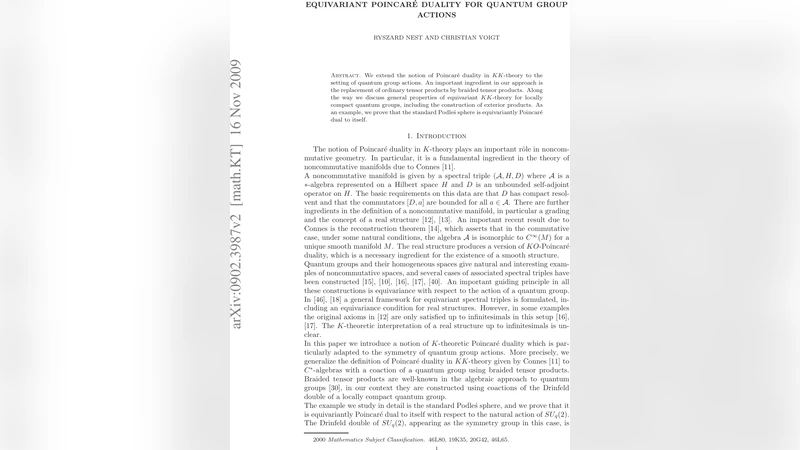
We extend the notion of Poincar'e duality in KK-theory to the setting of quantum group actions. An important ingredient in our approach is the replacement of ordinary tensor products by braided tensor products. Along the way we discuss general properties of equivariant KK-theory for locally compact quantum groups, including the construction of exterior products. As an example, we prove that the standard Podle's sphere is equivariantly Poincar'e dual to itself.
💡 Research Summary
The paper develops a comprehensive framework for extending Poincaré duality in Kasparov’s KK‑theory to the realm of locally compact quantum group actions. Classical equivariant KK‑theory relies on ordinary tensor products, which are compatible with the commutative symmetry of a group. When the symmetry is a quantum group, the coproduct is non‑cocommutative, and the usual tensor product no longer respects the equivariance structure. To overcome this obstacle the authors replace the ordinary tensor product by a braided tensor product, denoted ⊗_R, where R is the universal R‑matrix of the quantum group. This braided product inserts the appropriate R‑matrix twist whenever two equivariant modules are interchanged, thereby restoring a categorical form of commutativity that is essential for constructing external products.
The first part of the work establishes the basic properties of equivariant KK‑theory for a locally compact quantum group G. The authors define the groups KK^G(A,B) for G‑C∗‑algebras A and B, prove homotopy invariance, stability under suspension, and the existence of a six‑term exact sequence. They then construct an external product \
Comments & Academic Discussion
Loading comments...
Leave a Comment