We present the preliminary results of a systematic search for GRB and other transients in the publicly available data for the IBIS/PICsIT (0.2-10 MeV) detector on board INTEGRAL. Lightcurves in 2-8 energy bands with time resolution from 1 to 62.5 ms have been collected and an analysis of spectral and temporal characteristics has been performed. This is the nucleus of a forthcoming first catalog of GRB observed by PICsIT.
Deep Dive into GRB Observed by IBIS/PICsIT in the MeV Energy Range.
We present the preliminary results of a systematic search for GRB and other transients in the publicly available data for the IBIS/PICsIT (0.2-10 MeV) detector on board INTEGRAL. Lightcurves in 2-8 energy bands with time resolution from 1 to 62.5 ms have been collected and an analysis of spectral and temporal characteristics has been performed. This is the nucleus of a forthcoming first catalog of GRB observed by PICsIT.
PICsIT is the high-energy layer of the IBIS (Ubertini et al. , 2003) instrument on-board the INTEGRAL satellite, operating in the energy range between 200 keV and ∼ 10 MeV (Di Cocco et al. , 2003). Scientific pointings are acquired in Standard Mode, which is the combination of the two sub-modes: Spectral Imaging and Spectral Timing (ST), optimized for spatial and temporal resolution, respectively. For both modes, events are integrated over time and energy intervals according to the on-board settings; energy bins are derived from the original 1024 channels in conformity with the channel-to-energy relationship, defined in the on-board look-up tables (LUT) and derived from ground and in-flight calibration. ST mode allocates up to 8 energy bins and Email address: bianchin@iasfbo.inaf (V. Bianchin).
Preprint submitted to Elsevier time resolution down to ∼ 1 ms. However the limited telemetry budget requires data to be integrated over the whole detector surface, so that the event spatial information is lost. The on-board configuration history for the ST mode can be found at the INAF/IASF-Bologna web page1 .
Spectral Timing data are processed by the specific software OSA 7.0 (Goldwurm et al. , 2003). Each lightcurve in output is then scanned to search for excesses in each energy band. Excesses are selected where the background subtracted count rate is above a significance threshold defined as k * √ bkg, where k = 3 above 360 keV and it is set to 10 below. The energy dependent threshold is applied to reduce spurious cosmic rays induced events which can mainly affect lightcurves below ∼ 300 keV. The background is computed, for each energy band and binning time, as the average rate over the pointing, neglecting saturation periods, telemetry gaps or oscillations at the Earth radiation belts passage. An excess is marked as a GRB candidate if the background corrected count rate remains above 1σ over a time interval of 5 s around the peak. It is worth noting that with the present criteria only long GRB are selected and a different approach is to be implemented for the search of short events, which is hampered by the strong impact of cosmic rays background (Segreto et al. , 2003) and the lack of information on event position. Following the INTEGRAL Burst Alert System (IBAS) approach (Mereghetti et al. , 2003), the procedure applies to the original binning lightcurve and to rebinned lightcurves with time intervals of 0.5, 1 and 2 s. The effect of increasing binning time is to dilute cosmic rays induced spikes which have a typical time scale of tens ms (Segreto et al. , 2003). Since the procedure is still in a test phase in several cases the lightcurve is visually inspected.
We cross-check PICsIT triggers with events of particle and solar origin, reported by the INTEGRAL Radiation Environment Monitor (IREM - Hajdas et al. (2003)) and by the Geostationary Operational Environmental Satellites (GOES)2 . The most stringent criterion to validate an excess as a GRB is based on the directional information of the event. Although PICsIT Spectral Imaging (SI) mode is optimized for spatial resolution, events of typical GRB time scale are not detected in SI data since these are on-board integrated over the pointing duration (∼ 2000 s). In the present excess list only the very long (∼ 160 s) GRB 041219 was detected in both Spectral Imaging and Spectral Timing modes. Since the event position is not supplied by PICsIT Spectral Timing Mode data, to be confirmed as GRB, excesses are compared with GCN and other catalogs (KONUS-Wind, HETE, IBAS, IBIS/ISGRI).
Finally we point out that the sky coverage of PICsIT increases with energy, since the passive collimator between the coded mask and IBIS shields the detector against the cosmic background up to ∼ 300 keV and the active VETO surrounding the detector rejects spurious high-energy events up to ∼ 1 MeV (Quadrini et al. , 2003).
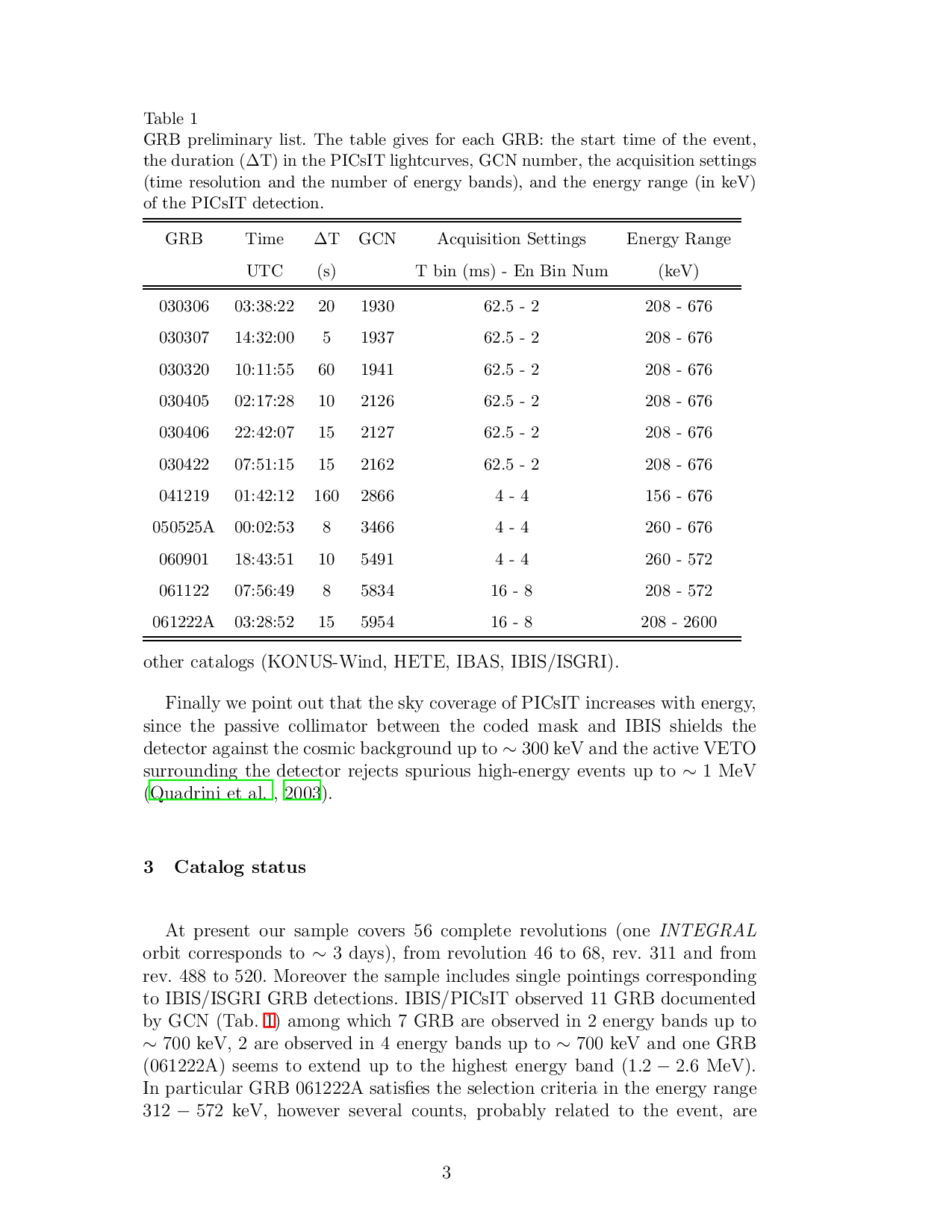
At present our sample covers 56 complete revolutions (one INTEGRAL orbit corresponds to ∼ 3 days), from revolution 46 to 68, rev. 311 and from rev. 488 to 520. Moreover the sample includes single pointings corresponding to IBIS/ISGRI GRB detections. IBIS/PICsIT observed 11 GRB documented by GCN (Tab. 1) among which 7 GRB are observed in 2 energy bands up to ∼ 700 keV, 2 are observed in 4 energy bands up to ∼ 700 keV and one GRB (061222A) seems to extend up to the highest energy band (1.2 -2.6 MeV). In particular GRB 061222A satisfies the selection criteria in the energy range 312 -572 keV, however several counts, probably related to the event, are present in all energy bins.
The updated list of events with lightcurves and spectra (if possible) is available at the web page3 . Spectral points are derived as the background subtracted count rate in each energy bin.
Among the confirmed events, we mention the very long GRB 041219 (McBreen et al. , 2006) that was also detected in Spectral Imaging Mode and GRB 061222A (Butler et al. , 2007) that appears up to ∼ 2.6 MeV. I
…(Full text truncated)…
This content is AI-processed based on ArXiv data.