This paper presents an approach for the development of a number theoretic discrete Hilbert transform. The forward transformation has been applied by taking the odd reciprocals that occur in the DHT matrix with respect to a power of 2. Specifically, the expression for a 16-point transform is provided and results of a few representative signals are provided. The inverse transform is the inverse of the forward 16-point matrix. But at this time the inverse transform is not identical to the forward transform and, therefore, our proposed number theoretic transform must be taken as a provisional result.
Deep Dive into Towards a Number Theoretic Discrete Hilbert Transform.
This paper presents an approach for the development of a number theoretic discrete Hilbert transform. The forward transformation has been applied by taking the odd reciprocals that occur in the DHT matrix with respect to a power of 2. Specifically, the expression for a 16-point transform is provided and results of a few representative signals are provided. The inverse transform is the inverse of the forward 16-point matrix. But at this time the inverse transform is not identical to the forward transform and, therefore, our proposed number theoretic transform must be taken as a provisional result.
1
Towards a Number Theoretic Discrete Hilbert Transform
Renuka Kandregula
Abstract
This paper presents an approach for the development of a number theoretic discrete Hilbert
transform. The forward transformation has been applied by taking the odd reciprocals that occur
in the DHT matrix with respect to a power of 2. Specifically, the expression for a 16-point
transform is provided and results of a few representative signals are provided. The inverse
transform is the inverse of the forward 16-point matrix. But at this time the inverse transform is
not identical to the forward transform and, therefore, our proposed number theoretic transform
must be taken as a provisional result.
Introduction
The Discrete Fourier Transform (DFT) has a number theoretic version that has many
applications [1]-[4]. We would like to have a similar number theoretic version of the Discrete
Hilbert Transform (DHT). This paper presents a number theoretic DHT although it does not
represent a general solution.
The Basic Discrete Hilbert Transform
The basic Discrete Hilbert Transform (DHT) of discrete data f(n) where n = (-∞,…,-1,0,1,…,∞)
was given by Kak [5]:
)1(
;
)
(
2
;)
(
2
)
(
)}
(
{
⎪
⎪
⎩
⎪⎪
⎨
⎧
−
−
=
∑
∑
odd
k
n
k
n
f
even
k
n
k
n
f
k
g
n
f
DHT
even
n
odd
n
π
π
The inverse Discrete Hilbert Transform (DHT) is given as:
)
2
(
;
)
(
2
;)
(
2
)
(
⎪
⎪
⎩
⎪⎪
⎨
⎧
−
−
−
−
∑
∑
odd
n
k
n
k
g
even
n
k
n
k
g
n
f
even
k
odd
k
π
π
The Hilbert transform has many applications in signal processing, imaging, modulation and
demodulation, determination of instantaneous frequency and in cryptography.
2
The discrete Hilbert transform (DHT) has several forms [6]-[8]. In [9]-[10], an application of
DHT to data hiding and measure of randomness is given.
The Matrix Form of the DHT
The matrix form of the DHT requires that the data be of finite length. Since the DHT transform
is defined for an infinite number of points, limitation of the DHT transform signal to a finite set
would set up an approximation in the signal that is recovered.
The DHT is given below for data n=0, 1, 2, … :
⎥
⎥
⎥
⎥
⎥
⎥
⎥
⎥
⎥
⎥
⎥
⎥
⎦
⎤
⎢
⎢
⎢
⎢
⎢
⎢
⎢
⎢
⎢
⎢
⎢
⎢
⎣
⎡
⋅
⋅
⋅
)
5
(
)
4
(
)
3
(
)
2
(
)1(
)
0
(
g
g
g
g
g
g
⎥
⎥
⎥
⎥
⎥
⎥
⎥
⎥
⎥
⎥
⎥
⎥
⎥
⎥
⎥
⎥
⎥
⎥
⎥
⎥
⎥
⎦
⎤
⎢
⎢
⎢
⎢
⎢
⎢
⎢
⎢
⎢
⎢
⎢
⎢
⎢
⎢
⎢
⎢
⎢
⎢
⎢
⎢
⎢
⎣
⎡
⋅
⋅
⋅
⋅
⋅
⋅
⋅
⋅
⋅
⋅
⋅
⋅
⋅
⋅
⋅
⋅
⋅
⋅
⋅
⋅
⋅
⋅
⋅
⋅
⋅
⋅
⋅
⋅
⋅
⋅
⋅
−
⋅
⋅
⋅
−
⋅
⋅
⋅
−
−
⋅
⋅
⋅
−
−
⋅
−
−
−
−
7
1
0
0
1
1
0
3
1
0
5
1
1
1
0
1
1
0
3
1
0
0
1
1
0
1
1
0
3
1
3
1
0
1
1
0
1
1
0
0
3
1
0
1
1
0
1
1
7
1
0
5
1
0
3
1
0
1
1
0
2
π
⎥
⎥
⎥
⎥
⎥
⎥
⎥
⎥
⎥
⎥
⎥
⎥
⎦
⎤
⎢
⎢
⎢
⎢
⎢
⎢
⎢
⎢
⎢
⎢
⎢
⎢
⎣
⎡
⋅
⋅
⋅
)
5
(
)
4
(
)3
(
)
2
(
)1(
)
0
(
f
f
f
f
f
f
We see that all the entries in the DHT matrix are odd reciprocals. To construct a number
theoretic version of this matrix, we would need to write these reciprocals modulo a suitably
chosen number.
In principle, the task of constructing the number theoretic DHT matrix should be easy. In reality,
it is a problem since the DHT matrix is defined for an infinite number of index values whereas
we are seeking a finite version of the matrix.
In some practical applications we would need to perform the DHT for a finite number of points.
In the next section, we present a 16-point number theoretic DHT matrix.
3
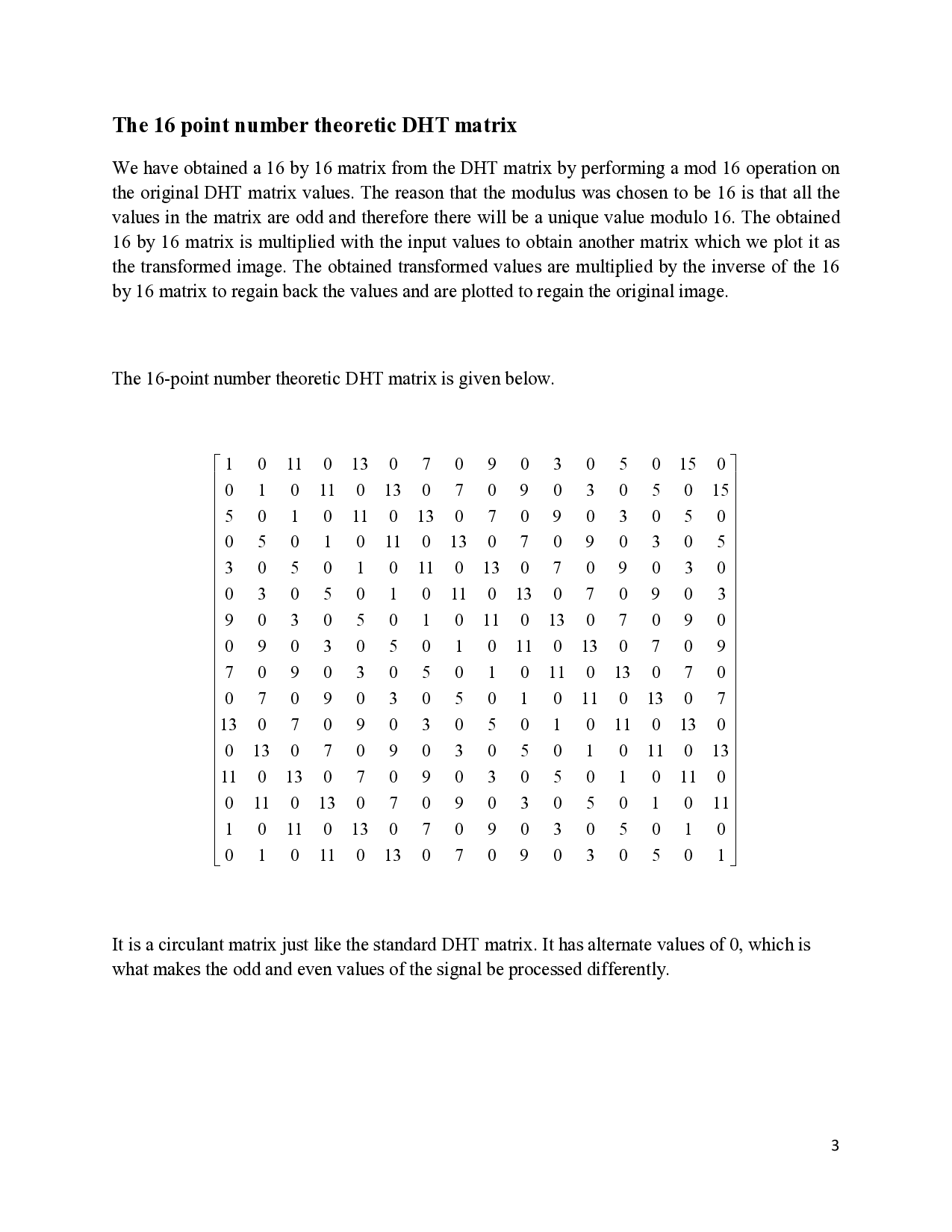
The 16 point number theoretic DHT matrix
We have obtained a 16 by 16 matrix from the DHT matrix by performing a mod 16 operation on
the original DHT matrix values. The reason that the modulus was chosen to be 16 is that all the
values in the matrix are odd and therefore there will be a unique value modulo 16. The obtained
16 by 16 matrix is multiplied with the input values to obtain another matrix which we plot it as
the transformed image. The obtained transformed values are multiplied by the inverse of the 16
by 16 matrix to regain back the values and are plotted to regain the original image.
The 16-point number theoretic DHT matrix is given below.
⎥
⎥
⎥
⎥
⎥
⎥
⎥
⎥
⎥
⎥
⎥
⎥
⎥
⎥
⎥
⎥
⎥
⎥
⎥
⎥
⎥
⎥
⎥
⎦
⎤
⎢
⎢
⎢
⎢
⎢
⎢
⎢
⎢
⎢
⎢
⎢
⎢
⎢
⎢
⎢
⎢
⎢
⎢
⎢
⎢
⎢
⎢
⎢
⎣
⎡
1
0
5
0
3
0
9
0
7
0
13
0
11
0
1
0
0
1
0
5
0
3
0
9
0
7
0
13
0
11
0
1
11
0
1
0
5
0
3
0
9
0
7
0
13
0
11
0
0
11
0
1
0
5
0
3
0
9
0
7
0
13
0
11
13
0
11
0
1
0
5
0
3
0
9
0
7
0
13
0
0
13
0
11
0
1
0
5
0
3
0
9
0
7
0
13
7
0
13
0
11
0
1
0
5
0
3
0
9
0
7
0
0
7
0
13
0
11
0
1
0
5
0
3
0
9
0
7
9
0
7
0
13
0
11
0
1
0
5
0
3
0
9
0
0
9
0
7
0
13
0
11
0
1
0
5
0
3
0
9
3
0
9
0
7
0
13
0
11
0
1
0
5
0
3
0
0
3
0
9
0
7
0
13
0
11
0
1
0
5
0
3
5
0
3
0
9
0
7
0
13
0
11
0
1
0
5
0
0
5
0
3
0
9
0
7
0
13
0
11
0
1
0
5
15
0
5
0
3
0
9
0
7
0
13
0
11
0
1
0
0
15
0
5
0
3
0
9
0
7
0
13
0
11
0
1
It is a circulant matrix just like the standard DHT matrix. It has alternate values of 0, which is
what makes the odd and even values of the signal be processed differently.
4
The Inverse 16 by 16 Matrix is given below. Its structure is similar to the forward transformation
but not identical.
⎥
⎥
⎥
⎥
⎥
⎥
⎥
⎥
⎥
⎥
⎥
⎥
⎥
⎥
⎥
⎥
⎥
⎥
⎥
⎥
⎥
⎥
⎥
⎦
⎤
⎢
⎢
⎢
⎢
⎢
⎢
⎢
⎢
…(Full text truncated)…
This content is AI-processed based on ArXiv data.