The discovery of the youngest Galactic supernova remnant (SNR) G1.9+0.3 has allowed a look at a stage of SNR evolution never before observed. We analyze the 50 ks Chandra observation with particular regard to spectral variations. The very high column density ($N_H \sim 6 \times 10^{22}$ cm$^{-2}$) implies that dust scattering is important, and we use a simple scattering model in our spectral analysis. The integrated X-ray spectrum of G1.9+0.3 is well described by synchrotron emission from a power-law electron distribution with an exponential cutoff. Using our measured radio flux and including scattering effects, we find a rolloff frequency of $5.4 (3.0, 10.2) \times 10^{17}$ Hz ($h \nu_{\rm roll} = 2.2$ keV). Including scattering in a two-region model gives lower values of \nu_roll by over a factor of 2. Dividing G1.9+0.3 into six regions, we find a systematic pattern in which spectra are hardest (highest \nu_roll) in the bright SE and NW limbs of the shell. They steepen as one moves around the shell or into the interior. The extensions beyond the bright parts of the shell have the hardest spectra of all. We interpret the results in terms of dependence of shock acceleration properties on the obliquity angle $\theta_{\rm Bn}$ between the shock velocity and a fairly uniform upstream magnetic field. This interpretation probably requires a Type Ia event. If electron acceleration is limited by synchrotron losses, the spectral variations require obliquity-dependence of the acceleration rate independent of the magnetic-field strength.
Deep Dive into X-ray Spectral Variations in the Youngest Galactic Supernova Remnant G1.9+0.3.
The discovery of the youngest Galactic supernova remnant (SNR) G1.9+0.3 has allowed a look at a stage of SNR evolution never before observed. We analyze the 50 ks Chandra observation with particular regard to spectral variations. The very high column density ($N_H \sim 6 \times 10^{22}$ cm$^{-2}$) implies that dust scattering is important, and we use a simple scattering model in our spectral analysis. The integrated X-ray spectrum of G1.9+0.3 is well described by synchrotron emission from a power-law electron distribution with an exponential cutoff. Using our measured radio flux and including scattering effects, we find a rolloff frequency of $5.4 (3.0, 10.2) \times 10^{17}$ Hz ($h \nu_{\rm roll} = 2.2$ keV). Including scattering in a two-region model gives lower values of \nu_roll by over a factor of 2. Dividing G1.9+0.3 into six regions, we find a systematic pattern in which spectra are hardest (highest \nu_roll) in the bright SE and NW limbs of the shell. They steepen as one moves a
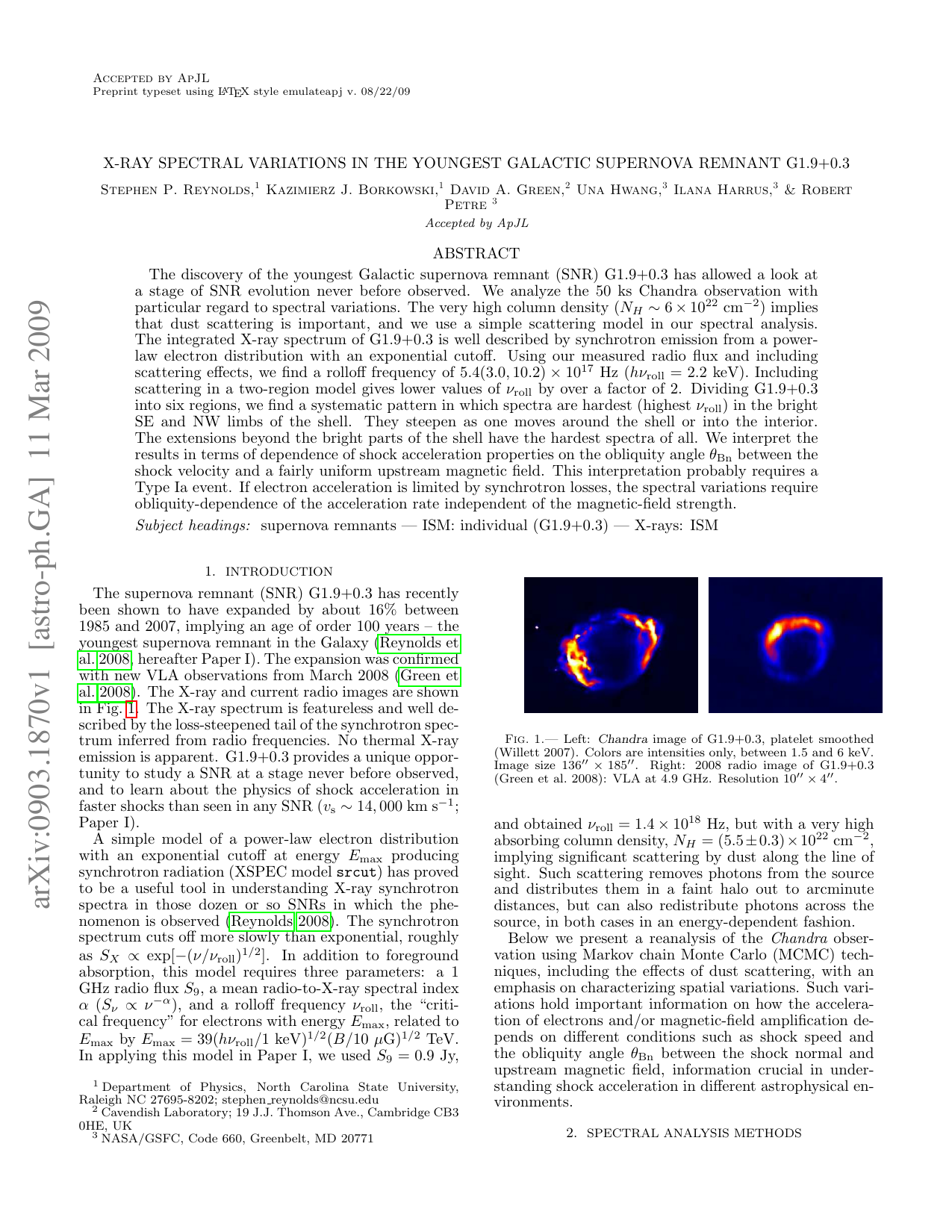
The supernova remnant (SNR) G1.9+0.3 has recently been shown to have expanded by about 16% between 1985 and 2007, implying an age of order 100 years -the youngest supernova remnant in the Galaxy (Reynolds et al. 2008, hereafter Paper I). The expansion was confirmed with new VLA observations from March 2008 (Green et al. 2008). The X-ray and current radio images are shown in Fig. 1. The X-ray spectrum is featureless and well described by the loss-steepened tail of the synchrotron spectrum inferred from radio frequencies. No thermal X-ray emission is apparent. G1.9+0.3 provides a unique opportunity to study a SNR at a stage never before observed, and to learn about the physics of shock acceleration in faster shocks than seen in any SNR (v s ∼ 14, 000 km s -1 ; Paper I).
A simple model of a power-law electron distribution with an exponential cutoff at energy E max producing synchrotron radiation (XSPEC model srcut) has proved to be a useful tool in understanding X-ray synchrotron spectra in those dozen or so SNRs in which the phenomenon is observed (Reynolds 2008). The synchrotron spectrum cuts off more slowly than exponential, roughly as S X ∝ exp[-(ν/ν roll ) 1/2 ]. In addition to foreground absorption, this model requires three parameters: a 1 GHz radio flux S 9 , a mean radio-to-X-ray spectral index α (S ν ∝ ν -α ), and a rolloff frequency ν roll , the “critical frequency” for electrons with energy E max , related to E max by E max = 39(hν roll /1 keV) 1/2 (B/10 µG) 1/2 TeV. In applying this model in Paper I, we used S 9 = 0.9 Jy, (Willett 2007). Colors are intensities only, between 1.5 and 6 keV. Image size 136 × 185 . Right: 2008 radio image of G1.9+0.3 (Green et al. 2008): VLA at 4.9 GHz. Resolution 10 × 4 .
and obtained ν roll = 1.4 × 10 18 Hz, but with a very high absorbing column density, N H = (5.5 ± 0.3) × 10 22 cm -2 , implying significant scattering by dust along the line of sight. Such scattering removes photons from the source and distributes them in a faint halo out to arcminute distances, but can also redistribute photons across the source, in both cases in an energy-dependent fashion.
Below we present a reanalysis of the Chandra observation using Markov chain Monte Carlo (MCMC) techniques, including the effects of dust scattering, with an emphasis on characterizing spatial variations. Such variations hold important information on how the acceleration of electrons and/or magnetic-field amplification depends on different conditions such as shock speed and the obliquity angle θ Bn between the shock normal and upstream magnetic field, information crucial in understanding shock acceleration in different astrophysical environments.
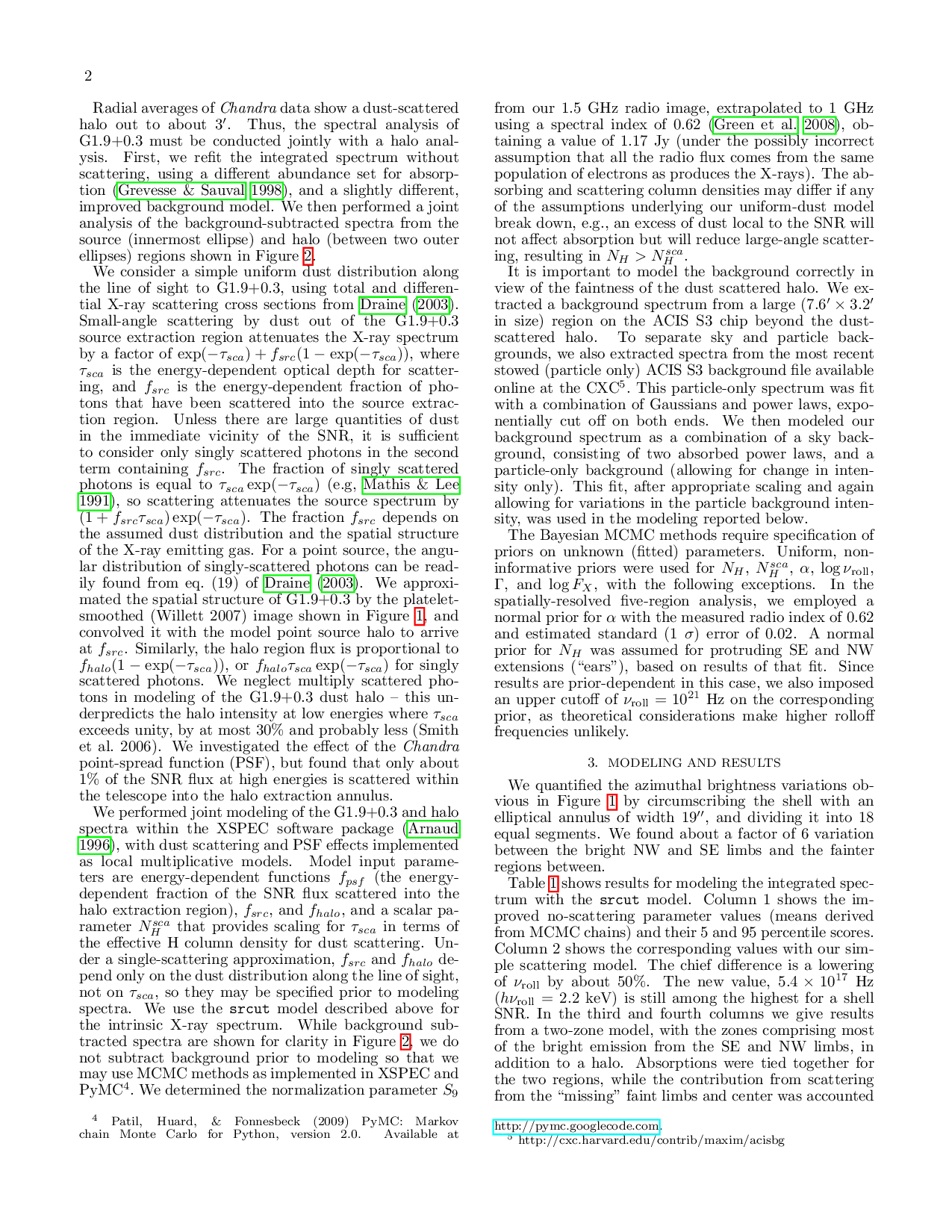
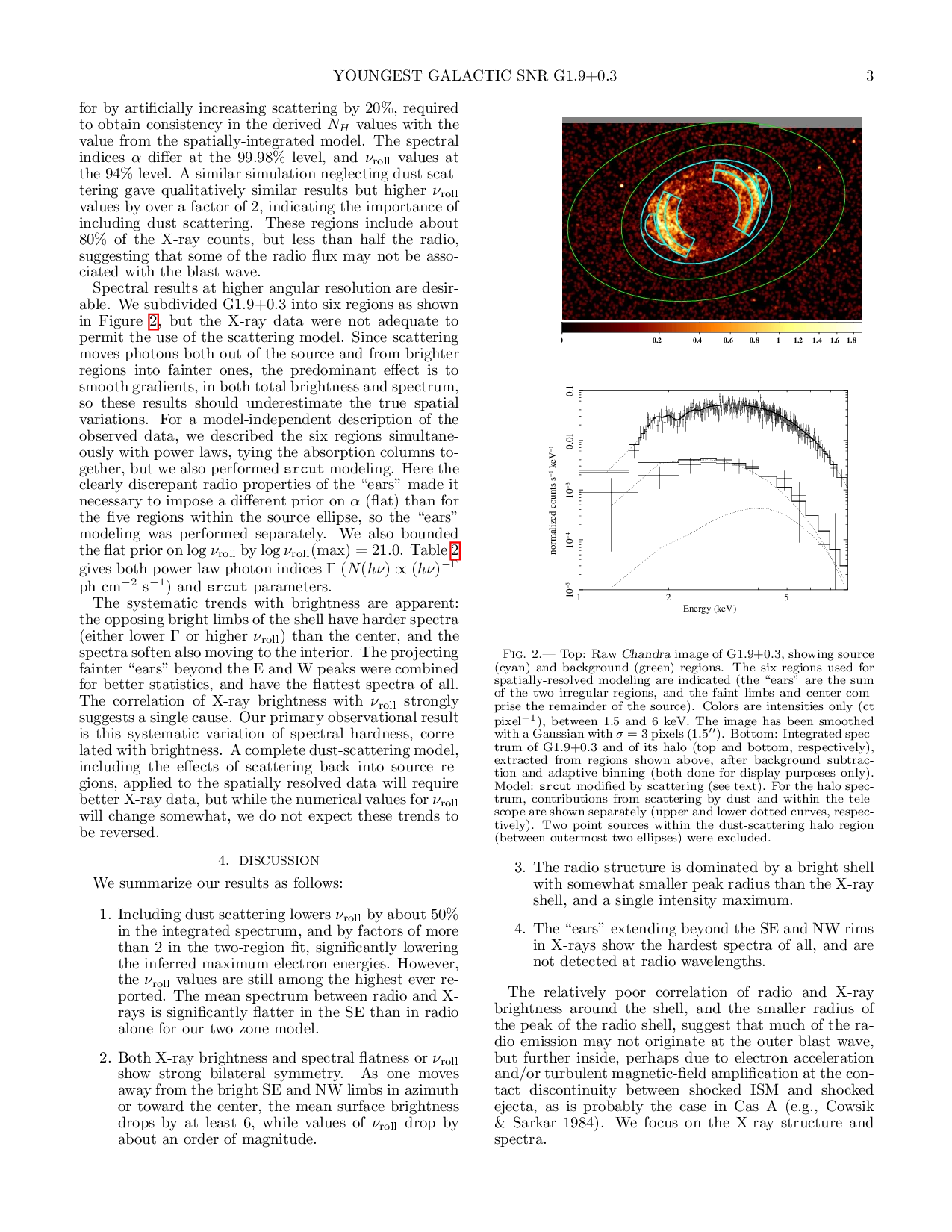
Radial averages of Chandra data show a dust-scattered halo out to about 3 . Thus, the spectral analysis of G1.9+0.3 must be conducted jointly with a halo analysis. First, we refit the integrated spectrum without scattering, using a different abundance set for absorption (Grevesse & Sauval 1998), and a slightly different, improved background model. We then performed a joint analysis of the background-subtracted spectra from the source (innermost ellipse) and halo (between two outer ellipses) regions shown in Figure 2.
We consider a simple uniform dust distribution along the line of sight to G1.9+0.3, using total and differential X-ray scattering cross sections from Draine (2003). Small-angle scattering by dust out of the G1.9+0.3 source extraction region attenuates the X-ray spectrum by a factor of exp(-τ sca ) + f src (1 -exp(-τ sca )), where τ sca is the energy-dependent optical depth for scattering, and f src is the energy-dependent fraction of photons that have been scattered into the source extraction region. Unless there are large quantities of dust in the immediate vicinity of the SNR, it is sufficient to consider only singly scattered photons in the second term containing f src . The fraction of singly scattered photons is equal to τ sca exp(-τ sca ) (e.g, Mathis & Lee 1991), so scattering attenuates the source spectrum by (1 + f src τ sca ) exp(-τ sca ). The fraction f src depends on the assumed dust distribution and the spatial structure of the X-ray emitting gas. For a point source, the angular distribution of singly-scattered photons can be readily found from eq. ( 19) of Draine (2003). We approximated the spatial structure of G1.9+0.3 by the plateletsmoothed (Willett 2007) image shown in Figure 1, and convolved it with the model point source halo to arrive at f src . Similarly, the halo region flux is proportional to f halo (1 -exp(-τ sca )), or f halo τ sca exp(-τ sca ) for singly scattered photons. We neglect multiply scattered photons in modeling of the G1.9+0.3 dust halo -this underpredicts the halo intensity at low energies where τ sca exceeds unity, by at most 30% and probably less (Smith et al. 2006). We investigated the effect of the Chandra point-spread function (PSF), but found that only about 1% of the SNR flux at high energies is scattered
…(Full text truncated)…
This content is AI-processed based on ArXiv data.