From the macroscopic viewpoint for describing the acceleration behavior of drivers, this letter presents a weighted probabilistic cellular automaton model (the WP model, for short) by introducing a kind of random acceleration probabilistic distribution function. The fundamental diagrams, the spatio-temporal pattern are analyzed in detail. It is shown that the presented model leads to the results consistent with the empirical data rather well, nonlinear velocity-density relationship exists in lower density region, and a new kind of traffic phenomenon called neo-synchronized flow is resulted. Furthermore, we give the criterion for distinguishing the high-speed and low-speed neo-synchronized flows and clarify the mechanism of this kind of traffic phenomena. In addition, the result that the time evolution of distribution of headways is displayed as a normal distribution further validates the reasonability of the neo-synchronized flow. These findings suggest that the diversity and randomicity of drivers and vehicles has indeed remarkable effect on traffic dynamics.
Deep Dive into New Insights into Traffic Dynamics: A Weighted Probabilistic Cellular Automaton Model.
From the macroscopic viewpoint for describing the acceleration behavior of drivers, this letter presents a weighted probabilistic cellular automaton model (the WP model, for short) by introducing a kind of random acceleration probabilistic distribution function. The fundamental diagrams, the spatio-temporal pattern are analyzed in detail. It is shown that the presented model leads to the results consistent with the empirical data rather well, nonlinear velocity-density relationship exists in lower density region, and a new kind of traffic phenomenon called neo-synchronized flow is resulted. Furthermore, we give the criterion for distinguishing the high-speed and low-speed neo-synchronized flows and clarify the mechanism of this kind of traffic phenomena. In addition, the result that the time evolution of distribution of headways is displayed as a normal distribution further validates the reasonability of the neo-synchronized flow. These findings suggest that the diversity and randomici
Over the past decades, traffic problems have attracted considerable attention and various modeling approaches have been presented [1,2], such as car-following models, cellular automaton models, gas kinetic models and hydrodynamic models, etc. Here we will focus on cellular automaton (CA) models [1,3]. Compared with others, CA models are conceptually simpler, and can be easily implemented on computers for numerical investigations. There are two basic CA models describing singe-lane traffic flow: the Nagel-Schreckenberg (NaSch) model [4] and the Fukui-Ishibashi (FI) model [5]. Both of them are defined on a one-dimensional lattice consisting of L sites with periodic boundary conditions. Each site is either occupied by a vehicle, or is empty.
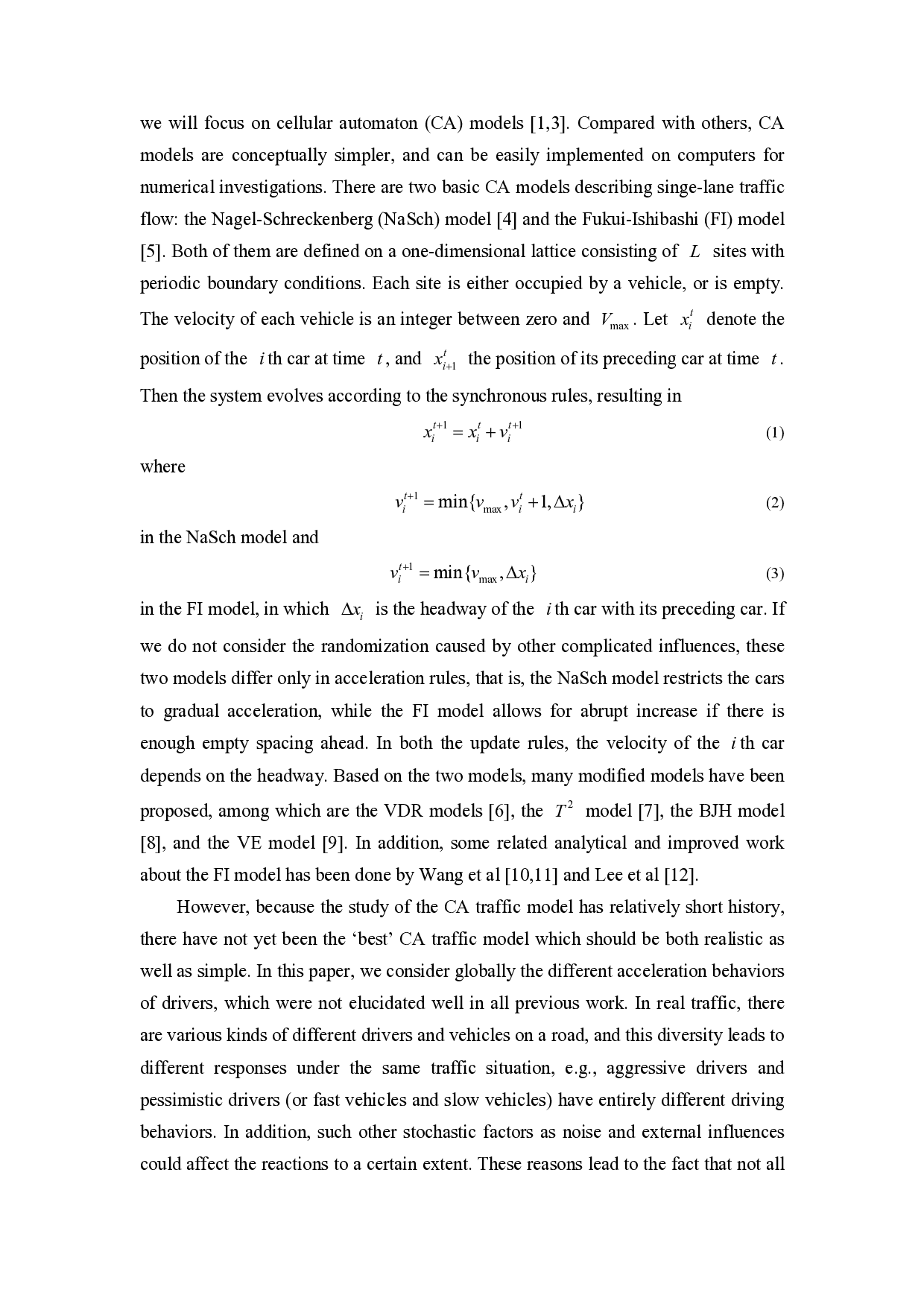
The velocity of each vehicle is an integer between zero and max V . Let t i x denote the position of the i th car at time t , and
x + the position of its preceding car at time t .
Then the system evolves according to the synchronous rules, resulting in
where
in the NaSch model and
in the FI model, in which i x Δ is the headway of the i th car with its preceding car. If we do not consider the randomization caused by other complicated influences, these two models differ only in acceleration rules, that is, the NaSch model restricts the cars to gradual acceleration, while the FI model allows for abrupt increase if there is enough empty spacing ahead. In both the update rules, the velocity of the i th car depends on the headway. Based on the two models, many modified models have been proposed, among which are the VDR models [6], the 2 T model [7], the BJH model [8], and the VE model [9]. In addition, some related analytical and improved work about the FI model has been done by Wang et al [10,11] and Lee et al [12].
First of all, we explain the general framework of our model for single-lane traffic.
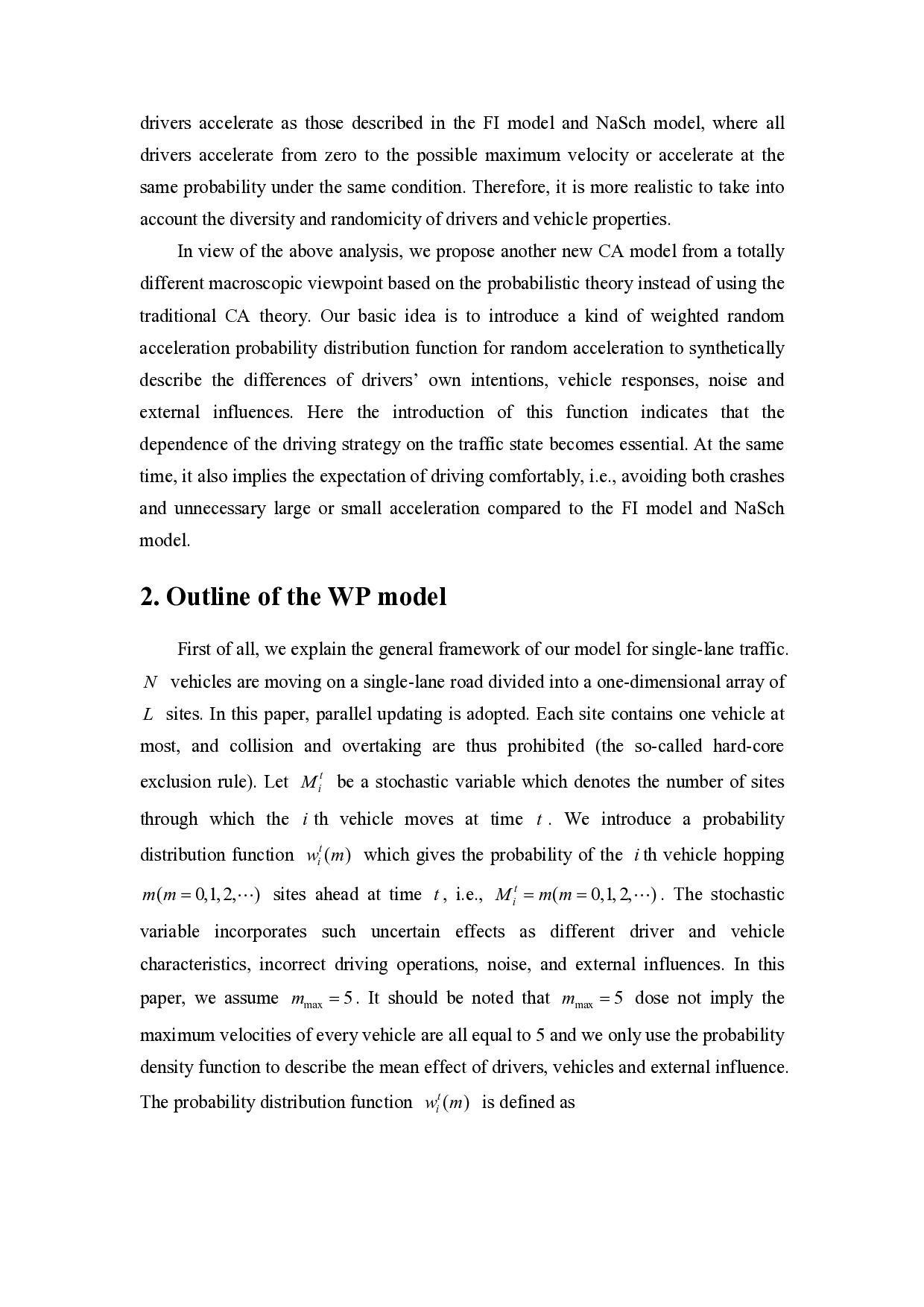
N vehicles are moving on a single-lane road divided into a one-dimensional array of L sites. In this paper, parallel updating is adopted. Each site contains one vehicle at most, and collision and overtaking are thus prohibited (the so-called hard-core exclusion rule). Let The probability distribution function ( )
w m is defined as
where α β , and γ are underdetermined parameters which should meet the requirements that Z
and α β γ
Here it is assumed that if 5
, i.e., the vehicle moves at the probability ( )
w m of 5 i x Δ = with considering the speed limit on roads. It is necessary to point out that ( )
w m has the following properties:
(1) ( )( 0 1 2 ) ,,,Δ increases monotonically with increasing m at given
w m w m / -> , for we know that drivers generally intend to move as fast as possible at constant i x Δ , but the ratio is close to 1 as m increases, which reflects that the acceleration effect is almost the same at larger headway;
(2) Based on the above analysis and realistic mathematical and physical consideration, the reasonable parameters are suggested as 2 1 3
The updating procedure consists of the following three steps.
• Determination of the randomization parameter ( )
w m based on Eq.( 4) at given
• Determination of the number of sites through which a vehicle passes (i.e., the probability velocity) according to the intention ( )
Based on Eq.( 4), the set of probability density is composed of the following
• Updating of the new position of each vehicle 1 ( )
We call the probability distribution t i w the intention because it is an intrinsic variable of drivers themselves. It brings uncertainty of operation into the traffic model and reflects a certain statistically mean effect.
The numerical simulation was performed according to the above updating rules under the periodic boundary condition. A one-dimensional lattice of L sites and vehicles moving unidirectionally were considered. Each site was set to be 7.5m long, L to be 1000, one time step to be 1s, being the order of the reaction time for humans, and the maximum velocity to be max 5 v = , corresponding to 135km/h. In order to characterize the behavior of the model, we determined the macroscopic quantities, including the global density ρ , the mean speed V , the mean flow J defined as
In numerical simulation, the
Van Aerde model and the empirical data presented in Ref. [13]. We can see the fundamental diagrams are in rather good agreement the empirical data. The results also validate the conclusion of general CA models well [14], i.e., on a single-lane road, the average velocity of vehicles is mainly determined by the slow vehicles.
Meanwhile, the variation tendency of mean velocity is in good agreenment with the empirical observations [15] instead of the occurrence of a plateau as appeared in other model CA models [3,4], and a nonlinear flow-velocity-density relationship [16] exists. In order to analyze the traffic behavior revealed by the WP model, we further study the fundamental diagram (see Fig. 2) and the spatio-temporal patterns (see Fig. ρ ρ ρ < < , the velocity of vehicles decreases
…(Full text truncated)…
This content is AI-processed based on ArXiv data.