We consider the level 1 solution of quantum Knizhnik-Zamolodchikov equation with reflecting boundary conditions which is relevant to the Temperley--Lieb model of loops on a strip. By use of integral formulae we prove conjectures relating it to the weighted enumeration of Cyclically Symmetric Transpose Complement Plane Partitions and related combinatorial objects.
Deep Dive into Quantum Knizhnik-Zamolodchikov equation: reflecting boundary conditions and combinatorics.
We consider the level 1 solution of quantum Knizhnik-Zamolodchikov equation with reflecting boundary conditions which is relevant to the Temperley–Lieb model of loops on a strip. By use of integral formulae we prove conjectures relating it to the weighted enumeration of Cyclically Symmetric Transpose Complement Plane Partitions and related combinatorial objects.
Since the papers [1,2], there has been a great deal of work on the combinatorial interpretation of quantum integrable models at special points of their parameter space.
The original observation is that the numbers of Alternating Sign Matrices (ASM) and Plane Partitions (PP) in various symmetry classes appear naturally in the ground state entries of the Temperley-Lieb O(τ = 1) model of (non-crossings) loops with various boundary conditions (and related models). The appearance of ASM numbers was developed further and to some extent explained by the Razumov-Stroganov conjecture [3] and variants [4,5] interpreting each ground state entry as a number of certain subsets of ASM. The role of plane partitions remained more obscure until the recent work [6,7] which showed that the enumeration of symmetry classes of PP also occurs naturally on condition that one consider a slightly more general problem, namely the quantum Knizhnik-Zamolodchikov equation (qKZ), first introduced in this context in [8], and in which the parameter τ is now free. This provided a (conjectural) bridge between enumerations of symmetry classes of ASM and PP, which is a fascinating topic of enumerative combinatorics in itself.
The present work is concerned more specifically with the case of the Temperley-Lieb loop model (and its qKZ generalization) defined on a strip with reflecting boundary conditions (the case of periodic boundary conditions was treated similarly in [9]). The corresponding ASM were discovered in [4,10]: they are Vertically Symmetric Alternating Sign Matrices (VSASM) of size (2n + 1) × (2n + 1) in even strip size N = 2n, and modified VSASM of size (2n + 1) × (2n + 3) in odd strip size N = 2n + 1. As to the PP, they were discussed in [7]: they are Cyclically Symmetric Transpose Complement Plane Partitions (CSTCPP) [11] in odd strip size, and certain modified CSTCPP (referred to as CSTCPP △ in the following) in even strip size. The conjectures of [7] concerning the τ -enumeration of these plane partitions are the main subject of this work. In Sect. 2 we shall review the basics of integrable loop models based on the Temperley-Lieb algebra; in Sect. 3 we shall discuss the related qKZ equation, and review the conjectures of [7]; in Sect. 4 we introduce the main technical tool, that is certain explicit integrals solving qKZ; and finally in Sect. 5 and 6 we prove the conjectures of [7], considering separately even and odd cases.
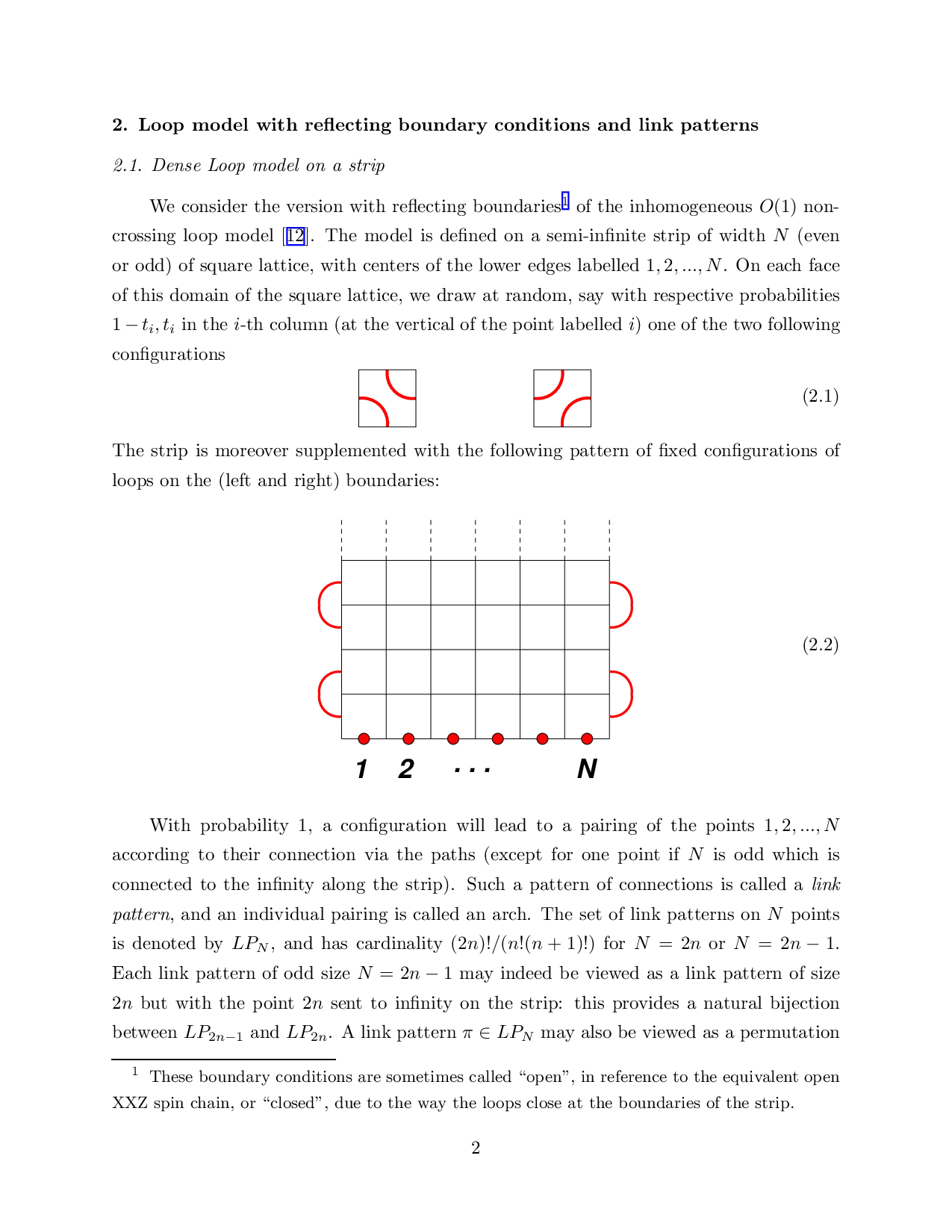
We consider the version with reflecting boundaries 1 of the inhomogeneous O(1) noncrossing loop model [12]. The model is defined on a semi-infinite strip of width N (even or odd) of square lattice, with centers of the lower edges labelled 1, 2, …, N . On each face of this domain of the square lattice, we draw at random, say with respective probabilities 1 -t i , t i in the i-th column (at the vertical of the point labelled i) one of the two following configurations (2.1) The strip is moreover supplemented with the following pattern of fixed configurations of loops on the (left and right) boundaries: N 1 2 . . . (2.2) With probability 1, a configuration will lead to a pairing of the points 1, 2, …, N according to their connection via the paths (except for one point if N is odd which is connected to the infinity along the strip). Such a pattern of connections is called a link pattern, and an individual pairing is called an arch. The set of link patterns on N points is denoted by LP N , and has cardinality (2n)!/(n!(n + 1)!) for N = 2n or N = 2n -1.
Each link pattern of odd size N = 2n -1 may indeed be viewed as a link pattern of size 2n but with the point 2n sent to infinity on the strip: this provides a natural bijection between LP 2n-1 and LP 2n . A link pattern π ∈ LP N may also be viewed as a permutation 1 These boundary conditions are sometimes called “open”, in reference to the equivalent open XXZ spin chain, or “closed”, due to the way the loops close at the boundaries of the strip. π ∈ S N with only cycles of length 2 (except one cycle of length 1 for N odd), and we shall use the notation π(i) = j to express that points i and j are connected by an arch.
For a pair (i, j) such that j = π(i) and i < j, we will call i the opening and j the closing of the arch connecting i and j. An example of loop configuration together with its link pattern are depicted in Fig. 1. We use a standard pictorial representation for link patterns in the form of configurations of non-intersecting arches connecting regularly spaced points on a line, within the upper-half plane it defines. For odd N , the unmatched point may be represented as connected to infinity in the upper-half plane via a vertical half-line.
We moreover attach a weight τ = -(q + q -1 ) = 1 to each loop (hence the denomination O(τ = 1) model, q = -e iπ/3 ). We may then compute the probability Prob(π) for a given randomly generated configuration of the loop model on the strip to be connecting the boundary points according to a given link pattern π.
I
…(Full text truncated)…
This content is AI-processed based on ArXiv data.