📝 Original Info
- Title: Distinct Scaling Regimes of Energy Release Dynamics in the Nighttime Magnetosphere
- ArXiv ID: 0807.0631
- Date: 2009-11-13
- Authors: Researchers from original ArXiv paper
📝 Abstract
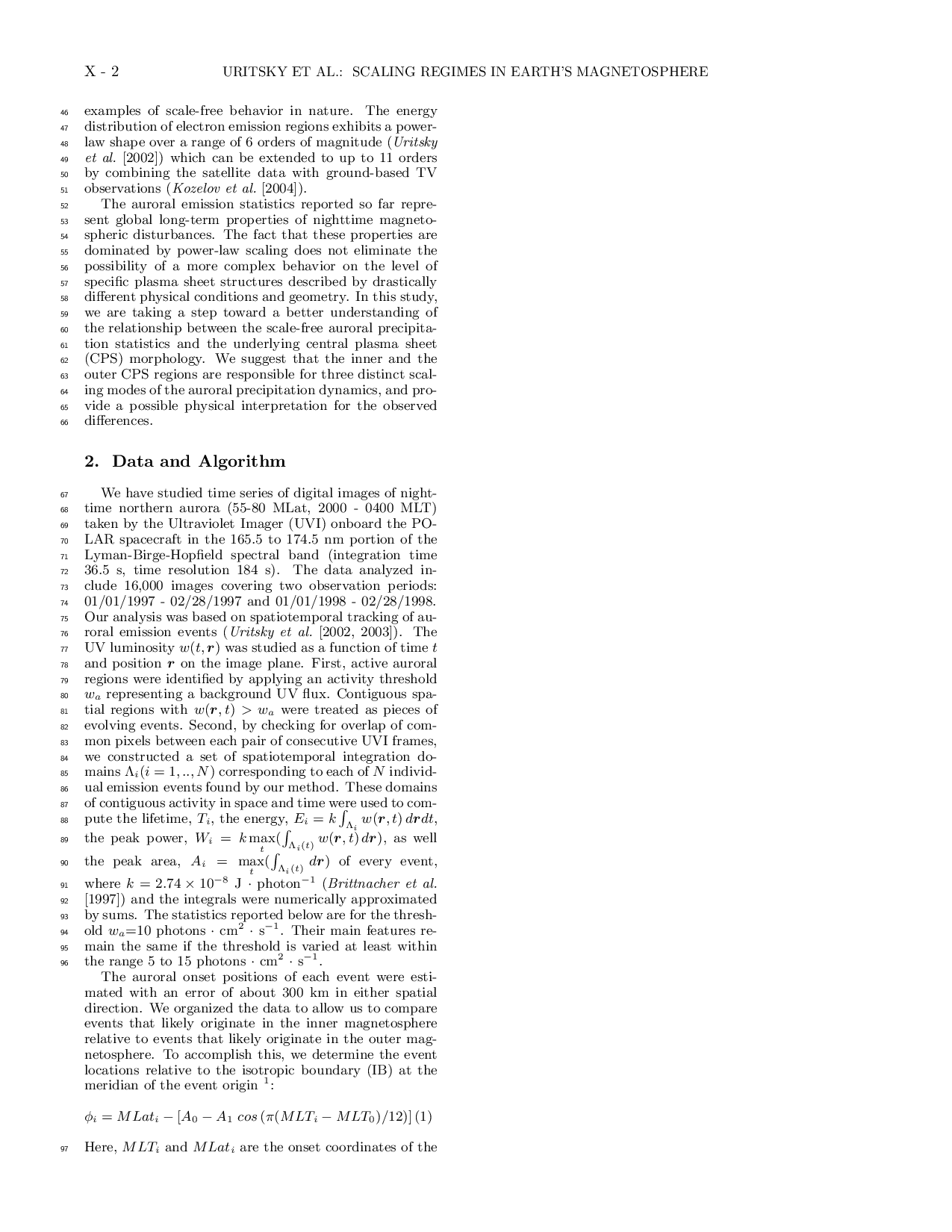
Based on a spatiotemporal analysis of POLAR UVI images, we show that the auroral emission events that initiate equatorward of the isotropic boundary (IB) obtained from a time-dependent empirical model, have systematically steeper power-law slopes of energy, power, area and lifetime probability distributions compared to the events that initiate poleward of the IB. The low-latitude group of events contains a distinct subpopulation of substorm-scale disturbances violating the power-law behavior, while the high latitude group is described by nearly perfect power-law statistics over the entire range of scales studied. The results obtained indicate that the inner and outer portions of the plasma sheet are characterized by substantially different scaling regimes of bursty energy dissipation suggestive of different physics in these regions.
💡 Deep Analysis
Deep Dive into Distinct Scaling Regimes of Energy Release Dynamics in the Nighttime Magnetosphere.
Based on a spatiotemporal analysis of POLAR UVI images, we show that the auroral emission events that initiate equatorward of the isotropic boundary (IB) obtained from a time-dependent empirical model, have systematically steeper power-law slopes of energy, power, area and lifetime probability distributions compared to the events that initiate poleward of the IB. The low-latitude group of events contains a distinct subpopulation of substorm-scale disturbances violating the power-law behavior, while the high latitude group is described by nearly perfect power-law statistics over the entire range of scales studied. The results obtained indicate that the inner and outer portions of the plasma sheet are characterized by substantially different scaling regimes of bursty energy dissipation suggestive of different physics in these regions.
📄 Full Content
arXiv:0807.0631v1 [physics.space-ph] 3 Jul 2008
GEOPHYSICAL RESEARCH LETTERS, VOL. ???, XXXX, DOI:10.1029/,
Distinct Scaling Regimes of Energy Release Dynamics in the
1
Nighttime Magnetosphere
2
V. M. Uritsky1, E. Donovan1, A. J. Klimas2, and E. Spanswick1
Based on a spatiotemporal analysis of POLAR UVI
3
images, we show that the auroral emission events that
4
initiate equatorward of the isotropic boundary (IB) ob-
5
tained from a time-dependent empirical model, have sys-
6
tematically steeper power-law slopes of energy, power,
7
area and lifetime probability distributions compared to
8
the events that initiate poleward of the IB. The low-
9
latitude group of events contains a distinct subpopulation
10
of substorm-scale disturbances violating the power-law
11
behavior, while the high latitude group is described by
12
nearly perfect power-law statistics over the entire range
13
of scales studied. The results obtained indicate that the
14
inner and outer portions of the plasma sheet are charac-
15
terized by substantially different scaling regimes of bursty
16
energy dissipation suggestive of different physics in these
17
regions.
18
1. Introduction
The activity of the nighttime auroral oval represents a
19
wide range of dynamical processes in the magnetotail,
20
including substorm expansion onsets, pseudobreakups,
21
steady magnetospheric convection events with or with-
22
out substorms, bursty bulk flows, and sawtooth events
23
(see e.g., Zesta et al. [2000]; Lui [2001]; Frey et al. [2004];
24
Henderson et al. [2006]). Despite the diversity of physical
25
conditions associated with each particular type of auroral
26
activity, their net energy output can be described by a
27
set of apparently universal power-laws (Lui et al. [2000];
28
Lui [2002]; Uritsky et al. [2003, 2002, 2006]) signaling
29
the existence of a organizing dynamical principle arrang-
30
ing intermittent magnetospheric dissipation across vast
31
ranges of spatial and temporal scales.
32
Power-law intermittency of energy dissipation has at-
33
tracted significant attention in modern statistical me-
34
chanics (see Dhar [2006] and refs therein) and is often
35
considered a hallmark of turbulent and/or critical phe-
36
nomena with no characteristic scales other than those
37
dictated by the finite size of the system (Sreenivasan
38
et al. [2004]; Lubeck [2004]).
Examples of such behav-
39
ior in geo- and space sciences include fully developed
40
turbulence in hydrodynamic or magnetized flows (Lazar-
41
ian [2006]), Guttenberg-Richter statistics of earthquake
42
magnitudes (Turcotte [1989]), scale-invariance in the so-
43
lar corona (Charbonneau et al. [2001]). In this context,
44
the auroral activity provides one of the most impressive
45
1Physics and Astronomy Department, University of
Calgary, Calgary, AB, Canada
2UMBC at NASA / Goddard Space Flight Center,
Greenbelt, Maryland, USA
Copyright 2018 by the American Geophysical Union.
0094-8276/18/$5.00
1
X - 2
URITSKY ET AL.: SCALING REGIMES IN EARTH’S MAGNETOSPHERE
examples of scale-free behavior in nature.
The energy
46
distribution of electron emission regions exhibits a power-
47
law shape over a range of 6 orders of magnitude (Uritsky
48
et al. [2002]) which can be extended to up to 11 orders
49
by combining the satellite data with ground-based TV
50
observations (Kozelov et al. [2004]).
51
The auroral emission statistics reported so far repre-
52
sent global long-term properties of nighttime magneto-
53
spheric disturbances. The fact that these properties are
54
dominated by power-law scaling does not eliminate the
55
possibility of a more complex behavior on the level of
56
specific plasma sheet structures described by drastically
57
different physical conditions and geometry. In this study,
58
we are taking a step toward a better understanding of
59
the relationship between the scale-free auroral precipita-
60
tion statistics and the underlying central plasma sheet
61
(CPS) morphology. We suggest that the inner and the
62
outer CPS regions are responsible for three distinct scal-
63
ing modes of the auroral precipitation dynamics, and pro-
64
vide a possible physical interpretation for the observed
65
differences.
66
2. Data and Algorithm
We have studied time series of digital images of night-
67
time northern aurora (55-80 MLat, 2000 - 0400 MLT)
68
taken by the Ultraviolet Imager (UVI) onboard the PO-
69
LAR spacecraft in the 165.5 to 174.5 nm portion of the
70
Lyman-Birge-Hopfield spectral band (integration time
71
36.5 s, time resolution 184 s).
The data analyzed in-
72
clude 16,000 images covering two observation periods:
73
01/01/1997 - 02/28/1997 and 01/01/1998 - 02/28/1998.
74
Our analysis was based on spatiotemporal tracking of au-
75
roral emission events (Uritsky et al. [2002, 2003]). The
76
UV luminosity w(t, r) was studied as a function of time t
77
and position r on the image plane. First, active auroral
78
regions were identified by applying an activity threshold
79
wa representing
…(Full text truncated)…
📸 Image Gallery
Reference
This content is AI-processed based on ArXiv data.