Towards a Number Theoretic Discrete Hilbert Transform
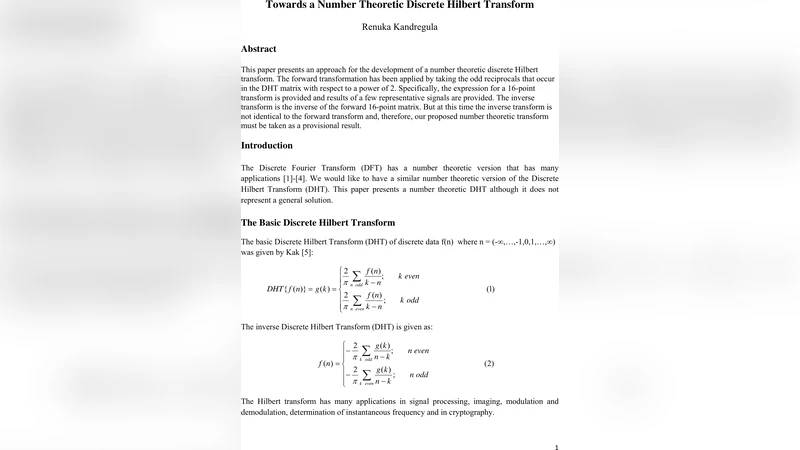
This paper presents an approach for the development of a number theoretic discrete Hilbert transform. The forward transformation has been applied by taking the odd reciprocals that occur in the DHT matrix with respect to a power of 2. Specifically, the expression for a 16-point transform is provided and results of a few representative signals are provided. The inverse transform is the inverse of the forward 16-point matrix. But at this time the inverse transform is not identical to the forward transform and, therefore, our proposed number theoretic transform must be taken as a provisional result.
💡 Research Summary
The paper attempts to bridge the discrete Hilbert transform (DHT) with number‑theoretic transforms (NTT), a connection that, to the best of the author’s knowledge, has not been explored before. The DHT is traditionally defined for an infinite‑length sequence and its matrix representation consists entirely of odd reciprocals (terms of the form 1/(2k‑1)·π) with alternating signs for even and odd indices. Because these entries are rational numbers, a direct implementation in modular arithmetic is not straightforward.
The author’s core idea is to take a power‑of‑two modulus, specifically 2⁴ = 16, and replace each odd reciprocal in the DHT matrix by its remainder modulo 16. Since every entry is odd, the remainder is unique and lies in the set {1,3,5,7,9,11,13,15}. The resulting 16 × 16 matrix is circulant, with alternating zero columns that separate the processing of even and odd samples. This matrix is then used as a forward transform: an input vector of length 16 is multiplied by the matrix to obtain a transformed vector whose components are integer values between 0 and 15.
To recover the original signal, the author computes the ordinary (real‑valued) inverse of the forward matrix and applies it to the transformed vector. The inverse matrix, however, does not share the same circulant structure and contains floating‑point coefficients such as 0.071, 0.004, etc. Consequently, the inverse operation is not the modular inverse of the forward transform; the two are not mathematically identical. The paper openly acknowledges this limitation and labels the current construction as a provisional result.
Experimental validation is performed in MATLAB on four synthetic 16‑point binary sequences: (1) a single step from 0 to 1, (2) a constant‑one sequence, (3) a pattern with two step transitions, and (4) the complement of (1). For each case the author displays three plots: the original sequence, the transformed sequence (after multiplication by the forward matrix), and the reconstructed sequence (after multiplication by the inverse matrix). The visual results show that a single amplitude transition is captured cleanly, whereas multiple transitions generate several smaller peaks, indicating that the transform does not preserve the exact shape of more complex signals. No quantitative error metrics (e.g., mean‑square error, SNR) are reported, and the scaling of the transformed values is not fully explained.
In the conclusion the author states that the number‑theoretic DHT can detect abrupt amplitude changes but does not do so “neatly” for signals with more than one transition. The work is presented as a first step toward a true number‑theoretic Hilbert transform. The paper calls for further research to (i) define a proper modular inverse that matches the forward transform, (ii) analyze the approximation error introduced by truncating the infinite‑length DHT to a finite size, and (iii) generalize the construction beyond the 16‑point case.
Overall, the contribution is primarily conceptual: it highlights that the odd‑reciprocal structure of the DHT can be mapped into a finite field by a power‑of‑two modulus. However, the lack of a mathematically consistent inverse, the absence of rigorous error analysis, and the limited experimental scope mean that the proposed transform cannot yet be used as a reliable tool in signal processing. Future work will need to address these shortcomings, perhaps by employing a modulus that is coprime to all denominators of the original DHT entries or by developing a dedicated number‑theoretic Hilbert kernel that preserves the analytic properties of the continuous Hilbert transform.
Comments & Academic Discussion
Loading comments...
Leave a Comment