Distributions generated by perturbation of symmetry with emphasis on a multivariate skew $t$ distribution
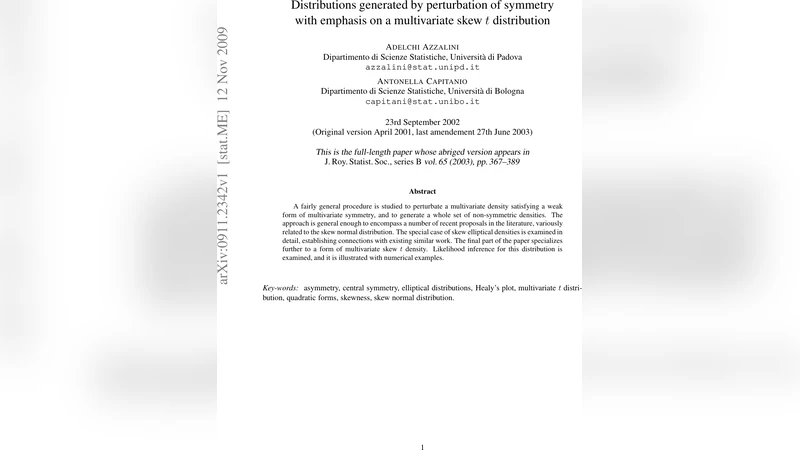
A fairly general procedure is studied to perturbate a multivariate density satisfying a weak form of multivariate symmetry, and to generate a whole set of non-symmetric densities. The approach is general enough to encompass a number of recent proposals in the literature, variously related to the skew normal distribution. The special case of skew elliptical densities is examined in detail, establishing connections with existing similar work. The final part of the paper specializes further to a form of multivariate skew $t$ density. Likelihood inference for this distribution is examined, and it is illustrated with numerical examples.
💡 Research Summary
The paper develops a unified framework for generating a broad class of asymmetric multivariate densities by perturbing a base density that satisfies a weak form of symmetry. The authors first define “weak symmetry” as a condition where a density f can be written as f(x)=f(−x)·g(αᵀx) for some direction vector α and scalar function g. Starting from any base density f₀ that fulfills this property, they introduce a perturbation function W, typically a cumulative distribution function (CDF), and construct the new density f(x)=2 f₀(x) W(αᵀx). This construction automatically yields a proper probability density and includes the well‑known skew‑normal distribution of Azzalini and Dalla Valle (1996) as a special case.
The authors then specialize the framework to elliptical base densities of the form
f₀(x)=c |Σ|⁻¹ᐟ² g\big((x‑μ)ᵀΣ⁻¹(x‑μ)\big),
where Σ is a positive‑definite scatter matrix, μ a location vector, and g a scalar generator that can produce normal, t, Cauchy, or other elliptical families. By choosing W=Φ, the standard normal CDF, the resulting “skew‑elliptical” density becomes
f(x)=2 c |Σ|⁻¹ᐟ² g\big((x‑μ)ᵀΣ⁻¹(x‑μ)\big) Φ\big(αᵀΣ⁻¹ᐟ²(x‑μ)\big).
In this expression the skewness parameter α controls both the magnitude and direction of asymmetry, while Σ and μ retain their usual interpretations, allowing a clean separation between scale, location, and skewness.
The central contribution of the paper is the derivation of a multivariate skew‑t distribution within this perturbation scheme. Starting from the multivariate t density
tₚ(x;μ,Σ,ν)=cₜ |Σ|⁻¹ᐟ² \big(1+δ(x)/ν\big)^{-(ν+p)/2},
with δ(x)=(x‑μ)ᵀΣ⁻¹(x‑μ) and ν degrees of freedom, the authors apply the same perturbation to obtain
f(x)=2 tₚ(x;μ,Σ,ν) Φ\Big(αᵀΣ⁻¹ᐟ²(x‑μ) √{(ν+p)/(ν+δ(x))}\Big).
This formulation preserves the heavy‑tailed nature of the t‑distribution while introducing a flexible skewness mechanism governed by α. The presence of ν in the scaling factor inside the Φ argument ensures that the amount of skewness adapts to the tail thickness, a feature not present in earlier skew‑t proposals.
For inference, the authors develop an Expectation‑Maximization (EM) algorithm that treats the t‑distribution as a normal‑variance mixture with a latent scaling variable Z. In the E‑step they compute the conditional expectations E
Comments & Academic Discussion
Loading comments...
Leave a Comment