Orthomodular Lattices Induced by the Concurrency Relation
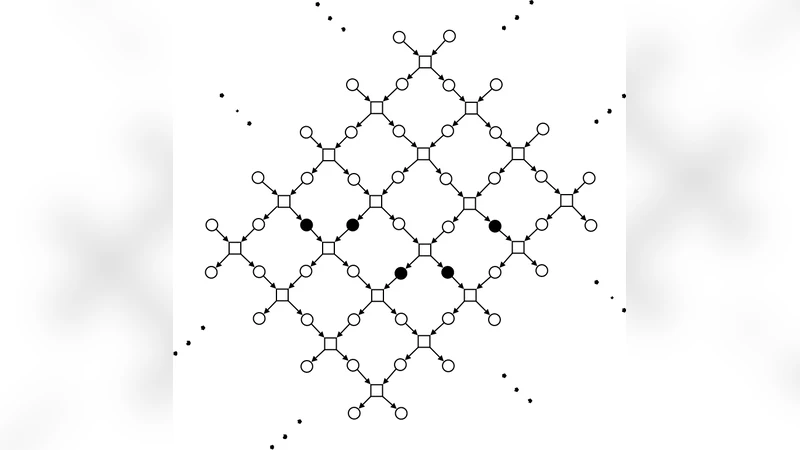
We apply to locally finite partially ordered sets a construction which associates a complete lattice to a given poset; the elements of the lattice are the closed subsets of a closure operator, defined starting from the concurrency relation. We show that, if the partially ordered set satisfies a property of local density, i.e.: N-density, then the associated lattice is also orthomodular. We then consider occurrence nets, introduced by C.A. Petri as models of concurrent computations, and define a family of subsets of the elements of an occurrence net; we call those subsets “causally closed” because they can be seen as subprocesses of the whole net which are, intuitively, closed with respect to the forward and backward local state changes. We show that, when the net is K-dense, the causally closed sets coincide with the closed sets induced by the closure operator defined starting from the concurrency relation. K-density is a property of partially ordered sets introduced by Petri, on the basis of former axiomatizations of special relativity theory.
💡 Research Summary
The paper investigates how a concurrency relation defined on a locally finite partially ordered set (poset) can be used to generate a complete lattice whose elements are the closed sets of a specially constructed closure operator, and under what conditions this lattice acquires the structure of an orthomodular lattice—a central algebraic model for quantum logic.
Construction of the closure operator.
Given a locally finite poset (P), the authors first introduce a binary concurrency relation (C\subseteq P\times P) that holds between two elements precisely when they are incomparable (i.e., neither precedes the other). From this relation they define a closure operator (\operatorname{cl}:2^{P}\rightarrow2^{P}) as follows: for any subset (X\subseteq P), (\operatorname{cl}(X)) is the smallest superset of (X) that contains every element that is concurrent with at least one element of (X). The operator is extensive, monotone, and idempotent, therefore its fixed points—sets satisfying (\operatorname{cl}(X)=X)—form a family (\mathcal{L}). Ordered by inclusion, (\mathcal{L}) is a complete lattice: arbitrary meets and joins are given by set‑intersection and the closure of set‑union, respectively.
From N‑density to orthomodularity.
A lattice of closed sets need not be orthomodular; orthomodularity requires a well‑behaved orthocomplementation and the orthomodular law (a\le b \Rightarrow b = a\vee (a^{\perp}\wedge b)). To guarantee these properties the authors introduce N‑density, a local density condition on the underlying poset. Roughly, N‑density asserts that for any two incomparable elements there exists a “dense” set of elements that are mutually concurrent and that fill the interval between them. This condition prevents pathological gaps that would otherwise break the orthocomplementation. Under N‑density the orthocomplement of a closed set (X) can be defined as (\neg X = \operatorname{cl}(P\setminus X)). The authors prove that this operation satisfies the required involution, order‑reversing, and orthogonality properties, and that the orthomodular law holds. Consequently, (\mathcal{L}) becomes an orthomodular lattice, providing a concrete, order‑theoretic realization of a quantum‑logic structure without invoking Hilbert spaces.
Application to occurrence nets.
The second part of the paper turns to occurrence nets, a class of Petri nets introduced by C. A. Petri to model concurrent computations. An occurrence net consists of conditions (places) and events (transitions) together with a causal partial order: an event is preceded by the conditions it consumes and succeeded by the conditions it produces. The authors define a notion of causally closed subsets of the net’s elements. A set (S) is causally closed if (i) whenever an event belongs to (S), all its pre‑conditions and post‑conditions also belong to (S); and (ii) whenever a condition belongs to (S), the unique event that produces it and the unique event that consumes it (if any) are also in (S). Intuitively, such a set represents a self‑contained subprocess of the whole net, closed under forward and backward state changes.
K‑density and equivalence of closures.
Petri’s K‑density is a classic density property stating that every maximal chain (a “line” of causally related events) intersects every maximal antichain (a “cut” of mutually concurrent conditions). In the language of posets, K‑density guarantees that any line and any cut have a common element. The authors prove that when an occurrence net satisfies K‑density, the family of causally closed subsets coincides exactly with the family of closed sets obtained from the concurrency‑based closure operator defined earlier. In other words, the two seemingly different closure notions—one rooted in causal closure, the other in concurrency—merge under K‑density.
Significance and outlook.
The paper establishes a bridge between three research areas: (1) order‑theoretic constructions of quantum‑logic lattices, (2) concurrency theory via the notion of a binary concurrency relation, and (3) Petri‑net models of distributed computation. By showing that N‑density yields orthomodularity, the authors provide a purely combinatorial criterion for when a poset‑derived lattice can serve as a quantum‑logic model. By demonstrating that K‑density aligns causal and concurrency closures in occurrence nets, they give a robust algebraic tool for reasoning about subprocesses in concurrent systems. The results suggest further extensions, such as investigating other concurrency models (event structures, Mazurkiewicz traces) or exploring the impact of weaker density conditions on the lattice properties. Overall, the work enriches the theoretical toolbox for both quantum logicians and concurrency theorists, offering a unified perspective on how local density properties shape the algebraic structure of information flow in distributed systems.
Comments & Academic Discussion
Loading comments...
Leave a Comment