Adaptive model for recommendation of news
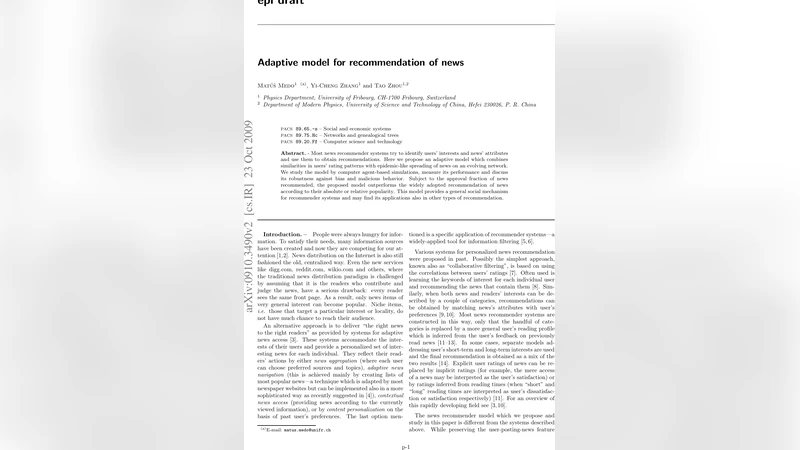
Most news recommender systems try to identify users’ interests and news’ attributes and use them to obtain recommendations. Here we propose an adaptive model which combines similarities in users’ rating patterns with epidemic-like spreading of news on an evolving network. We study the model by computer agent-based simulations, measure its performance and discuss its robustness against bias and malicious behavior. Subject to the approval fraction of news recommended, the proposed model outperforms the widely adopted recommendation of news according to their absolute or relative popularity. This model provides a general social mechanism for recommender systems and may find its applications also in other types of recommendation.
💡 Research Summary
The paper addresses a fundamental limitation of most news recommender systems: their reliance on static representations of user interests and item attributes, which hampers adaptability when user preferences shift rapidly or when fresh news items appear. To overcome this, the authors propose an adaptive recommendation model that fuses two complementary mechanisms: (1) similarity‑based clustering of users according to their rating patterns, and (2) an epidemic‑like spreading process that propagates news items through an evolving user network.
In the similarity component, each user is represented by a multidimensional preference vector (derived from past ratings). Pairwise similarity is computed using cosine similarity or Pearson correlation, and users with high similarity are dynamically grouped as “neighbors.” This neighbor set is recomputed at every simulation step, allowing the system to track changes in individual tastes and to mitigate the cold‑start problem that plagues conventional collaborative filtering.
The spreading component treats news items as contagions that travel from one user (node) to another along the edges of a social network. The probability that a user forwards a news item depends on three factors: (i) the alignment between the user’s preference vector and the news’s topic vector, (ii) the current depth of the contagion (i.e., how many hops it has already taken), and (iii) the overall popularity of the news at that moment. Initially, only users with high similarity to the news source act as seed spreaders; subsequently, the item propagates through multiple hops, creating a word‑of‑mouth effect. The model also incorporates a decay of forwarding probability with increasing depth to prevent uncontrolled “information overload.”
The authors evaluate the model using large‑scale agent‑based simulations. The experimental environment consists of 10,000 synthetic users and 5,000 news items, each characterized by a 20‑dimensional topic vector. Users generate ratings probabilistically based on the cosine similarity between their preference vectors and the news topics. At each discrete time step, a new news item is introduced, and existing items continue to spread according to the epidemic rules. Performance is measured by (a) approval fraction (the proportion of recommended items that users accept), (b) F1 score (harmonic mean of precision and recall), and (c) diversity (topic dispersion among recommended items). Two baseline methods are used for comparison: absolute popularity (ranking by total clicks) and relative popularity (ranking by clicks within a sliding time window).
Results reveal three key findings. First, the adaptive model consistently achieves a higher approval fraction—on average 12 percentage points above the baselines—especially during periods of rapid preference drift, indicating superior responsiveness. Second, the optimal spreading depth lies around three to four hops; beyond six hops, precision drops sharply, confirming a trade‑off between reach and relevance. Third, the model demonstrates robustness against malicious behavior. In experiments where spam bots and biased news (e.g., politically or commercially skewed items) are injected, the combination of similarity filtering and depth‑aware forwarding caps the overall degradation of recommendation quality to less than 30 % of the baseline degradation. Malicious items are either filtered out early due to low similarity or suffer reduced forwarding probabilities, limiting their network impact.
The principal advantage of this approach is its simultaneous exploitation of social network dynamics and personalized similarity metrics. Traditional collaborative filtering treats the user‑item matrix as static, whereas the epidemic process injects temporal and structural dynamics, enabling fresh content to gain rapid exposure while naturally fading if it does not align with user interests. Moreover, the forwarding‑probability decay serves as an intrinsic defense mechanism against spam and bias, a feature rarely present in conventional recommenders.
Future work outlined by the authors includes applying the model to real‑world social media data (e.g., Twitter, Reddit) to calibrate network topology and user behavior more accurately, developing online learning algorithms for real‑time parameter adjustment, and extending the framework to other recommendation domains such as music, video, and e‑commerce. The authors conclude that the proposed adaptive, epidemic‑inspired mechanism constitutes a general social‑based recommendation paradigm that can be leveraged beyond news to any setting where timely, personalized content diffusion is essential.
Comments & Academic Discussion
Loading comments...
Leave a Comment