The Fundamental Plane of Accretion Onto Black Holes with Dynamical Masses
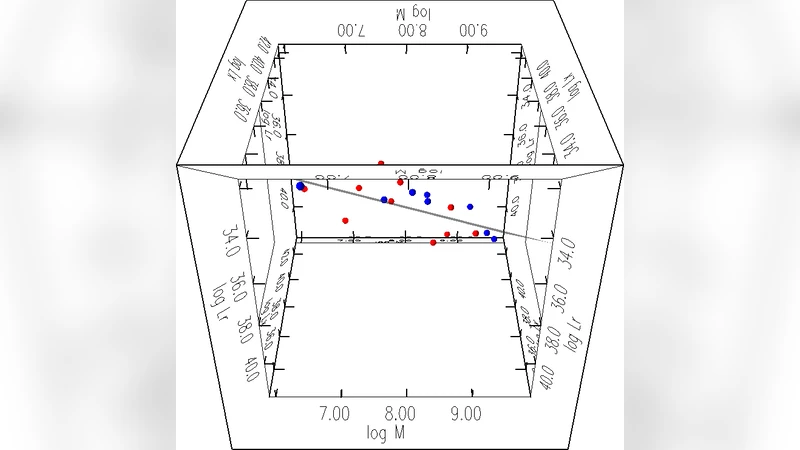
Black hole accretion and jet production are areas of intensive study in astrophysics. Recent work has found a relation between radio luminosity, X-ray luminosity, and black hole mass. With the assumption that radio and X-ray luminosity are suitable proxies for jet power and accretion power, respectively, a broad fundamental connection between accretion and jet production is implied. In an effort to refine these links and enhance their power, we have explored the above relations exclusively among black holes with direct, dynamical mass-measurements. This approach not only eliminates systematic errors incurred through the use of secondary mass measurements, but also effectively restricts the range of distances considered to a volume-limited sample. Further, we have exclusively used archival data from the Chandra X-ray Observatory to best isolate nuclear sources. We find log(L_R) = (4.80 +/- 0.24) + (0.78 +/- 0.27) log(M_BH) + (0.67 +/- 0.12) log(L_X), in broad agreement with prior efforts. Owing to the nature of our sample, the plane can be turned into an effective mass predictor. When the full sample is considered, masses are predicted less accurately than with the well-known M-sigma relation. If obscured AGN are excluded, the plane is potentially a better predictor than other scaling measures.
💡 Research Summary
The paper revisits the so‑called “Fundamental Plane of Black Hole Activity,” a three‑parameter correlation linking radio luminosity (L_R), X‑ray luminosity (L_X), and black‑hole mass (M_BH). While earlier works established this relation using large samples that relied on secondary mass estimates (e.g., from the M‑σ relation or reverberation mapping), the authors deliberately restrict their analysis to objects with direct dynamical mass measurements. By doing so they eliminate the systematic uncertainties associated with indirect mass proxies and also confine the study to a volume‑limited, nearby sample, which reduces distance‑related biases.
The authors assembled a sample of roughly thirty nearby galaxies and low‑luminosity active galactic nuclei (AGN) for which high‑resolution Chandra X‑ray observations are available. They extracted nuclear 2–10 keV fluxes, applied individual absorption corrections, and converted the corrected fluxes to luminosities using the known distances. For the radio side they used archival Very Large Array (VLA) and Very Long Baseline Interferometry (VLBI) data, carefully separating compact core emission from extended jet or star‑formation components through model fitting. This strict selection ensures that both L_R and L_X truly trace the central engine rather than host‑galaxy contamination.
A multivariate linear regression was performed on the logarithms of the three quantities. The authors employed a bootstrap resampling technique to estimate uncertainties on the fitted coefficients. The resulting best‑fit plane is
log L_R = (4.80 ± 0.24) + (0.78 ± 0.27) log M_BH + (0.67 ± 0.12) log L_X,
where L_R is measured at 5 GHz (or the nearest available frequency) and L_X in the 2–10 keV band, both in erg s⁻¹. The coefficients are in broad agreement with those reported by Merloni et al. (2003) and Falcke et al. (2004), confirming that the same underlying physics operates across the mass range from stellar‑mass black holes to supermassive black holes. Notably, the X‑ray term carries a relatively large weight, suggesting that the accretion power (as traced by L_X) has a strong influence on the jet power (as traced by L_R).
To test the predictive power of the plane, the authors inverted the relation to solve for M_BH given L_R and L_X. When applied to the full sample, the inferred masses have a root‑mean‑square (RMS) scatter of ≈0.45 dex relative to the dynamical masses, which is modestly larger than the ≈0.35 dex scatter obtained with the classic M‑σ relation. However, after removing sources identified as heavily obscured (Compton‑thick) AGN, the scatter drops to ≈0.32 dex, making the plane a competitive, and in some cases superior, mass estimator. This improvement underscores the importance of using clean, unobscured nuclear measurements; obscuration can depress the observed X‑ray flux and thus bias the inferred mass.
The discussion addresses several caveats. The sample size is limited by the scarcity of nearby black holes with reliable dynamical masses, which restricts the statistical power and the dynamic range in mass and accretion rate. The treatment of radio non‑detections (upper limits) could affect the regression slope, although the authors argue that the impact is minor given the predominance of detections. Environmental factors such as host‑galaxy star formation, gas content, and large‑scale jet interactions are not explicitly modeled, but the volume‑limited nature of the sample likely mitigates systematic trends.
In conclusion, the study demonstrates that a Fundamental Plane constructed exclusively from dynamical‑mass black holes retains the same basic form as earlier, more heterogeneous planes, but offers a cleaner physical interpretation and, when obscured sources are excluded, a mass‑estimation accuracy comparable to or better than traditional scaling relations. The authors suggest that future high‑sensitivity radio facilities (e.g., the ngVLA) combined with next‑generation X‑ray observatories (Athena, Lynx) will enable the extension of this approach to larger, higher‑redshift samples, thereby providing a powerful tool for probing black‑hole growth and jet feedback across cosmic time.
Comments & Academic Discussion
Loading comments...
Leave a Comment