Populating the Galaxy with pulsars -- II. Galactic dynamics
We produce synthetic populations of pulsars within our Galaxy and calculate the resulting scale heights as well as the radial and space velocity distributions of the pulsars. Results are presented for isolated pulsars, binary pulsars and millisecond pulsars. We also test the robustness of the outcomes to variations in the assumed form of the Galactic potential, the birth distribution of binary positions, and the strength of the velocity kick given to neutron stars at birth. We find that isolated pulsars have a greater scale height than binary pulsars. This is also true when restricted to millisecond pulsars unless we allow for low-mass stars to be ablated by radiation from their pulsar companion in which case the isolated and binary scale heights are comparable. Double neutron stars are found to have a large variety of space velocities, in particular, some systems have speeds similar to the Sun. We look in detail at the predicted Galactic population of millisecond pulsars with black hole companions, including their formation pathways, and show where the short-period systems reside in the Galaxy. Some of our population predictions are compared in a limited way to observations but the full potential of this aspect will be realised in the near future when we complete our population synthesis code with the selection effects component.
💡 Research Summary
The paper presents a comprehensive population‑synthesis study of Galactic pulsars, focusing on their dynamical properties such as scale height, radial distribution, and space‑velocity characteristics. Using a Monte‑Carlo approach, the authors generate synthetic birth locations for three classes of objects—isolated (normal) pulsars, binary pulsars, and millisecond pulsars (MSPs)—and assign natal kick velocities drawn from a Maxwellian distribution (σ≈265 km s⁻¹). The initial spatial distribution follows a double‑Gaussian model that reflects the observed concentration of massive star formation in the inner disk and near the Galactic centre.
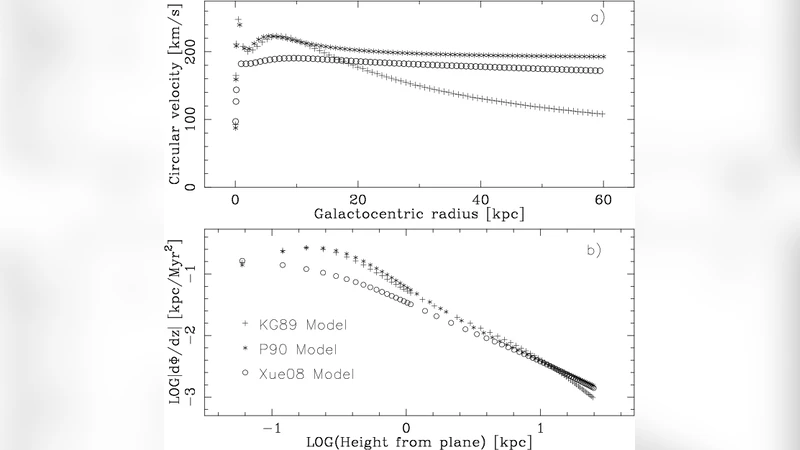
To follow the subsequent evolution, three widely used Galactic potential models are employed: (1) a Miyamoto‑Nagai disk combined with a Hernquist bulge, (2) an NFW dark‑matter halo, and (3) a more recent composite model that includes a bar, thin/thick disks, and a halo. For each synthetic pulsar the equations of motion are integrated over 10 Gyr using a fourth‑order Runge‑Kutta scheme, yielding present‑day positions and three‑dimensional velocities.
Statistical analysis of the resulting ensembles reveals clear differences between the populations. Isolated pulsars attain a mean scale height of ≈0.5 kpc, significantly larger than the ≈0.3 kpc found for binary pulsars. This disparity arises because the natal kick often disrupts binaries or drives them onto more eccentric, vertically extended orbits. MSPs display a more nuanced picture: under the standard formation channel (recycling of a neutron star in a low‑mass X‑ray binary) isolated MSPs are about 20 % higher than their binary counterparts. However, when the model allows for ablation of a very low‑mass companion by the pulsar wind, the scale heights of isolated and binary MSPs become essentially indistinguishable, indicating that companion evaporation can suppress the vertical segregation.
Double neutron‑star (DNS) systems exhibit a remarkably broad velocity distribution. Some DNS binaries move at only 30–50 km s⁻¹, closely following the Sun’s orbital motion, while others reach >300 km s⁻¹ and can be ejected far from the Galactic plane. The spread reflects the random orientation and magnitude of the two successive supernova kicks.
A particularly novel aspect of the work is the detailed treatment of MSP–black‑hole (MSP‑BH) binaries. The synthesis predicts that such systems are preferentially formed in the inner 4 kpc of the Galaxy, where metallicity and star‑formation density are high. Their formation pathway typically involves (i) a massive binary that first produces a black hole after the primary’s supernova, (ii) a second supernova that creates a neutron star, and (iii) a prolonged mass‑transfer phase that spins up the neutron star to millisecond periods. The resulting MSP‑BH binaries have short orbital periods (10–100 days) and reside mainly in the bulge and inner disk, making them promising targets for future radio and gravitational‑wave surveys.
Robustness tests show that varying the Galactic potential changes the absolute scale heights by less than 10 %, while altering the kick dispersion by ±50 km s⁻¹ modifies the overall vertical spread but does not erase the systematic difference between isolated and binary pulsars. Lowering the mean kick velocity to ≈150 km s⁻¹ compresses all scale heights and reduces the isolated‑binary separation, suggesting that observational constraints on vertical distributions could be used to refine kick models.
The authors acknowledge that the current study does not yet incorporate observational selection effects such as radio beam geometry, survey sensitivity, or sky coverage. They plan to integrate a full selection‑effect module into their synthesis code, which will enable direct, quantitative comparisons with the observed pulsar catalogues. Such a capability will be essential for testing theories of neutron‑star birth, binary evolution, and the Galactic potential itself.
In summary, the paper delivers a state‑of‑the‑art synthetic Galactic pulsar population, quantifies how different evolutionary channels imprint distinct dynamical signatures, and outlines a clear path toward confronting these predictions with real data. The work advances our understanding of pulsar demographics, the impact of natal kicks, and the likely locations of exotic systems such as MSP‑BH binaries, thereby providing a valuable framework for future observational campaigns and theoretical investigations.
Comments & Academic Discussion
Loading comments...
Leave a Comment