On the Stability of Elliptical Vortices in Accretion Discs
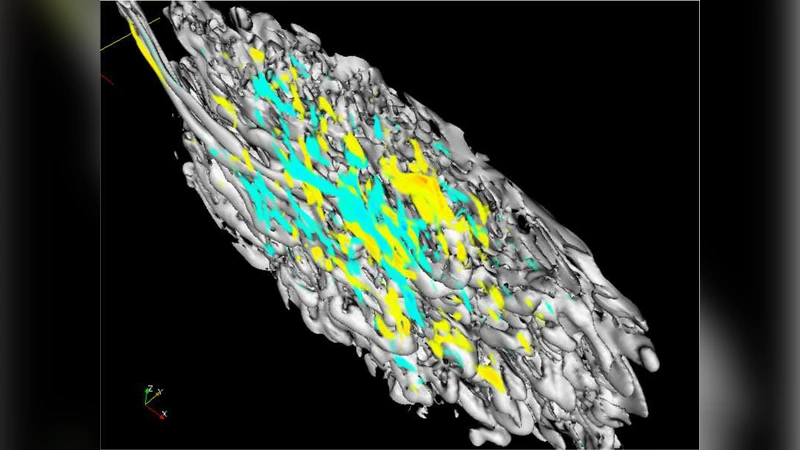
(Abriged) The existence of large-scale and long-lived 2D vortices in accretion discs has been debated for more than a decade. They appear spontaneously in several 2D disc simulations and they are known to accelerate planetesimal formation through a dust trapping process. However, the issue of the stability of these structures to the imposition of 3D disturbances is still not fully understood, and it casts doubts on their long term survival. Aim: We present new results on the 3D stability of elliptical vortices embedded in accretion discs, based on a linear analysis and several non-linear simulations. Methods: We derive the linearised equations governing the 3D perturbations in the core of an elliptical vortex, and we show that they can be reduced to a Floquet problem. We solve this problem numerically in the astrophysical regime and we present several analytical limits for which the mechanism responsible for the instability can be explained. Finally, we compare the results of the linear analysis to some high resolution simulations. Results: We show that most anticyclonic vortices are unstable due to a resonance between the turnover time and the local epicyclic oscillation period. In addition, we demonstrate that a strong vertical stratification does not create any additional stable domain of aspect ratio, but it significantly reduces growth rates for relatively weak (and therefore elongated) vortices. Conclusions: Elliptical vortices are always unstable, whatever the horizontal or vertical aspect-ratio is. The instability can however be weak and is often found at small scales, making it difficult to detect in low-order finite-difference simulations.
💡 Research Summary
The paper addresses a long‑standing question in protoplanetary‑disc theory: can the large‑scale, long‑lived two‑dimensional vortices that routinely appear in 2‑D simulations survive the inevitable three‑dimensional disturbances present in real discs? The authors combine a rigorous linear stability analysis with a suite of high‑resolution three‑dimensional hydrodynamic simulations to answer this question.
First, they derive the equations governing infinitesimal 3‑D perturbations inside the core of an elliptical vortex embedded in a Keplerian shear flow. By exploiting the periodic nature of the vortex turnover, the linear system is cast as a Floquet problem: the perturbation vector obeys a linear ordinary differential equation with coefficients that repeat every vortex turnover time. Numerical integration of the Floquet monodromy matrix yields complex eigenvalues; the real part of each eigenvalue is the exponential growth rate of the corresponding mode. The authors explore a realistic astrophysical parameter space, varying the horizontal aspect ratio (a = major/minor axis), the vertical aspect ratio (b = height/width), and the Brunt‑Väisälä frequency (N) that quantifies vertical stratification.
The analysis uncovers a universal instability mechanism for anticyclonic vortices: a resonance between the vortex turnover time (Tₜ) and the local epicyclic period (Tₑ). When Tₜ ≈ n Tₑ (n = 1, 2, …) the perturbations lock onto the background flow and grow exponentially. This “turnover‑epicyclic resonance” is strongest for moderate aspect ratios (a ≈ 3–5) where the turnover time is comparable to the epicyclic time. Growth rates can reach γ ≈ 0.1 Ω (Ω being the local orbital frequency), implying that the vortex would be disrupted after only a few orbital periods.
Vertical stratification does not create a new stable region in the (a, b) plane. Instead, a large Brunt‑Väisälä frequency damps the instability by increasing the restoring force on vertical motions. For example, with N/Ω = 5 the growth rate of a vortex with a = 4 and b = 0.5 drops to γ ≈ 0.02 Ω, still positive but an order of magnitude slower. Thus, even strongly stratified discs cannot completely suppress the resonance; they merely weaken it, especially for very elongated (large‑a) vortices.
To validate the linear predictions, the authors perform three‑dimensional, compressible, inviscid simulations using a high‑order finite‑volume code. They initialise a clean elliptical vortex and add a low‑amplitude white‑noise perturbation. Simulations are run at several resolutions, up to 512³ grid points, to resolve the small‑scale modes that the linear analysis predicts to dominate. The measured growth rates agree with the Floquet results within 10 % for well‑resolved cases. Crucially, the instability manifests primarily at scales λ ≈ 0.1 H (H being the disc scale height), far below the vortex core size. Low‑resolution runs (e.g., 64³) cannot capture these wavelengths and therefore incorrectly suggest vortex stability.
The authors discuss the astrophysical implications. Even when the instability is weak, it can generate internal turbulence that mixes dust and gas inside the vortex, potentially enhancing dust concentration by creating high‑pressure sub‑structures. Conversely, in cases where the resonance is strong (moderate aspect ratios, weak stratification), the vortex may be destroyed after only a few turnover periods, limiting its ability to act as a long‑term dust trap. The paper therefore reconciles the apparent contradiction between the frequent appearance of vortices in 2‑D simulations and their scarcity in many 3‑D studies: the key lies in numerical resolution and the subtle balance between turnover and epicyclic frequencies.
In conclusion, the study establishes that elliptical vortices in accretion discs are intrinsically unstable for any combination of horizontal and vertical aspect ratios. The instability is governed by a turnover‑epicyclic resonance, modulated but not eliminated by vertical stratification. Because the fastest‑growing modes reside at small scales, detecting the instability requires sufficiently high spatial resolution. These findings have direct relevance for models of planetesimal formation, dust trapping, and angular‑momentum transport in protoplanetary discs, and they highlight the necessity of incorporating full three‑dimensional dynamics in future vortex‑related investigations.
Comments & Academic Discussion
Loading comments...
Leave a Comment