Evidence for an Edge-On Disk around the Young Star MWC 778 from Infrared Imaging and Polarimetry
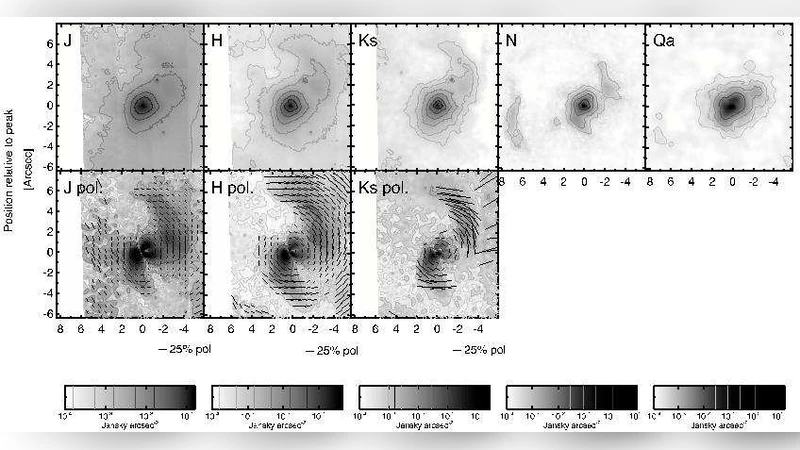
MWC 778 is an unusual and little-studied young stellar object located in the IC 2144 nebula. Recent spectroscopy by Herbig and Vacca (2008) suggested the presence of an edge-on circumstellar disk around it. We present near-infrared adaptive optics imaging polarimetry and mid-infrared imaging which directly confirm the suspected nearly-edge-on disk around MWC 778 (i ~ 70-80 degrees) plus reveal a more extensive envelope pierced by bipolar outflow cavities. In addition, our mid-infrared images and near-infrared polarization maps detect a spiral-shaped structure surrounding MWC 778, with arms that extend beyond 6" on either side of the star. Although MWC 778 has previously been classified as an Herbig Ae/Be star, the properties of its central source (including its spectral type) remain fairly uncertain. Herbig & Vacca (2008) suggested an F or G spectral type based on the presence of metallic absorption lines in the optical spectrum, which implies that MWC 778 may belong to the fairly rare class of Intermediate-Mass T Tauri Stars (IMTTSs) which are the evolutionary precursors to Herbig Ae/Be objects. Yet its integrated bolometric luminosity, > 750 L_sun (for an assumed distance of 1 kpc) is surprisingly high for an F or G spectral type, even for an IMTTS. We speculate on several possible explanations for this discrepancy, including its true distance being much closer than 1 kpc, the presence of a binary companion, and/or a non-stellar origin for the observed absorption lines.
💡 Research Summary
This paper presents a comprehensive observational study of the young stellar object MWC 778, located in the IC 2144 nebula, using near‑infrared adaptive‑optics (AO) imaging polarimetry and mid‑infrared (mid‑IR) imaging. Earlier optical spectroscopy (Herbig & Vacca 2008) hinted at an edge‑on circumstellar disk and suggested a spectral type of F or G based on metallic absorption lines, raising the possibility that MWC 778 belongs to the rare class of Intermediate‑Mass T Tauri Stars (IMTTS), precursors to Herbig Ae/Be objects. However, the direct detection of the disk geometry and the surrounding envelope had not been achieved.
The authors obtained high‑resolution H‑band (1.6 µm) and K‑band (2.2 µm) polarimetric images with an 8‑meter class telescope equipped with AO. The polarization maps reveal a classic centrosymmetric pattern indicative of scattering off a flattened structure. Two low‑polarization lobes perpendicular to the bright polarized band trace bipolar outflow cavities, confirming the presence of an almost edge‑on disk with an inclination of roughly 70–80°. Radiative‑transfer modeling of the polarized intensity and the disk’s surface brightness profile supports this inclination estimate and constrains the disk’s vertical thickness and optical depth.
Mid‑IR images at 10–20 µm further expose the disk’s thermal emission and a more extended circumstellar envelope. Most strikingly, both the near‑IR polarization maps and the mid‑IR images reveal a large‑scale spiral‑shaped structure that wraps around the star on both sides, extending beyond 6 arcseconds (≈6 × 10³ AU assuming a distance of 1 kpc). The spiral arms exhibit higher scattering efficiency and distinct color gradients, suggesting they are composed of relatively small dust grains illuminated by the central source. The authors discuss possible origins: density waves driven by gravitational instability in the massive disk, tidal perturbations from an unseen companion, or remnants of the parental molecular cloud being shaped by the outflow cavities.
A central puzzle addressed in the paper is the apparent mismatch between the inferred spectral type (F/G) and the bolometric luminosity (>750 L⊙ for an assumed distance of 1 kpc). Such a luminosity is far higher than expected for a main‑sequence F or G star, even for an IMTTS. The authors explore three main explanations. First, the distance could be overestimated; a true distance of 400–600 pc would reduce the luminosity to a few hundred solar units, more compatible with an F/G pre‑main‑sequence star. Second, MWC 778 may be a binary or higher‑order multiple system, with the combined light of two (or more) intermediate‑mass stars inflating the observed luminosity. Third, the metallic absorption lines used to assign the spectral type might arise not from the stellar photosphere but from cool gas in the disk or envelope, leading to a misclassification. Each scenario has distinct observational signatures that can be tested with future high‑resolution spectroscopy, interferometry, and precise parallax measurements (e.g., Gaia).
In summary, the study provides the first direct imaging confirmation of an almost edge‑on disk around MWC 778, delineates its bipolar cavities, and uncovers a remarkable large‑scale spiral structure. These findings place MWC 778 as a key laboratory for studying the transition from IMTTS to Herbig Ae/Be stars, the dynamics of massive circumstellar disks, and the interaction between disks, outflows, and surrounding material. The paper also highlights the need for further multi‑wavelength observations to resolve the distance ambiguity, assess binarity, and clarify the true nature of the absorption features, thereby refining our understanding of this intriguing young stellar system.
Comments & Academic Discussion
Loading comments...
Leave a Comment