Magnetic fields, stellar feedback, and the geometry of H II Regions
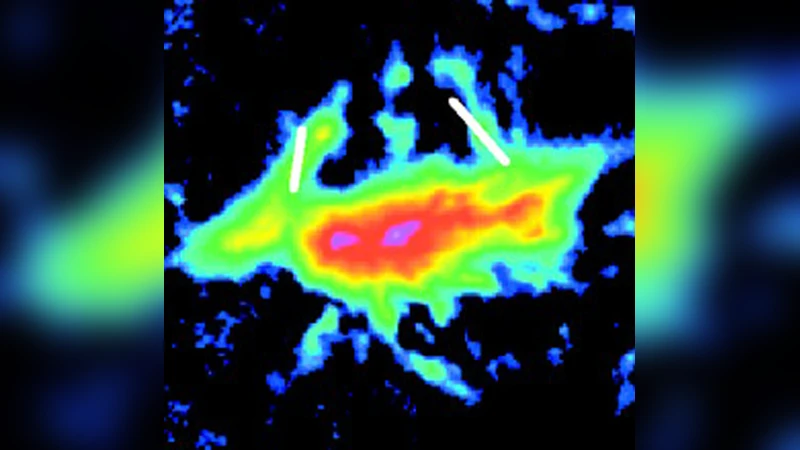
Magnetic pressure has long been known to dominate over gas pressure in atomic and molecular regions of the interstellar medium. Here I review several recent observational studies of the relationships between the H^+, H^0 and H_2 regions in M42 (the Orion complex) and M17. A simple picture results. When stars form they push back surrounding material, mainly through the outward momentum of starlight acting on grains, and field lines are dragged with the gas due to flux freezing. The magnetic field is compressed and the magnetic pressure increases until it is able to resist further expansion and the system comes into approximate magnetostatic equilibrium. Magnetic field lines can be preferentially aligned perpendicular to the long axis of quiescent cloud before stars form. After star formation and pushback occurs ionized gas will be constrained to flow along field lines and escape from the system along directions perpendicular to the long axis. The magnetic field may play other roles in the physics of the H II region and associated PDR. Cosmic rays may be enhanced along with the field and provide additional heating of atomic and molecular material. Wave motions may be associated with the field and contribute a component of turbulence to observed line profiles.
💡 Research Summary
The paper presents a synthesis of recent observational studies of the Orion Nebula (M42) and the massive star‑forming region M17, focusing on the interplay between magnetic fields, stellar feedback, and the geometry of H II regions. It begins by recalling that in atomic and molecular phases of the interstellar medium magnetic pressure typically exceeds thermal gas pressure. When massive stars form, their intense radiation field exerts outward momentum on dust grains; because the interstellar plasma is well coupled to the magnetic field (flux freezing), the gas drags the field lines with it. This process compresses the magnetic field, raising the magnetic field strength to several hundred microgauss in both M42 and M17. The resulting magnetic pressure, P_B = B²/8π, quickly becomes dominant over thermal and ram pressures, halting further expansion of the ionized bubble. The system therefore approaches a magnetostatic equilibrium in which magnetic forces balance the outward push from stellar radiation.
A key observational result is that the pre‑star‑formation magnetic field is often oriented perpendicular to the long axis of the parental molecular cloud. After star formation, the compressed field retains this orientation, and the ionized gas is forced to flow along the field lines. Consequently, ionized material preferentially escapes in directions perpendicular to the cloud’s long axis, while expansion along the axis is constrained, producing the observed elongated, “plume‑like” morphology of the H II region.
The paper also discusses secondary effects of the enhanced magnetic field. Cosmic‑ray (CR) particles become concentrated along the amplified field lines, raising the local CR energy density. Low‑energy CRs provide an additional heating source for the adjacent photodissociation region (PDR) and molecular gas, helping to maintain temperatures above those expected from UV heating alone. Moreover, magnetohydrodynamic (MHD) waves, such as Alfvén waves, are expected to be excited in the compressed field. These waves contribute a non‑thermal component to the observed line widths in both optical recombination lines and molecular tracers, offering a natural explanation for the excess turbulence inferred from spectroscopy.
Overall, the authors propose a simple yet powerful picture: stellar radiation compresses the magnetic field, the field resists further expansion, and the resulting magnetostatic configuration dictates the flow geometry of ionized gas, the heating balance of the surrounding neutral material, and the turbulent motions observed in line profiles. This framework unifies magnetic pressure, radiation pressure, cosmic‑ray heating, and MHD turbulence as co‑dependent agents shaping the structure and evolution of H II regions. The paper calls for high‑resolution polarimetric mapping, Zeeman measurements, and coupled CR‑MHD simulations to test and refine this paradigm.
Comments & Academic Discussion
Loading comments...
Leave a Comment