What is Driving the HI Velocity Dispersion?
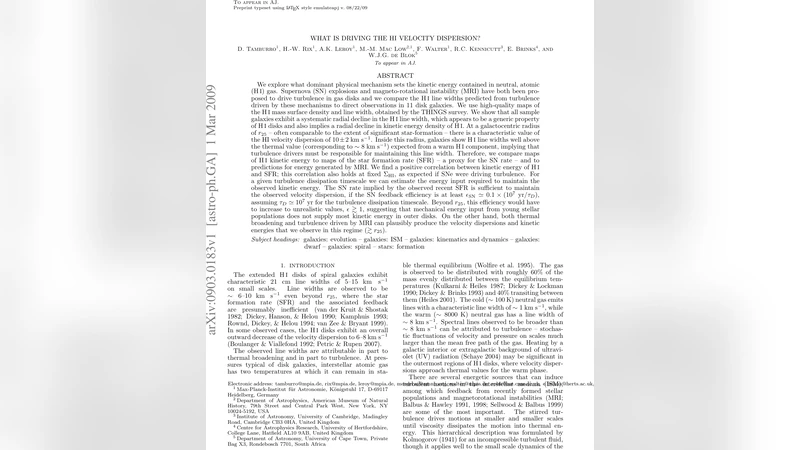
We explore what dominant physical mechanism sets the kinetic energy contained in neutral, atomic (HI) gas. We compare the HI line widths predicted from turbulence driven by supernova (SN) explosions and magneto-rotational instability (MRI) to direct observations in 11 disk galaxies. We use high-quality maps of the HI mass surface density and line width, obtained by the THINGS survey. We show that all sample galaxies exhibit a systematic radial decline in the HI line width, which appears to be a generic property of HI disks and also implies a radial decline in kinetic energy density of HI. At a galactocentric radius of r25 there is a characteristic value of the HI velocity dispersion of $10\pm2$ \kms. Inside this radius, galaxies show HI line widths above the thermal value expected from a warm HI component, implying that turbulence drivers must be responsible for maintaining this line width. Therefore, we compare maps of HI kinetic energy to maps of the star formation rate (SFR) and to predictions for energy generated by MRI. We find a positive correlation between kinetic energy of HI and SFR. For a given turbulence dissipation timescale we can estimate the energy input required to maintain the observed kinetic energy. The SN rate implied by the observed recent SFR is sufficient to maintain the observed velocity dispersion, if the SN feedback efficiency is at least \epsilon_SN\simeq0.1. Beyond r25, this efficiency would have to increase to unrealistic values, $\epsilon>1$, suggesting that mechanical energy from young stars does not supply most energy in outer disks. On the other hand, both thermal broadening and turbulence driven by MRI can produce the velocity dispersions and kinetic energies that we observe in this regime.
💡 Research Summary
The authors investigate which physical processes dominate the kinetic energy budget of neutral atomic (HI) gas in galaxy disks. Using high‑resolution HI surface‑density and line‑width maps from the THINGS survey for a sample of eleven nearby spiral galaxies, they first demonstrate that the HI velocity dispersion (σ_HI) declines systematically with galactocentric radius in every galaxy. At the optical radius r_25 the dispersion converges to a characteristic value of 10 ± 2 km s⁻¹. Inside r_25 the measured dispersions exceed the thermal width expected for warm neutral medium (≈6 km s⁻¹), indicating that non‑thermal turbulence must be maintained.
To identify the turbulence driver, the authors compare the spatial distribution of HI kinetic energy density (E_kin = ½ Σ_HI σ_HI²) with two candidate energy sources: (1) supernova (SN) feedback associated with recent star formation, and (2) magneto‑rotational instability (MRI) driven by differential rotation and magnetic fields. For the SN channel they convert the observed star‑formation rate surface density (Σ_SFR) into a SN rate using a standard IMF (η_SN ≈ 0.01 SN M_⊙⁻¹ yr⁻¹). Assuming each SN injects 10⁵¹ erg and that a fraction ε_SN of that energy feeds turbulent motions, the energy injection rate per unit area is Γ_SN = ε_SN η_SN Σ_SFR 10⁵¹ erg yr⁻¹ kpc⁻². With a typical turbulent dissipation timescale τ_diss ≈ 10 Myr, the required ε_SN to balance the observed E_kin is ≈0.1 in the inner disks. This efficiency is physically plausible and shows a strong positive correlation (Pearson r ≈ 0.7) between E_kin and Σ_SFR inside r_25.
Beyond r_25 the Σ_SFR drops sharply, yet σ_HI remains at 6–8 km s⁻¹, close to the thermal width of warm HI. Maintaining the observed kinetic energy with SN feedback alone would demand ε_SN > 1, an unphysical value, implying that young‑star mechanical energy cannot dominate in the outer parts.
The authors therefore evaluate MRI as an alternative driver. The MRI energy generation rate per unit area can be expressed as Γ_MRI = ε_MRI (B²/8π) Ω q, where B is the magnetic field strength (assumed ≈5 µG), Ω the angular rotation rate (≈30 km s⁻¹ kpc⁻¹), q the shear parameter, and ε_MRI a modest efficiency (0.1–0.3). For these typical parameters, Γ_MRI × τ_diss yields kinetic energy densities comparable to the observed values in the outer disks. Moreover, the thermal broadening of a warm (T ≈ 8000 K) HI component alone can account for σ ≈ 6 km s⁻¹, suggesting that a combination of thermal pressure and MRI‑driven turbulence can sustain the observed line widths where star formation is negligible.
In summary, the paper presents a coherent picture in which HI velocity dispersion is regulated by different mechanisms at different radii. Inside the optical radius, supernova feedback with an efficiency of about ten percent supplies sufficient energy to balance turbulent dissipation, producing the observed supra‑thermal dispersions. Outside the optical radius, the decline of star formation forces the system to rely on magnetic‑rotational stresses and the intrinsic thermal motions of warm HI. This radial transition appears to be a generic property of disk galaxies and provides an important constraint for models of galactic interstellar‑medium dynamics and evolution.
Comments & Academic Discussion
Loading comments...
Leave a Comment