Can the Known Millisecond Pulsars Help in the Detection of Intermediate-Mass Black Holes at the Centers of Globular Clusters?
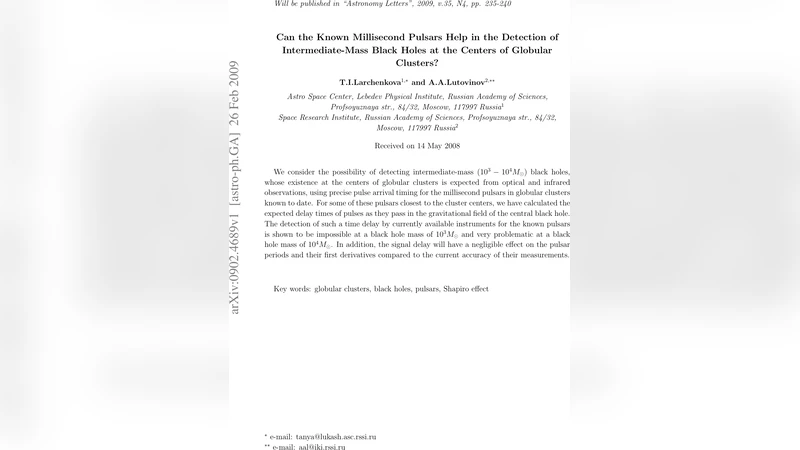
We consider the possibility of detecting intermediate-mass ($10^3-10^4 M_{\odot}$) black holes, whose existence at the centers of globular clusters is expected from optical and infrared observations, using precise pulse arrival timing for the millisecond pulsars in globular clusters known to date. For some of these pulsars closest to the cluster centers, we have calculated the expected delay times of pulses as they pass in the gravitational field of the central black hole. The detection of such a time delay by currently available instruments for the known pulsars is shown to be impossible at a black hole mass of $10^3 M_{\odot}$ and very problematic at a black hole mass of $10^4 M_{\odot}$. In addition, the signal delay will have a negligible effect on the pulsar periods and their first derivatives compared to the current accuracy of their measurements.
💡 Research Summary
The paper investigates whether intermediate‑mass black holes (IMBHs) with masses of 10³–10⁴ M☉, which are suggested by optical and infrared studies to reside at the centers of globular clusters, can be detected through precise timing of the millisecond pulsars (MSPs) already known in those clusters. The authors first summarize the indirect evidence for IMBHs in globular clusters—such as anomalous stellar velocity dispersions and surface‑brightness profiles—and argue that a dynamical probe independent of photometric modeling would be valuable. MSPs are ideal candidates because their pulse arrival times (TOAs) can be measured with microsecond‑level precision, making them sensitive to the Shapiro delay caused by a massive compact object along the line of sight.
A sample of the most centrally located MSPs in several well‑studied clusters (e.g., 47 Tuc, M15, NGC 6752) is selected. For each pulsar the projected distance from the cluster centre (impact parameter b), the distance to Earth, and the existing timing precision are compiled. Using the standard general‑relativistic expression for the Shapiro delay, \
Comments & Academic Discussion
Loading comments...
Leave a Comment