The Active Centaurs
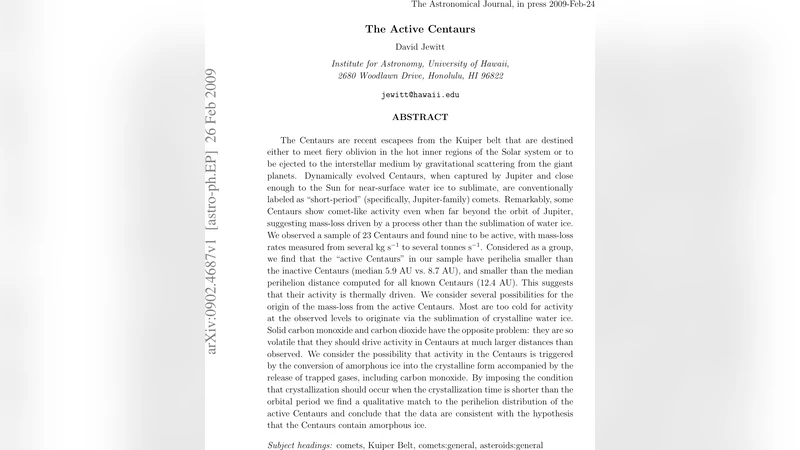
The Centaurs are recent escapees from the Kuiper belt that are destined either to meet fiery oblivion in the hot inner regions of the Solar system or to be ejected to the interstellar medium by gravitational scattering from the giant planets. Dynamically evolved Centaurs, when captured by Jupiter and close enough to the Sun for near-surface water ice to sublimate, are conventionally labeled as “short-period” (specifically, Jupiter-family) comets. Remarkably, some Centaurs show comet-like activity even when far beyond the orbit of Jupiter, suggesting mass-loss driven by a process other than the sublimation of water ice. We observed a sample of 23 Centaurs and found nine to be active, with mass-loss rates measured from several kg/s to several tonnes/s. Considered as a group, we find that the “active Centaurs” in our sample have perihelia smaller than the inactive Centaurs (median 5.9 AU vs. 8.7 AU), and smaller than the median perihelion distance computed for all known Centaurs (12.4 AU). This suggests that their activity is thermally driven. There are several possibilities for the origin of the mass-loss from the active Centaurs. We consider the possibility that activity in the Centaurs is triggered by the conversion of amorphous ice into the crystalline form accompanied by the release of trapped gases, including carbon monoxide. By imposing the condition that crystallization should occur when the crystallization time is shorter than the orbital period we find a qualitative match to the perihelion distribution of the active Centaurs and conclude that the data are consistent with the hypothesis that the Centaurs contain amorphous ice.
💡 Research Summary
The paper investigates the phenomenon of comet‑like activity among Centaurs—objects that have escaped the Kuiper Belt and now orbit between the giant planets. While traditional short‑period (Jupiter‑family) comets become active only when near‑surface water ice sublimates at heliocentric distances inside roughly 5 AU, several Centaurs have been observed to display comae far beyond Jupiter’s orbit, implying a different driver of mass loss. To explore this, the authors observed a sample of 23 Centaurs using optical and infrared facilities and identified nine objects that exhibited clear activity. Mass‑loss rates derived from photometry and gas production models range from a few kilograms per second up to several tonnes per second.
A statistical comparison of orbital elements shows that the active Centaurs have significantly smaller perihelion distances than the inactive ones (median 5.9 AU versus 8.7 AU) and also smaller than the median perihelion of the entire known Centaur population (≈12.4 AU). This correlation strongly suggests that the activity is thermally driven rather than being caused by random collisions or external perturbations.
Because water‑ice sublimation cannot account for the observed activity at 6–15 AU, the authors examine the role of amorphous water ice. Amorphous ice, formed at very low temperatures in the early solar nebula, can trap volatile gases such as CO, CH₄, and NH₃ within its disordered matrix. When the ice is heated, it undergoes a phase transition to crystalline ice, releasing the trapped gases in a rapid outburst. The crystallization timescale τ follows an Arrhenius‑type relation τ ≈ τ₀ exp(Eₐ/kT), where Eₐ is the activation energy. By requiring τ to be shorter than the orbital period, the authors derive a “crystallization threshold” that depends on perihelion distance. Their calculations show that for perihelion distances roughly between 5 AU and 10 AU, the crystallization time becomes comparable to or shorter than the orbital period, allowing the release of CO and other volatiles sufficient to generate the observed comae.
The model is consistent with the measured mass‑loss rates and with direct detections of CO in a subset of the active Centaurs. In contrast, Centaurs with perihelia beyond ~12 AU have crystallization times far longer than an orbital period, so they remain in the amorphous state or are insulated by a dust mantle that prevents sufficient heating of the subsurface ice. Some objects show activity only near perihelion, supporting the idea that crystallization can be a transient, “spike‑like” event triggered by a brief temperature rise.
The authors discuss the evolutionary implications: as amorphous ice crystallizes and volatiles are depleted, a Centaur will gradually lose its ability to drive activity at large distances. Eventually, when the object’s perihelion drops below ~5 AU, water‑ice sublimation becomes the dominant mechanism, and the body will resemble a typical Jupiter‑family comet. Thus, the active Centaurs observed in this study likely represent a transitional stage between distant, inert Kuiper‑belt objects and the short‑period comets that populate the inner solar system.
In summary, the paper provides (1) robust observational evidence that Centaur activity correlates with small perihelion distances, (2) a quantitative framework showing that amorphous‑ice crystallization can explain the mass‑loss rates and perihelion distribution of the active sample, and (3) a coherent evolutionary picture linking the distant Centaur population to the short‑period comet reservoir. These findings reinforce the hypothesis that many Centaurs retain primordial amorphous ice and that its thermally induced transformation is a key driver of activity well beyond the water‑ice sublimation zone.
Comments & Academic Discussion
Loading comments...
Leave a Comment