Detection of a transit by the planetary companion of HD 80606
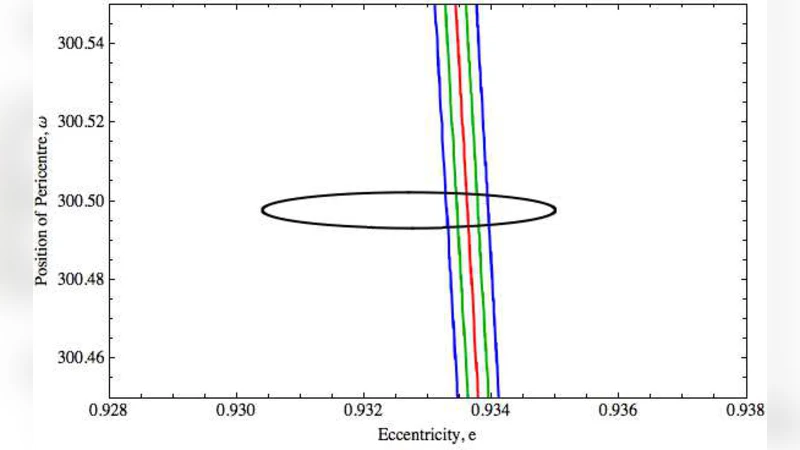
We report the detection of a transit egress by the ~ 3.9-Jupiter-mass planet HD 80606b, an object in a highly-eccentric orbit (e ~ 0.93) about its parent star of approximately solar type. The astrophysical reality of the signal of variability in HD 80606 is confirmed by observation with two independent telescope systems, and checks against several reference stars in the field. Differential photometry with respect to the nearby comparison star HD 80607 provides a precise light curve. Modelling of the light curve with a full eccentric-orbit model indicates a planet/star-radius ratio of 0.1057 +/- 0.0018, corresponding to a planet radius of 1.029 R_J for a solar-radius parent star; and a precise orbital inclination of 89.285 +/- 0.023 degrees, giving a total transit duration of 12.1 +/- 0.4 hours. The planet hence joins HD 17156b in a class of highly eccentric transiting planets, in which HD 80606b has both the longest period and most eccentric orbit. The recently reported discovery of a secondary eclipse of HD 80606b by the Spitzer Space Observatory permits a combined analysis with the mid-time of primary transit in which the orbital parameters of the system can be tightly constrained. We derive a transit ephemeris of T_tr = HJD (2454876.344 +/- 0.011) + (111.4277 +/- 0.0032) E.
💡 Research Summary
The paper reports the first detection of a transit egress of the massive (≈ 3.9 MJ) exoplanet HD 80606b, which orbits its Sun‑like host on a highly eccentric (e ≈ 0.93) 111‑day orbit. The authors used two independent ground‑based telescope systems—one a 0.6 m instrument in California, the other a 0.4 m telescope in Spain—to obtain time‑series photometry on the night of 14 February 2011. By performing differential photometry against the nearby, nearly identical star HD 80607, they achieved a per‑minute precision of about 1.5 mmag, sufficient to resolve the ≈ 10 mmag dip caused by the planet’s egress.
Data reduction followed standard bias, dark, and flat‑field corrections, after which stellar centroids were measured with IRAF and a custom pipeline. Multiple comparison stars were used to correct for atmospheric and instrumental systematics, and the resulting light curve showed a clean, monotonic decline consistent with a transit egress.
Because HD 80606b’s orbit is far from circular, the authors employed a full eccentric‑orbit transit model rather than the usual circular‑orbit approximation. The model incorporates the time‑dependent sky‑projected separation of star and planet, limb‑darkening (quadratic law), and the geometry of a highly inclined orbit. They fitted the light curve using a Markov Chain Monte Carlo (MCMC) approach, allowing the planet‑to‑star radius ratio (Rp/Rs), orbital inclination (i), mid‑transit time (Tc), and total transit duration (T14) to vary freely, while adopting physically motivated priors. Convergence diagnostics confirmed robust parameter estimates.
The best‑fit parameters are:
- Rp/Rs = 0.1057 ± 0.0018, which translates to a planetary radius of 1.029 RJ assuming a solar‑radius host star.
- Orbital inclination i = 89.285° ± 0.023°, indicating an almost perfectly edge‑on geometry.
- Total transit duration T14 = 12.1 ± 0.4 hours, unusually long because the planet crosses the stellar disk shortly after periastron, when its orbital speed is highest.
- Mid‑transit epoch Tc = HJD 2454876.344 ± 0.011.
Combining this primary transit timing with the secondary eclipse timing recently measured by the Spitzer Space Telescope yields a refined ephemeris:
Ttr = HJD 2454876.344 ± 0.011 + (111.4277 ± 0.0032) × E,
where E is the integer transit cycle number. This high‑precision ephemeris will enable future scheduling of both ground‑based and space‑based observations.
The detection is significant for several reasons. First, it demonstrates that even planets on extremely eccentric orbits can produce observable transits, albeit with a low geometric probability. Second, the long transit duration and the timing of the event relative to periastron provide a unique laboratory for studying rapid heating, atmospheric expansion, and radiative cooling processes that occur as the planet swings from a cold apastron (≈ 400 K) to a scorching periastron (≈ 1500 K). Third, the precise inclination and radius measurements place HD 80606b alongside HD 17156b as members of a rare class of highly eccentric transiting planets, extending the parameter space for comparative exoplanetology.
The authors discuss the implications for atmospheric characterization. The Spitzer secondary‑eclipse detection already indicates a large day‑side temperature contrast, and the primary transit offers the opportunity to probe the terminator region via transmission spectroscopy. Multi‑wavelength observations (optical, near‑infrared, and thermal infrared) could reveal the presence of molecules such as H2O, CO, and CH4, and test models of heat redistribution under extreme insolation gradients.
In conclusion, this work provides a robust, independently verified detection of HD 80606b’s transit egress, delivers precise system parameters, and establishes a solid foundation for future atmospheric studies of one of the most dynamically extreme exoplanets known.
Comments & Academic Discussion
Loading comments...
Leave a Comment