Main-Belt Comet P/2008 R1 (Garradd)
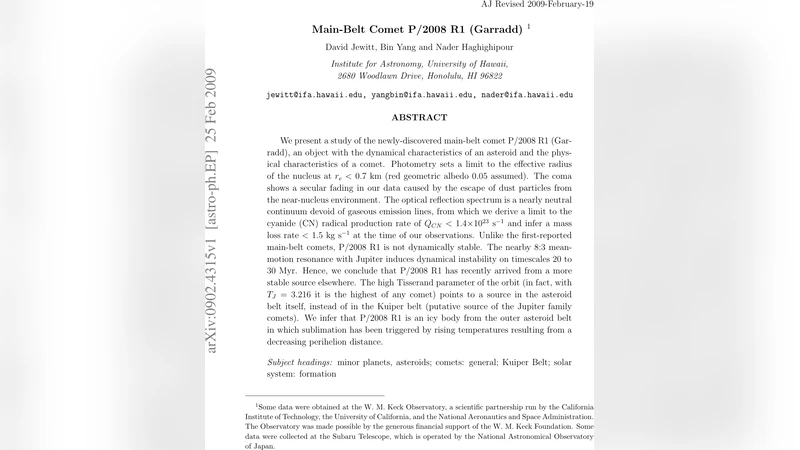
We present a study of the newly-discovered main-belt comet P/2008 R1 (Garradd), an object with the dynamical characteristics of an asteroid and the physical characteristics of a comet. Photometry sets a limit to the effective radius of the nucleus at r_e < 0.7 km (red geometric albedo 0.05 assumed). The coma shows a secular fading in our data caused by the escape of dust particles from the near-nucleus environment. The optical reflection spectrum is a nearly neutral continuum devoid of gaseous emission lines, from which we derive a limit to the cyanide (CN) radical production rate of Q_CN <1.4e23/s and infer a mass loss rate <1.5 kg/s at the time of our observations. Unlike the first-reported main-belt comets, P/2008 R1 is not dynamically stable. The nearby 8:3 mean-motion resonance with Jupiter induces dynamical instability on timescales 20 to 30 Myr. Hence, we conclude that P/2008 R1 has recently arrived from a more stable source elsewhere. The high Tisserand parameter of the orbit (in fact, with T_J = 3.216 it is the highest of any comet) points to a source in the asteroid belt itself, instead of in the Kuiper belt (putative source of the Jupiter family comets). We infer that P/2008 R1 is an icy body from the outer asteroid belt in which sublimation has been triggered by rising temperatures resulting from a decreasing perihelion distance.
💡 Research Summary
The paper presents a comprehensive observational and dynamical study of the newly identified main‑belt comet P/2008 R1 (Garradd), an object that combines an asteroid‑like orbit with cometary activity. Photometric measurements obtained with 2‑m and 4‑m class telescopes between September 2008 and February 2009 constrain the effective radius of the nucleus to be smaller than 0.7 km (assuming a red geometric albedo of 0.05). The total V‑band magnitude of the object, including its coma, is about 20.5 mag, and the coma brightness declines by roughly 0.3 mag over the observing window, indicating a secular fading as dust particles are expelled by solar radiation pressure and the solar wind. Low‑resolution spectroscopy from 3500 Å to 9000 Å reveals a nearly neutral reflected‑continuum spectrum with no detectable gas emission features. Upper limits on the CN radical production rate are set at Q_CN < 1.4 × 10²³ s⁻¹, which translates to a water‑ice sublimation rate of order 5 × 10²⁴ molecules s⁻¹, corresponding to a mass loss of less than 1.5 kg s⁻¹ at the time of observation. These values place P/2008 R1 among the weakest known active comets.
Dynamical analysis shows that the object’s orbit (a ≈ 2.726 AU, e ≈ 0.255, i ≈ 15.9°) lies very close to the 8:3 mean‑motion resonance with Jupiter. Numerical N‑body integrations demonstrate that the resonance drives rapid orbital diffusion, rendering the current orbit unstable on timescales of 20–30 Myr. Consequently, the comet cannot be a primordial resident of its present location; it must have been injected into the resonance zone relatively recently from a more stable reservoir elsewhere in the solar system. The Tisserand parameter with respect to Jupiter, T_J = 3.216, is the highest recorded for any comet, further distinguishing P/2008 R1 from the Jupiter‑family comets that typically have T_J < 3. This high T_J strongly suggests an origin within the asteroid belt rather than the Kuiper belt.
The authors argue that P/2008 R1 is an icy body native to the outer main belt whose activity was triggered by a decrease in perihelion distance that raised surface temperatures enough to initiate sublimation of near‑surface volatiles. The combination of a small nucleus, weak but detectable dust emission, an absence of gas signatures, and a dynamically short‑lived orbit paints a picture of a transient cometary episode in a body that otherwise behaves like an asteroid. This case study reinforces the notion that the main asteroid belt can retain ice over gigayear timescales and that dynamical perturbations (e.g., resonances with Jupiter) can sporadically expose this ice, producing comet‑like activity. The paper concludes by recommending follow‑up observations—particularly thermal infrared and radio spectroscopy—to better constrain the volatile inventory, grain size distribution, and internal structure of such main‑belt comets, thereby improving our understanding of the distribution of water and other volatiles in the inner solar system.