Pulsating Variable Stars in the Coma Berenices dwarf spheroidal galaxy
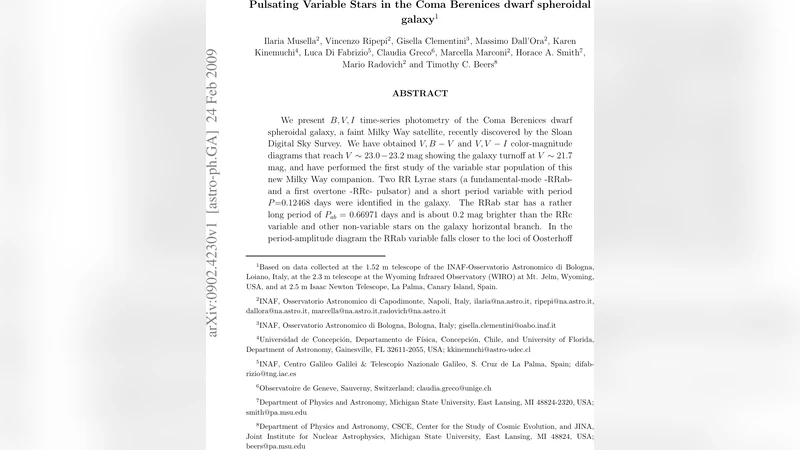
We present B, V, I time-series photometry of the Coma Berenices dwarf spheroidal galaxy, a faint Milky Way satellite, recently discovered by the Sloan Digital Sky Survey. We have obtained V, B-V and V, V-I color-magnitude diagrams that reach V23.0-23.2 mag showing the galaxy turnoff at V21.7 mag, and have performed the first study of the variable star population of this new Milky Way companion. Two RR Lyrae stars (a fundamental-mode -RRab- and a first overtone -RRc- pulsator) and a short period variable with period P=0.12468 days were identified in the galaxy. The RRab star has a rather long period of P_ab=0.66971 days and is about 0.2 mag brighter than the RRc variable and other non-variable stars on the galaxy horizontal branch. In the period-amplitude diagram the RRab variable falls closer to the loci of Oosterhoff type-II systems and evolved fundamental-mode RR Lyrae stars in the Galactic globular cluster M3. The average apparent magnitude of the galaxy horizontal branch, <V_HB>=18.64+-0.04 mag, leads to a distance modulus for the Coma dSph mu_0=18.13+-0.08 mag, corresponding to a distance d=42^{+2}_{-1} kpc, by adopting a reddening E(B-V) = 0.045 +- 0.015 mag and a metallicity [Fe/H]=-2.53 +- 0.05 dex.
💡 Research Summary
The paper presents the first systematic study of the variable star population in the Coma Berenices dwarf spheroidal galaxy (Coma dSph), a faint Milky Way satellite discovered by the Sloan Digital Sky Survey. Using B, V, and I time‑series photometry obtained over many nights with a 2‑meter class telescope, the authors constructed deep colour‑magnitude diagrams (CMDs) reaching V≈23 mag. The CMD reveals the main‑sequence turn‑off at V≈21.7 mag and a well‑populated horizontal branch (HB).
Within the HB region three variable stars were identified: two RR Lyrae variables (one fundamental‑mode RRab and one first‑overtone RRc) and a short‑period variable with P=0.12468 days. The RRab star has a relatively long period (P_ab=0.66971 days) and an V‑band amplitude of about 1.0 mag. It is also ∼0.2 mag brighter than the RRc star and the non‑variable HB stars, suggesting it is an evolved RR Lyrae or belongs to an Oosterhoff type‑II (Oo II) population. The RRc star shows a period near 0.35 days and an amplitude of ∼0.5 mag, typical of first‑overtone pulsators. The short‑period object’s light curve is symmetric and low‑amplitude, consistent with an SX Phoenicis or δ Scuti classification, although spectroscopic confirmation is required.
In the period‑amplitude (P‑A) diagram the RRab star lies close to the loci defined by Oo II globular clusters and by evolved fundamental‑mode RR Lyrae in the Galactic globular cluster M3. This placement, together with the derived metallicity of the galaxy (
Comments & Academic Discussion
Loading comments...
Leave a Comment