A large-scale CO survey of the Rosette Molecular Cloud: assessing the effects of O stars on surrounding molecular gas
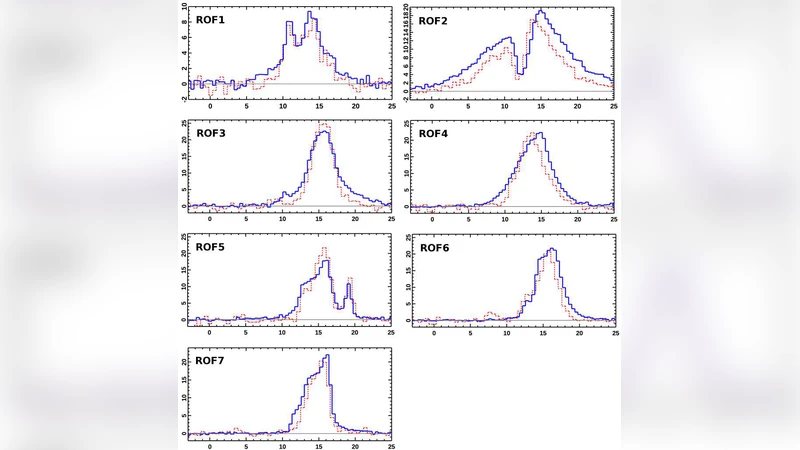
We present a new large-scale survey of J=3-2 12CO emission covering 4.8 square degrees around the Rosette Nebula. Approximately 2000 compact clumps are identified, with a spatially-invariant power law mass distribution index of -1.8. Most of the inner clumps show velocity gradients of 1-3 km/s/pc, directed away from the exciting nebula. The gradients decrease with distance from the central O stars, and are consistent with a photoionised gas acceleration model, assuming clump lifetimes of a few 10^5 yrs. However, in one clear case, the observed near-constant velocity gradient is difficult to explain with simple models. Most blue-shifted but very few of the red-shifted clumps are associated with dark absorbing optical globules, confirming that the dominant molecular gas motion is expansion away from the central nebula and O stars. Many clumps also lie in a molecular ring, having an expansion velocity of 30 km/s, radius 11pc, and dynamical lifetime of ~1Myr. The J=3-2/1-0 12CO line ratios of the clumps decrease with distance from the O stars, implying a gradient in their surface temperatures; the results are consistent with a simple model of clump surface heating due to the central stars. Seven high-velocity molecular flows are found in the region, with a close correspondence between these flows and embedded young clusters. These outflows are sufficiently energetic to drive local gas turbulence within each cluster. We find 14 clear examples of association between embedded young stars seen at 24um and CO clumps; these are thought to be photoevaporating molecular envelopes. The CO clumps without evidence of embedded stars tend to have lower velocity gradients, and it is suggested that the presence of the young star may extend the lifespan of the photoevaporating envelope.
💡 Research Summary
This paper presents a comprehensive J = 3‑2 ¹²CO survey of the Rosette Molecular Cloud covering 4.8 deg² around the Rosette Nebula. The authors identify roughly 2 000 compact clumps and find that their mass distribution follows a spatially invariant power‑law with an index of –1.8, indicating a universal fragmentation pattern in this giant molecular complex. Most clumps located within the inner region exhibit systematic velocity gradients of 1–3 km s⁻¹ pc⁻¹ directed radially away from the central O‑star cluster. The magnitude of these gradients declines with increasing distance from the massive stars, a trend that is well reproduced by a simple photo‑ionised gas acceleration model assuming clump lifetimes of a few × 10⁵ yr. One notable exception shows an almost constant gradient irrespective of distance, suggesting that additional physics—such as magnetic support, density inhomogeneities, or external shock interactions—must be considered.
The authors also demonstrate that blue‑shifted clumps are frequently associated with dark optical globules, whereas red‑shifted counterparts are scarce, confirming that the dominant motion of the molecular gas is expansion away from the nebular core. A striking “molecular ring” is identified, with a radius of ~11 pc, an expansion velocity of ~30 km s⁻¹, and a dynamical age of ~1 Myr, implying that the O‑stars have been driving a large‑scale bubble for about a million years.
Line‑ratio analysis (J = 3‑2/1‑0) shows a clear decrease with distance from the O‑stars, indicating that clump surface temperatures fall off with increasing radius. This behavior matches a simple radiative heating model where the stellar luminosity drops as r⁻².
Seven high‑velocity molecular outflows are detected, each spatially coincident with embedded young clusters. The kinetic energy contained in these flows is sufficient to sustain the observed level of turbulence within the respective clusters, supporting the idea that protostellar feedback can locally regulate cloud dynamics.
Finally, the study finds 14 clear associations between 24 µm point sources (embedded young stars) and CO clumps, interpreted as photo‑evaporating envelopes. Clumps lacking an embedded source tend to have weaker velocity gradients, suggesting that the presence of a young star may prolong the lifetime of the evaporating envelope by providing additional pressure support or shielding.
Overall, the work provides a detailed, multi‑scale picture of how massive O‑type stars shape the kinematics, temperature structure, and star‑formation activity of their surrounding molecular environment, combining large‑area mapping, statistical clump analysis, and simple physical models to elucidate the feedback processes at play.
Comments & Academic Discussion
Loading comments...
Leave a Comment