Albedos of Main-Belt Comets 133P/Elst-Pizarro and 176P/LINEAR
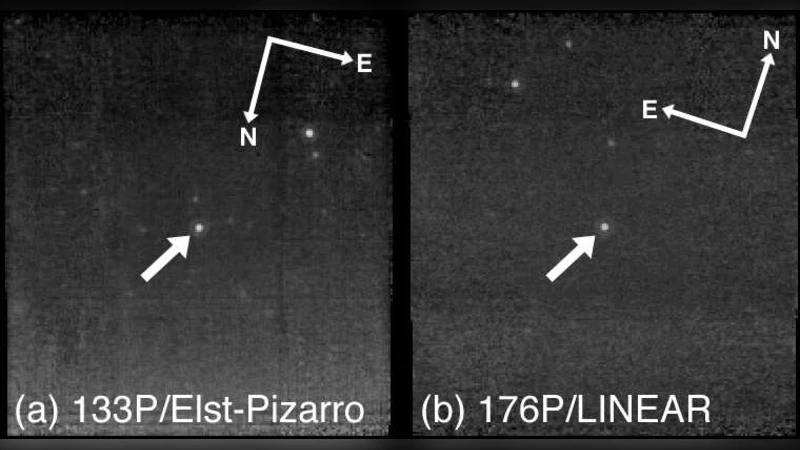
We present the determination of the geometric R-band albedos of two main-belt comet nuclei based on data from the Spitzer Space Telescope and a number of ground-based optical facilities. For 133P/Elst-Pizarro, we find an albedo of p_R=0.05+/-0.02 and an effective radius of r_e=1.9+/-0.3 km (estimated semi-axes of a2.3 km and b1.6 km). For 176P/LINEAR, we find an albedo of p_R=0.06+/-0.02 and an effective radius of r_e=2.0+/-0.2 km (estimated semi-axes of a2.6 km and b1.5 km). In terms of albedo, 133P and 176P are similar to each other and are typical of other Themis family asteroids, C-class asteroids, and other comet nuclei. We find no indication that 133P and 176P are compositionally unique among other dynamically-similar (but inactive) members of the Themis family, in agreement with previous assertions that the two objects most likely formed in-situ. We also note that low albedo (p_R<0.075) remains a consistent feature of all cometary (i.e., icy) bodies, whether they originate in the inner solar system (the main-belt comets) or in the outer solar system (all other comets).
💡 Research Summary
This paper presents the first quantitative determination of the geometric R‑band albedos and effective radii of two main‑belt comets (MBCs), 133P/Elst‑Pizarro and 176P/LINEAR, by combining thermal infrared observations from the Spitzer Space Telescope with contemporaneous ground‑based optical photometry. The authors employed the Near‑Earth Asteroid Thermal Model (NEATM) with a beaming parameter η set to 1.0 ± 0.2 to account for surface roughness and rotational effects. Optical absolute magnitudes (H_R) were derived from R‑band measurements (H_R ≈ 15.9 for 133P and 15.7 for 176P) and corrected for phase angle using standard C‑type asteroid color indices (V–R ≈ 0.38–0.40).
From the thermal fits, the geometric albedos were found to be p_R = 0.05 ± 0.02 for 133P and p_R = 0.06 ± 0.02 for 176P. Corresponding effective radii are r_e = 1.9 ± 0.3 km and r_e = 2.0 ± 0.2 km, respectively. Assuming an ellipsoidal shape, the semi‑axes are estimated at a ≈ 2.3 km, b ≈ 1.6 km for 133P and a ≈ 2.6 km, b ≈ 1.5 km for 176P. The uncertainties incorporate errors in the optical absolute magnitudes, the beaming parameter, and the Spitzer 24 µm flux measurements.
When placed in context, these albedo values are indistinguishable from those of Themis family asteroids (typical p_R ≈ 0.07), C‑type asteroids (p_R ≈ 0.04–0.08), and the nuclei of classical comets (p_R ≈ 0.04–0.06). The similarity indicates that the surface reflectivity of MBCs does not differ significantly from that of inactive, dynamically similar family members, suggesting no unique compositional signature for the active objects. Moreover, the low albedo (p_R < 0.075) appears to be a universal characteristic of icy bodies throughout the Solar System, regardless of whether they reside in the inner main belt or the distant Oort cloud.
The authors interpret these findings as supporting an “in‑situ” formation scenario for the two MBCs. Both objects belong dynamically to the Themis collisional family, and their albedos, colors, and sizes are consistent with being fragments of the same parent body that retained subsurface ice. Subsequent exposure of this ice—perhaps through small impacts, thermal stresses, or rotational spin‑up—could trigger the observed episodic dust emission without requiring a distinct compositional reservoir.
The paper also discusses methodological implications. The combination of space‑based thermal infrared data with ground‑based optical photometry provides a robust pathway to constrain both size and albedo for faint, distant objects. Future improvements could arise from higher‑resolution thermal imaging, laser ranging, or spacecraft fly‑bys, which would refine the beaming parameter and directly measure surface roughness and shape. Such refinements are essential for building accurate thermal models, estimating bulk densities, and ultimately assessing the volatile content of MBCs.
In summary, this study demonstrates that 133P and 176P possess low albedos and sizes typical of both Themis family asteroids and cometary nuclei, reinforcing the view that main‑belt comets are not compositionally exotic but rather represent a continuum of icy bodies that formed locally in the asteroid belt. The results have broad implications for our understanding of the distribution of water and other volatiles in the early Solar System and provide a solid observational foundation for future investigations of MBCs and their role in planetary science.
Comments & Academic Discussion
Loading comments...
Leave a Comment