Chemical abundances of 451 stars from the HARPS GTO planet search program: Thin disc, thick disc, and planets
We present a uniform study of the chemical abundances of 12 elements (Si, Ca, Sc, Ti, V, Cr, Mn, Co, Ni, Na, Mg, and Al) derived from the spectra of 451 stars observed as part of one of the HARPS GTO planet search programs. Sixty eight of these are planet-bearing stars. The main goals of our work are: i) the investigation of possible differences between the abundances of stars with and without planets; ii) the study of the possible differences in the abundances of stars in the thin and the thick disc. We confirm that there is a systematically higher metallicity in planet host stars, when compared to non planet-hosts, common to all studied species. We also found that there is no difference in the galactic chemical evolution trends of the stars with and without planets. Stars that harbour planetary companions simply appear to be in the high metallicity tail of the distribution. We also confirm that Neptunian and super-Earth class planets may be easier to find at lower metallicities. A statistically significative abundance difference between stars of the thin and the thick disc was found for [Fe/H] $<$ 0. However, the populations from the thick and the thin disc cannot be clearly separated.
💡 Research Summary
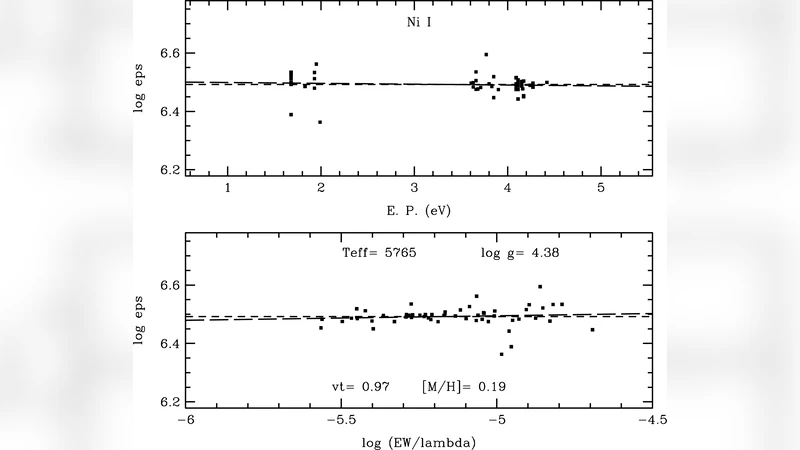
The paper presents a homogeneous spectroscopic analysis of 12 chemical elements (Si, Ca, Sc, Ti, V, Cr, Mn, Co, Ni, Na, Mg, Al) for 451 FGK-type stars observed in the HARPS GTO planet‑search program, of which 68 are known to host planets. Stellar parameters were derived by enforcing Fe I/Fe II ionization and excitation equilibrium, and abundances were obtained under LTE using the MOOG code with a consistent line list and atomic data for all stars. The authors address three central questions: (1) whether planet‑hosting stars differ chemically from non‑hosts, (2) whether thin‑disc and thick‑disc stars show distinct abundance patterns, and (3) how the metallicity dependence varies with planetary mass class (giant vs. Neptune‑/super‑Earth‑type planets).
The first major result is the confirmation of the well‑known planet‑metallicity correlation across all studied elements. Planet hosts have on average +0.15 to +0.20 dex higher
Comments & Academic Discussion
Loading comments...
Leave a Comment