A Deep VLA Radio Continuum Study of the Core and Outskirts of the Coma Cluster
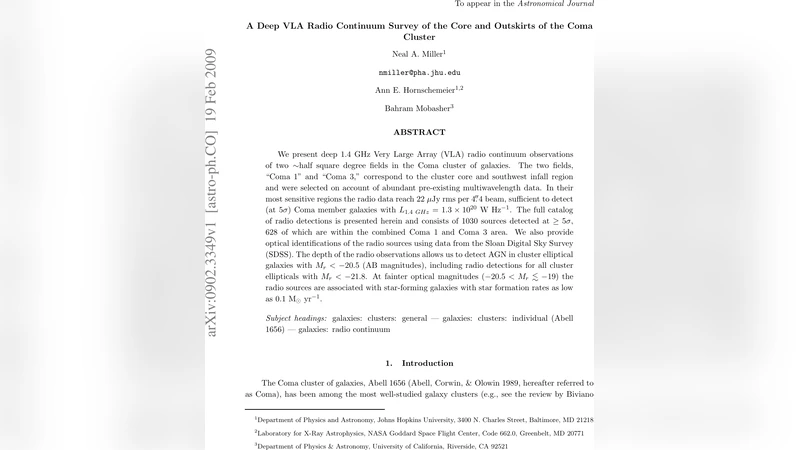
We present deep 1.4GHz Very Large Array (VLA) radio continuum observations of two half square degree fields in the Coma cluster of galaxies. The two fields, “Coma 1” and “Coma 3,” correspond to the cluster core and southwest infall region and were selected on account of abundant pre-existing multiwavelength data. In their most sensitive regions the radio data reach 22 uJy rms per 4.4" beam, sufficient to detect (at 5-sigma) Coma member galaxies with log(L) = 20.11 W/Hz. The full catalog of radio detections is presented herein and consists of 1030 sources detected at >=5 sigma, 628 of which are within the combined Coma 1 and Coma 3 area. We also provide optical identifications of the radio sources using data from the Sloan Digital Sky Survey (SDSS). The depth of the radio observations allows us to detect AGN in cluster elliptical galaxies with Mr < -20.5 (AB magnitudes), including radio detections for all cluster ellipticals with Mr < -21.8. At fainter optical magnitudes (-20.5 < Mr < -19) the radio sources are associated with star-forming galaxies with star formation rates as low as 0.1 solar masses per year.
💡 Research Summary
The authors present a deep 1.4 GHz continuum survey of the Coma cluster using the Karl G. Jansky Very Large Array. Two fields, designated “Coma 1” (the dense core) and “Coma 3” (the southwest infall region), each cover roughly half a square degree and were chosen because of the wealth of ancillary data already available at other wavelengths. By combining C‑array and D‑array configurations they achieve a synthesized beam of 4.4 arcsec and a median rms noise of 22 µJy beam⁻¹ in the most sensitive portions of the maps. This sensitivity corresponds to a 5‑σ detection limit of L₁.₄ GHz ≈ 10²⁰·¹¹ W Hz⁻¹ at the distance of Coma (≈100 Mpc), allowing the detection of very low‑luminosity radio sources that were previously inaccessible.
A total of 1,030 radio components are catalogued, of which 628 lie within the combined Coma 1 and Coma 3 footprints. Source extraction was performed with the PyBDSF package using a 5‑σ threshold, and each detection is accompanied by a suite of measured parameters (peak flux, integrated flux, deconvolved size, position angle, etc.). The authors then cross‑matched the radio catalog with the Sloan Digital Sky Survey (SDSS) photometric database. Optical counterparts were identified for the overwhelming majority of radio sources, enabling a clear separation between cluster members, background galaxies, and a small number of quasars or stellar objects.
The optical–radio association reveals two distinct populations. First, massive early‑type galaxies (absolute r‑band magnitude Mr < ‑20.5) host compact radio cores that are interpreted as low‑luminosity active galactic nuclei (AGN). Remarkably, every Coma elliptical brighter than Mr = ‑21.8 is detected in the radio, indicating that virtually all of the most luminous cluster ellipticals harbor an active nucleus at the level probed by this survey. The detection fraction drops for fainter ellipticals but remains high down to the survey limit, providing a robust measurement of the AGN duty cycle in a dense environment.
Second, galaxies with intermediate optical luminosities (‑20.5 ≲ Mr ≲ ‑19) are predominantly star‑forming systems. Their radio luminosities translate into star‑formation rates (SFRs) as low as ~0.1 M⊙ yr⁻¹, thanks to the dust‑insensitive nature of synchrotron emission at 1.4 GHz. This is a factor of several deeper than typical far‑infrared or ultraviolet surveys of the same region, allowing the authors to probe the low‑SFR tail of the cluster galaxy population. The spatial distribution of these star‑forming radio sources shows no dramatic deficit in the core relative to the infall region, suggesting that environmental quenching mechanisms are either gradual or that a fraction of gas‑rich galaxies are still being accreted onto the cluster.
The surface density of radio sources is roughly 1,200 deg⁻² in the core and 1,000 deg⁻² in the southwest field, indicating that the overall radio source density does not vary dramatically between the high‑density core and the lower‑density outskirts. This similarity implies that the infall region already contains a substantial population of radio‑emitting galaxies, possibly reflecting pre‑processing in group environments before they enter the main cluster potential.
From a methodological standpoint, the authors demonstrate the power of combining high‑resolution (4.4″) imaging with deep sensitivity to resolve both compact AGN cores and extended star‑forming disks within the same dataset. Their use of multi‑scale CLEAN and self‑calibration ensures that faint, diffuse emission is not suppressed, a critical consideration for studies of low‑SFR galaxies. The resulting catalog, with its detailed radio measurements and SDSS identifications, provides a valuable resource for a variety of follow‑up investigations: (i) constructing radio luminosity functions (RLFs) for AGN and star‑forming galaxies separately, (ii) comparing the RLF in the Coma core versus the infall region to quantify environmental effects, (iii) cross‑matching with existing X‑ray (e.g., XMM‑Newton, Chandra) and infrared (Spitzer, Herschel) data to explore multi‑wavelength correlations, and (iv) testing semi‑analytic models of galaxy evolution that predict AGN feedback and ram‑pressure stripping in dense environments.
In summary, this work delivers the deepest, most extensive 1.4 GHz radio map of the Coma cluster to date, revealing that (1) low‑luminosity AGN are ubiquitous among the brightest ellipticals, (2) star‑forming galaxies with SFRs down to 0.1 M⊙ yr⁻¹ are detectable across both core and outskirts, and (3) the radio source density remains relatively uniform across environments, highlighting the importance of pre‑processing. The publicly released catalog and the thorough multi‑wavelength identification lay the groundwork for future studies of how dense environments regulate both black‑hole activity and star formation in galaxies.
Comments & Academic Discussion
Loading comments...
Leave a Comment