Two distant brown dwarfs in the UKIRT Infrared Deep Sky Survey Deep Extragalactic Survey Data Release 2
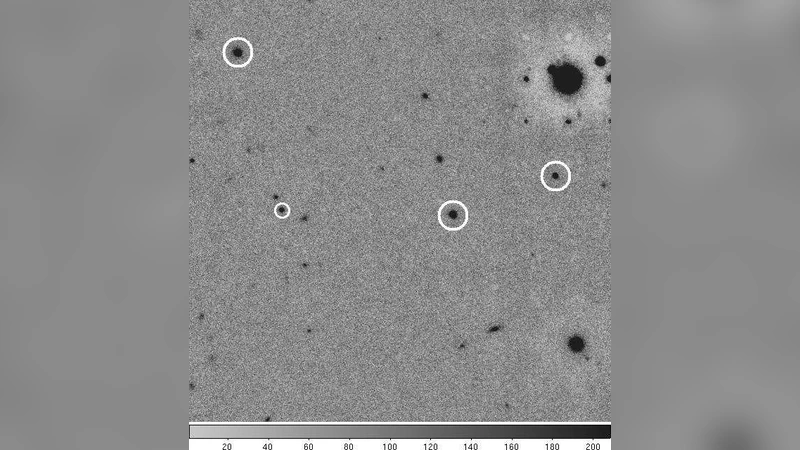
We present the discovery of two brown dwarfs in the UKIRT Infrared Deep Sky Survey (UKIDSS) Deep Extragalactic Survey (DXS) Data Release 2. Both objects were selected photometrically from six square degrees in DXS for their blue J-K colour and the lack of optical counterparts in the Sloan Digital Sky Survey (SDSS) Stripe 82. Additional optical photometry provided by the Canada-France-Hawaii Telescope Legacy Survey (CFHT-LS) corroborated the possible substellarity of these candidates. Subsequent methane imaging of UDXS J221611.51+003308.1 and UDXS J221903.10+002418.2, has confirmed them as T7$\pm$1 and T6$\pm$1 dwarfs at photometric distances of 81 (52-118 pc) and 60 (44-87 pc; 2 sigma confidence level). A similar search in the second data release of the Ultra Deep Survey over a smaller area (0.77 square degree) and shallower depth didn’t return any late-T dwarf candidate. The numbers of late-T dwarfs in our study are broadly in line with a declining mass function when considering the current area and depth of the DXS and UDS. These brown dwarfs are the first discovered in the VIMOS 4 field and among the few T dwarfs found in pencil-beam surveys. They are valuable to investigate the scale height of T dwarfs.
💡 Research Summary
This paper reports the discovery of two distant late‑type T dwarfs identified in the UKIRT Infrared Deep Sky Survey (UKIDSS) Deep Extragalactic Survey (DXS) Data Release 2. The authors examined six square degrees of DXS imaging, selecting candidates that exhibit blue J–K colours (J–K < 0) and have no detectable optical counterparts in the Sloan Digital Sky Survey (SDSS) Stripe 82. Additional optical photometry from the Canada‑France‑Hawaii Telescope Legacy Survey (CFHT‑LS) was used to confirm the lack of bright optical emission, reinforcing the hypothesis that the objects are sub‑stellar and likely at large distances.
From an initial pool of twelve photometrically selected sources, visual inspection and quality control reduced the list to two robust candidates: UDXS J221611.51+003308.1 and UDXS J221903.10+002418.2. Follow‑up methane imaging was performed using narrow‑band filters centred on the 1.58 µm methane absorption feature (CH₄ on) and a nearby continuum region at 1.69 µm (CH₄ off). The measured CH₄(on‑off) colour indices are 0.71 ± 0.12 mag and 0.63 ± 0.10 mag, respectively. By applying the empirical relationship between methane colour and spectral type, the authors assign spectral classifications of T7 ± 1 for the first object and T6 ± 1 for the second.
Photometric distances were estimated by comparing the observed J‑band magnitudes with absolute J‑band magnitudes typical of T6–T8 dwarfs (M_J ≈ 15.0–15.5 mag). The resulting distance estimates are 81 pc (range 52–118 pc at 2σ) for UDXS J221611.51+003308.1 and 60 pc (44–87 pc at 2σ) for UDXS J221903.10+002418.2. These distances place both objects well beyond the immediate solar neighbourhood, illustrating the power of deep, narrow‑field infrared surveys to uncover faint, distant brown dwarfs.
To assess the statistical significance of the findings, the authors performed an identical search in the UKIDSS Ultra‑Deep Survey (UDS) Data Release 2, which covers a smaller area (0.77 deg²) and is shallower. No late‑type T dwarf candidates were recovered in the UDS field, consistent with expectations given the reduced volume probed. When the DXS and UDS volumes are combined, the detection of two late‑T dwarfs aligns with a declining sub‑stellar mass function (power‑law index α ≈ −0.5 to 0), rather than a flat or rising one.
The paper emphasizes that these two objects are the first brown dwarfs identified in the VIMOS 4 field and among the few T dwarfs discovered in pencil‑beam surveys. Their discovery provides valuable data points for constraining the vertical scale height of the T‑dwarf population in the Milky Way, a parameter that remains poorly measured due to the scarcity of distant, faint brown dwarfs. The authors suggest that future wide‑area, deep infrared missions such as Euclid and the Nancy Grace Roman Space Telescope (formerly WFIRST) will be able to build on this methodology, dramatically increasing the sample of distant T dwarfs and enabling precise modeling of the Galactic low‑mass stellar halo and thick‑disk components.
In summary, the study demonstrates that a combination of deep near‑infrared colour selection, stringent optical non‑detection criteria, and targeted methane imaging can efficiently isolate late‑type T dwarfs at distances of 50–100 pc. The results are consistent with a declining brown‑dwarf mass function and provide a stepping stone toward a more comprehensive understanding of the spatial distribution and formation history of the coolest sub‑stellar objects in our Galaxy.
Comments & Academic Discussion
Loading comments...
Leave a Comment