Detection of Star Formation in the Unusually Cold Giant Molecular Cloud G216
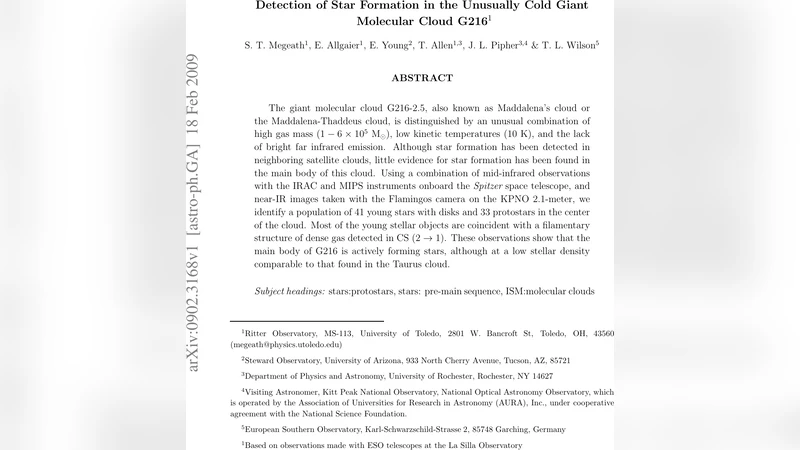
The giant molecular cloud G216-2.5, also known as Maddalena’s cloud or the Maddalena-Thaddeus cloud, is distinguished by an unusual combination of high gas mass (1-6 x 10^5) solar masses, low kinetic temperatures (10 K), and the lack of bright far infrared emission. Although star formation has been detected in neighboring satellite clouds, little evidence for star formation has been found in the main body of this cloud. Using a combination of mid-infrared observations with the IRAC and MIPS instruments onboard the Spitzer space telescope, and near-IR images taken with the Flamingos camera on the KPNO 2.1-meter, we identify a population of 41 young stars with disks and 33 protostars in the center of the cloud. Most of the young stellar objects are coincident with a filamentary structure of dense gas detected in CS (2-1). These observations show that the main body of G216 is actively forming stars, although at a low stellar density comparable to that found in the Taurus cloud.
💡 Research Summary
The giant molecular cloud G216‑2.5 (Maddalena‑Thaddeus cloud) has long been regarded as an anomalous object: it contains a huge amount of molecular gas (≈1–6 × 10⁵ M☉) yet exhibits an exceptionally low kinetic temperature (~10 K) and a faint far‑infrared (FIR) signature. Because of these properties, previous surveys concluded that the main body of the cloud was essentially quiescent, with only a few star‑forming satellite clumps detected on its periphery. The present study set out to test this assumption by conducting a deep, multi‑wavelength infrared census of the cloud’s central region.
Observations were carried out with the Spitzer Space Telescope’s IRAC (3.6, 4.5, 5.8, 8.0 µm) and MIPS (24 µm) instruments, providing high‑sensitivity coverage of both the warm dust continuum and the polycyclic aromatic hydrocarbon (PAH) emission that trace young stellar objects (YSOs). Complementary near‑infrared (NIR) imaging in J, H, Kₛ bands was obtained using the Flamingos camera on the KPNO 2.1‑m telescope, allowing accurate extinction correction and additional color diagnostics.
Data reduction followed standard Spitzer pipelines: Basic Calibrated Data (BCD) frames were mosaicked with MOPEX, point‑spread‑function (PSF) photometry was performed for each band, and source catalogs were cross‑matched with the NIR catalog using a 1″ radius. Photometric uncertainties were minimized by applying the latest calibration factors and by performing local background subtraction to mitigate the highly variable nebulosity across the cloud.
YSO candidates were identified in two stages. First, IRAC color criteria derived from Gutermuth et al. (2009) were applied to isolate objects with infrared excesses indicative of circumstellar material. Second, the presence or absence of a 24 µm detection, together with NIR colors, was used to separate Class I/0 protostars (still embedded in dense envelopes) from Class II sources (disk‑bearing pre‑main‑sequence stars). After rigorous contamination checks (e.g., removal of background galaxies and shock‑excited knots), the final sample comprised 41 Class II objects and 33 Class I/0 protostars.
Spatial analysis revealed that the overwhelming majority of the identified YSOs lie along a filamentary network traced by CS (2‑1) emission, previously mapped by Lee et al. (1996). The CS line traces gas at densities of n(H₂) ≈ 10⁴–10⁵ cm⁻³, confirming that star formation is confined to the densest substructures within the otherwise cold and diffuse cloud. The surface density of YSOs is ≈ 1 pc⁻², comparable to the Taurus molecular cloud, but far lower than the clustered environments of Orion or the Carina Nebula.
By assuming an average stellar mass of 0.5 M☉ for the detected YSOs and adopting a cloud mass of ≈ 3 × 10⁵ M☉ (the midpoint of the published range), the star‑formation efficiency (SFE) of G216 is estimated at ≈ 0.02 %. This low SFE reflects the cloud’s overall quiescence, yet the presence of a non‑negligible population of protostars demonstrates that star formation is ongoing, albeit at a dispersed, low‑density rate.
The study also addresses why previous FIR surveys missed this activity. The bulk of the cloud’s mass resides at 10 K, producing only weak thermal dust emission; the high‑density filaments occupy a small fraction of the total volume, so their contribution to the integrated FIR flux is minimal. Consequently, large‑scale FIR diagnostics alone are insufficient to reveal star formation in such cold, massive clouds.
In conclusion, the combination of mid‑infrared Spitzer imaging and ground‑based NIR observations has uncovered a hidden population of young stars within G216‑2.5. The findings overturn the notion that the cloud is completely dormant and place it in the same regime as low‑density star‑forming regions like Taurus. Future high‑resolution studies with ALMA and JWST will be essential to probe the internal kinematics of the CS filaments, measure core masses, and refine the initial mass function in this unique environment, thereby advancing our understanding of how stars can emerge from some of the coldest and most massive molecular reservoirs in the Galaxy.
Comments & Academic Discussion
Loading comments...
Leave a Comment