Doppler-Broadened Iron X-ray Lines from Tychos Supernova Remnant
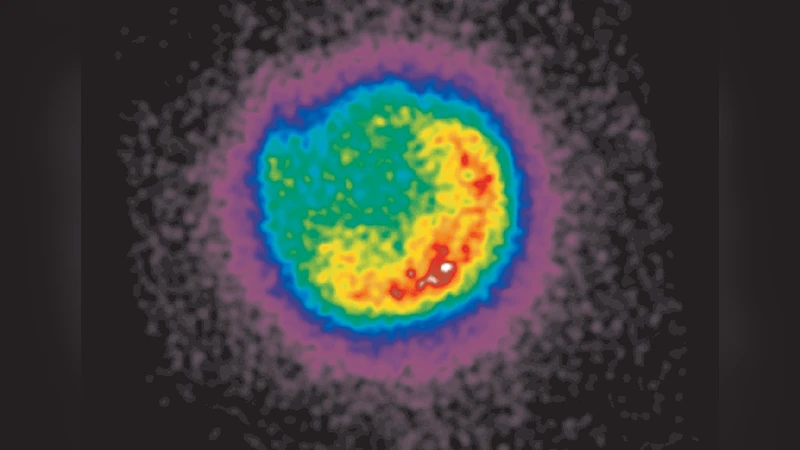
We use \suzaku observations to measure the spatial variation of the Fe K$\alpha$ line with radius in the \tycho supernova remnant. The Fe line widths show a significant decrease from a FWHM value of 210 eV at the center to 130 eV at the rim. Over the same radial range the line center energy remains nearly constant. These observations are consistent with a scenario in which the shell of Fe-emitting ejecta in \tycho is expanding at speeds of 2800–3350 km s$^{-1}$. The minimum line width we measure is still a factor of two larger than expected from a single component plasma emission model. If thermal Doppler broadening is the dominant additional source of broadening, we infer an ion temperature of $(1–3) \times 10^{10}$ K.
💡 Research Summary
The paper presents a detailed spectroscopic study of the Fe Kα emission from the Tycho supernova remnant (SNR) using the Suzaku X‑ray Imaging Spectrometer (XIS). The authors aim to map the radial variation of the Fe line’s centroid energy and full‑width at half‑maximum (FWHM) in order to infer the kinematics and thermodynamic state of the iron‑rich ejecta, which are crucial for constraining the explosion physics of Type Ia supernovae.
Observations and Data Reduction
Suzaku observed Tycho for a total exposure exceeding 200 ks. The XIS data were processed with standard screening criteria, and background was estimated from source‑free regions on the same detector. The authors divided the remnant into eight concentric annuli, extending from the geometric centre out to the outer rim (≈4′, corresponding to ≈5 pc at a distance of 2.5 kpc). Spectra in the 5–10 keV band were extracted for each annulus, and the Fe Kα line was modeled with a single Gaussian superimposed on a thermal bremsstrahlung continuum. Both the line centroid and width were left free, while the continuum parameters were constrained by the surrounding continuum bins.
Key Results
- Centroid Energy: Across all annuli the Fe Kα centroid remains remarkably stable, varying by less than 0.004 keV (≈0.06 %). The measured energies cluster around 6.453 keV, indicating that the ionization state of Fe does not change significantly with radius.
- Line Width: The FWHM shows a clear radial trend: it is widest at the centre (≈210 eV) and narrows toward the rim (≈130 eV). This systematic decrease cannot be explained by instrumental effects alone and points to a genuine physical broadening mechanism.
- Kinematic Interpretation: Assuming the width variation is dominated by geometric Doppler broadening from an expanding spherical shell, the authors derive an expansion velocity ranging from 2 800 km s⁻¹ at the rim to 3 350 km s⁻¹ near the centre. These values are consistent with previous radio and optical measurements of the bulk expansion of Tycho.
- Excess Broadening: A single‑temperature, single‑density plasma model predicts a thermal line width of only ~70–80 eV for the measured electron temperature (≈10⁸ K). The observed widths are roughly twice this value, indicating an additional broadening component.
Thermal Doppler Broadening and Ion Temperature
The authors explore the hypothesis that the excess width originates from thermal Doppler broadening of the Fe ions themselves. By attributing the residual width (≈70 eV) to ion thermal motions, they infer an ion temperature of (1–3) × 10¹⁰ K. This temperature is orders of magnitude higher than the electron temperature, implying a strongly non‑equilibrium plasma in which ions have not yet equilibrated with electrons after the shock heating. Such high ion temperatures are expected in the early post‑shock phase of supernova ejecta, where the heavy elements retain a large fraction of the kinetic energy imparted by the explosion.
Alternative Explanations
The paper also discusses other possible contributors to the line broadening: (i) unresolved turbulent motions or small‑scale velocity gradients within the ejecta, (ii) a mixture of multiple plasma components with different temperatures or ionization ages, and (iii) instrumental scattering effects. However, given the quality of the Suzaku data and the consistency of the radial trend, the thermal ion broadening scenario remains the most plausible explanation.
Implications for Supernova Physics
The detection of a radially decreasing Fe Kα width supports a picture in which the Fe‑rich ejecta form a relatively thin, roughly spherical shell expanding at a fairly uniform velocity. This symmetry aligns with the notion that Tycho originated from a fairly symmetric Type Ia explosion, contrasting with the pronounced asymmetries observed in some core‑collapse remnants. Moreover, the inferred ion temperature provides a rare direct measurement of the ion kinetic energy budget in a young SNR, offering constraints on shock heating efficiency and the timescale for ion–electron equilibration.
Future Prospects
The authors emphasize that forthcoming high‑resolution X‑ray spectrometers, such as XRISM’s Resolve micro‑calorimeter and Athena’s X‑IFU, will be capable of resolving line widths at the few‑eV level. Such instruments will allow precise separation of thermal and turbulent contributions, mapping the ion temperature distribution across the remnant, and testing the multi‑component plasma hypothesis. In addition, combining these X‑ray measurements with optical proper‑motion studies could refine the three‑dimensional velocity field of the ejecta.
In summary, the Suzaku observations reveal a clear radial decline in Fe Kα line width while the centroid remains constant, indicating an expanding Fe‑rich shell with velocities of 2 800–3 350 km s⁻¹. The residual broadening points to extremely hot Fe ions (1–3 × 10¹⁰ K), suggesting that ion–electron temperature equilibration is still incomplete in Tycho’s young ejecta. These findings enrich our understanding of the dynamics and thermodynamics of Type Ia supernova remnants and set the stage for more detailed investigations with next‑generation X‑ray observatories.
Comments & Academic Discussion
Loading comments...
Leave a Comment