Multi-wavelength Variability of the Broad Line Radio Galaxy 3C 120
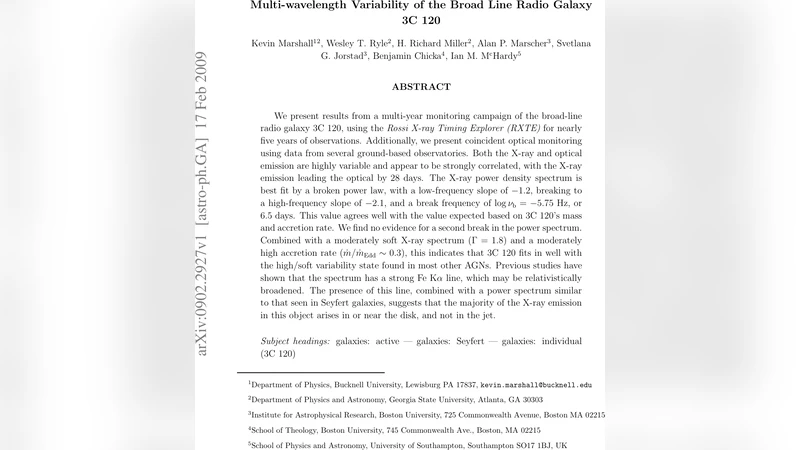
We present results from a multi-year monitoring campaign of the broad-line radio galaxy 3C 120, using the Rossi X-ray Timing Explorer (RXTE) for nearly five years of observations. Additionally, we present coincident optical monitoring using data from several ground-based observatories. Both the X-ray and optical emission are highly variable and appear to be strongly correlated, with the X-ray emission leading the optical by 28 days. The X-ray power density spectrum is best fit by a broken power law, with a low-frequency slope of -1.2, breaking to a high-frequency slope of -2.1, and a break frequency of log nu_b=-5.75 Hz, or 6.5 days. This value agrees well with the value expected based on 3C 120’s mass and accretion rate. We find no evidence for a second break in the power spectrum. Combined with a moderately soft X-ray spectrum (Gamma=1.8) and a moderately high accretion rate (mdot / mdot_Edd ~ 0.3), this indicates that 3C 120 fits in wellwith the high/soft variability state found in most other AGNs. Previous studies have shown that the spectrum has a strong Fe K-alpha line, which may be relativistically broadened. The presence of this line, combined with a power spectrum similar to that seen in Seyfert galaxies, suggests that the majority of the X-ray emission in this object arises in or near the disk, and not in the jet.
💡 Research Summary
This paper presents the results of a comprehensive, multi‑year monitoring campaign of the broad‑line radio galaxy 3C 120, combining nearly five years of Rossi X‑ray Timing Explorer (RXTE) observations with contemporaneous optical photometry from several ground‑based observatories. The X‑ray light curve (2–10 keV) exhibits strong, rapid variability, while the optical V‑band data show similarly large amplitude changes. Cross‑correlation analysis reveals a statistically significant lag of approximately 28 ± 5 days, with the X‑ray variations leading the optical, strongly supporting a re‑processing scenario in which X‑ray photons from the innermost accretion flow heat the outer disk, producing delayed optical emission.
The X‑ray power density spectrum (PDS) was constructed using Lomb‑Scargle periodograms and maximum‑likelihood fitting. The best‑fit model is a broken power‑law: a low‑frequency slope of –1.2, a high‑frequency slope of –2.1, and a break frequency log ν_b = –5.75 Hz, corresponding to a characteristic timescale of about 6.5 days. No evidence for a second break is found, indicating a single‑break structure akin to that observed in Seyfert galaxies. This break frequency matches the prediction from the established mass–frequency–accretion‑rate scaling relation when the black‑hole mass (≈5 × 10⁷ M⊙) and the Eddington‑scaled accretion rate (ṁ/ṁ_Edd ≈ 0.3) of 3C 120 are inserted, reinforcing the view that the same physical processes govern variability across the AGN mass spectrum.
Spectral analysis yields an average photon index Γ ≈ 1.8, indicating a moderately soft X‑ray continuum, and a prominent Fe Kα emission line with an equivalent width of ~100 eV and a broadened profile suggestive of relativistic effects near the black hole. The presence of this line, together with the Seyfert‑like PDS, argues that the bulk of the X‑ray emission originates in the accretion disk or its corona rather than in the relativistic jet, despite 3C 120’s classification as a radio‑loud source.
Putting these results together, the authors conclude that 3C 120 occupies the high/soft variability state commonly seen in radio‑quiet AGN. Its X‑ray timing and spectral characteristics, the measured X‑ray‑optical lag, and the consistency with mass‑scaled variability models all point to a disk‑dominated X‑ray production mechanism. The study thus provides a valuable benchmark for understanding disk‑jet coupling in radio‑loud AGN and demonstrates that, even in the presence of a powerful jet, the fundamental X‑ray variability properties can remain governed by the same accretion physics that dominate Seyfert galaxies.
Comments & Academic Discussion
Loading comments...
Leave a Comment