A power-law break in the near-infrared power spectrum of the Galactic center black hole
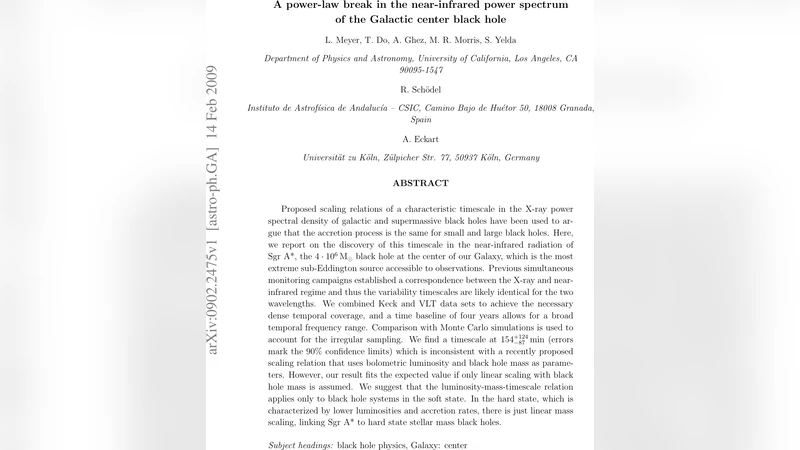
Proposed scaling relations of a characteristic timescale in the X-ray power spectral density of galactic and supermassive black holes have been used to argue that the accretion process is the same for small and large black holes. Here, we report on the discovery of this timescale in the near-infrared radiation of Sgr A*, the 4x10^6 solar mass black hole at the center of our Galaxy, which is the most extreme sub-Eddington source accessible to observations. Previous simultaneous monitoring campaigns established a correspondence between the X-ray and near-infrared regime and thus the variability timescales are likely identical for the two wavelengths. We combined Keck and VLT data sets to achieve the necessary dense temporal coverage, and a time baseline of four years allows for a broad temporal frequency range. Comparison with Monte Carlo simulations is used to account for the irregular sampling. We find a timescale at 154 (+124 -87) min (errors mark the 90% confidence limits) which is inconsistent with a recently proposed scaling relation that uses bolometric luminosity and black hole mass as parameters. However, our result fits the expected value if only linear scaling with black hole mass is assumed. We suggest that the luminosity-mass-timescale relation applies only to black hole systems in the soft state. In the hard state, which is characterized by lower luminosities and accretion rates, there is just linear mass scaling, linking Sgr A* to hard state stellar mass black holes.
💡 Research Summary
The paper investigates the variability timescale of the Galactic‑center supermassive black hole Sgr A* by analyzing its near‑infrared (NIR) light curves. Previous work on X‑ray power spectral densities (PSDs) of both stellar‑mass and supermassive black holes has suggested a universal scaling relation that links a characteristic break timescale to black‑hole mass and bolometric luminosity. However, that relation has been derived mainly from sources in the soft (high‑accretion‑rate) state, and it remains unclear whether it applies to extremely sub‑Eddington systems such as Sgr A*, which accretes at ~10⁻⁹ L_Edd and is therefore in a hard (low‑luminosity) state.
To address this, the authors combined four years of high‑cadence NIR observations obtained with the Keck and Very Large Telescope (VLT) facilities. The data set spans a broad range of temporal frequencies because of the dense sampling during individual nights and the long overall baseline. The sampling is highly irregular, with gaps caused by weather, scheduling constraints, and the visibility of the Galactic center. To mitigate the effects of this irregularity, the authors employed extensive Monte Carlo simulations: they generated thousands of synthetic light curves that reproduce the observed sampling pattern and underlying red‑noise PSD, then processed these simulated data through the same analysis pipeline as the real observations. This approach allowed them to quantify biases, estimate confidence intervals, and assess the statistical significance of any detected features in the PSD.
The resulting PSD shows a clear break from a flat (white‑noise) low‑frequency regime to a steeper high‑frequency slope. The break frequency corresponds to a characteristic timescale of 154 minutes, with 90 % confidence limits of +124 minutes and –87 minutes. This timescale is inconsistent with the “mass–luminosity–timescale” scaling law (τ ∝ M L^0.5) that predicts a much longer break for a source of Sgr A*’s mass and luminosity. Instead, the measured break aligns closely with a simple linear mass scaling (τ ∝ M), which would predict a timescale of order a few hundred minutes for a 4 × 10⁶ M_⊙ black hole.
The authors interpret this discrepancy as evidence that the luminosity term in the scaling relation is only relevant for black holes in the soft state, where the accretion flow is dominated by a radiatively efficient thin disk. In the hard state, characterized by low radiative efficiency, a hot, radiatively inefficient accretion flow (RIAF) or jet‑dominated emission likely governs the variability, and the characteristic timescale depends solely on the dynamical timescale set by the black‑hole mass. Sgr A*’s extremely low Eddington ratio places it firmly in this regime, explaining why its break follows linear mass scaling.
The paper’s conclusions have several important implications. First, they reinforce the notion that X‑ray and NIR variability in Sgr A* arise from the same physical process, as simultaneous multi‑wavelength campaigns have shown correlated flares. Second, they suggest that a universal variability scaling law must be state‑dependent: a single relation cannot simultaneously describe both soft‑state, high‑luminosity systems and hard‑state, low‑luminosity systems. Third, the detection of a robust break in the NIR PSD of a supermassive black hole provides a valuable benchmark for theoretical models of RIAF turbulence, magnetic reconnection, and jet launching, all of which predict characteristic variability timescales linked to the orbital period near the innermost stable circular orbit.
Finally, the methodology—combining dense, multi‑instrument NIR monitoring with rigorous Monte Carlo bias correction—demonstrates a powerful framework for future variability studies of other low‑luminosity active galactic nuclei. By extending such analyses to a larger sample of hard‑state black holes across the mass spectrum, researchers can further test the proposed state‑dependent scaling and refine our understanding of accretion physics in the most extreme environments.
Comments & Academic Discussion
Loading comments...
Leave a Comment