The kinematics of late type stars in the solar cylinder studied with SDSS data
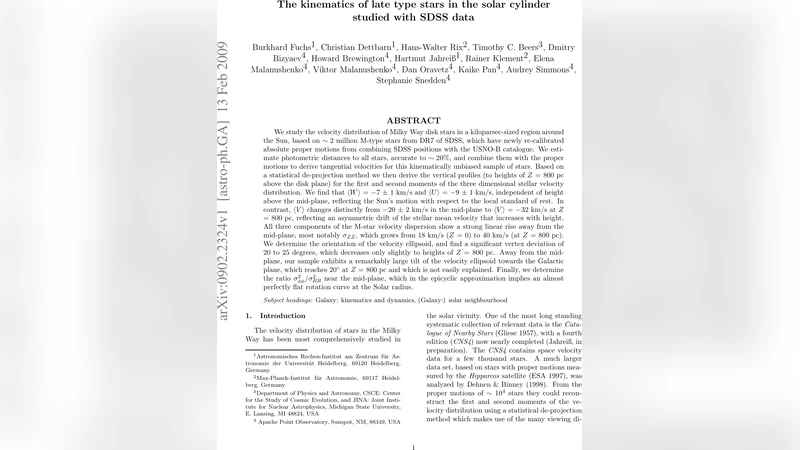
We study the velocity distribution of Milky Way disk stars in a kiloparsec-sized region around the Sun, based on ~ 2 million M-type stars from DR7 of SDSS, which have newly re-calibrated absolute proper motions from combining SDSS positions with the USNO-B catalogue. We estimate photometric distances to all stars, accurate to ~ 20 %, and combine them with the proper motions to derive tangential velocities for this kinematically unbiased sample of stars. Based on a statistical de-projection method we then derive the vertical profiles (to heights of Z = 800 pc above the disk plane) for the first and second moments of the three dimensional stellar velocity distribution. We find that
💡 Research Summary
This paper presents a comprehensive kinematic analysis of Milky Way disk stars within a kiloparsec‑scale cylindrical volume centered on the Sun, using approximately two million M‑type stars drawn from the Sloan Digital Sky Survey Data Release 7 (SDSS‑DR7). The authors first obtain newly calibrated absolute proper motions by cross‑matching SDSS positions with the USNO‑B catalogue, thereby reducing systematic errors that have plagued earlier proper‑motion studies. Photometric distances are estimated for every star via an (r‑i) colour–absolute magnitude relation, achieving an accuracy of roughly 20 %. By combining these distances with the proper motions, the authors compute tangential velocities for the entire, kinematically unbiased sample.
Because only two components of the three‑dimensional velocity vector are directly observable (the line‑of‑sight component is unavailable for the majority of the sample), the authors employ a statistical de‑projection technique. This method uses the known sky positions (Galactic longitude ℓ, latitude b, and distance d) to invert the observed tangential velocities into estimates of the full velocity distribution’s first and second moments. The analysis is performed in discrete vertical slices ranging from the mid‑plane (Z = 0 pc) up to Z = 800 pc, assuming axisymmetry and a locally Gaussian velocity distribution.
The resulting mean velocities reveal that the radial (U) and vertical (W) components are essentially constant with height: ⟨U⟩ = ‑9 ± 1 km s⁻¹ and ⟨W⟩ = ‑7 ± 1 km s⁻¹. These values reflect the Sun’s motion relative to the local standard of rest (LSR). In contrast, the azimuthal component ⟨V⟩ shows a clear vertical gradient, shifting from about –20 km s⁻¹ in the plane to –32 km s⁻¹ at Z = 800 pc. This trend is interpreted as an increasing asymmetric drift with height, consistent with older, dynamically hotter populations dominating at larger Z.
All three diagonal elements of the velocity dispersion tensor increase linearly with Z. The vertical dispersion σ_ZZ grows from 18 km s⁻¹ at the mid‑plane to 40 km s⁻¹ at 800 pc, while σ_RR and σ_φφ also rise, though σ_RR does so slightly more steeply, indicating growing anisotropy. The orientation of the velocity ellipsoid is examined through the vertex deviation and tilt angle. The vertex deviation remains large, 20°–25°, with only a modest decrease at higher Z, suggesting that the principal axes of the velocity ellipsoid are not aligned with the Galactic cylindrical coordinates. More strikingly, the tilt of the ellipsoid toward the Galactic plane reaches about 20° at Z = 800 pc, a magnitude that is difficult to reconcile with simple axisymmetric disk models and may point to external perturbations (e.g., satellite interactions) or the influence of non‑axisymmetric structures such as spiral arms or the bar.
Finally, the ratio σ_φφ²/σ_RR² near the plane is found to be close to unity (≈ 0.95). Within the epicyclic approximation, this ratio directly relates to the slope of the rotation curve; a value near one implies an almost perfectly flat rotation curve at the Solar radius, corroborating independent measurements from gas and other stellar tracers.
In summary, by leveraging an unprecedentedly large, homogeneous sample of M dwarfs with high‑quality proper motions and photometric distances, the authors deliver precise vertical profiles of the Milky Way disk’s kinematic moments. Their findings confirm the Sun’s peculiar motion, quantify the height‑dependent asymmetric drift, document a strong linear increase in velocity dispersions, and uncover a pronounced tilt of the velocity ellipsoid that challenges conventional axisymmetric models. These results provide stringent constraints for dynamical models of the Galactic disk, its heating mechanisms, and its interaction with the surrounding halo and satellite system, and they set the stage for future refinements using Gaia’s full 6‑dimensional phase‑space data.
Comments & Academic Discussion
Loading comments...
Leave a Comment