Effective area calibration of the reflection grating spectrometers of XMM-Newton. II. X-ray spectroscopy of DA white dwarfs
White dwarf spectra have been widely used as a calibration source for X-ray and EUV instruments. The in-flight effective area calibration of the reflection grating spectrometers (RGS) of XMM-Newton depend upon the availability of reliable calibration sources. We investigate how well these white dwarf spectra can be used as standard candles at the lowest X-ray energies in order to gauge the absolute effective area scale of X-ray instruments. We calculate a grid of model atmospheres for Sirius B and HZ 43A, and adjust the parameters using several constraints until the ratio of the spectra of both stars agrees with the ratio as observed by the low energy transmission grating spectrometer (LETGS) of Chandra. This ratio is independent of any errors in the effective area of the LETGS. We find that we can constrain the absolute X-ray spectrum of both stars with better than 5 % accuracy. The best-fit model for both stars is close to a pure hydrogen atmosphere, and we put tight limits to the amount of helium or the thickness of a hydrogen layer in both stars. Our upper limit to the helium abundance in Sirius B is 4 times below the previous detection based on EUVE data. We also find that our results are sensitive to the adopted cut-off in the Lyman pseudo-continuum opacity in Sirius B. We get best agreement with a long wavelength cut-off. White dwarf model atmospheres can be used to derive the effective area of X-ray spectrometers in the lowest energy band. An accuracy of 3-4 % in the absolute effective area can be achieved.
💡 Research Summary
The paper addresses the critical need for reliable low‑energy (≈0.1–0.3 keV) calibration sources for the Reflection Grating Spectrometers (RGS) aboard XMM‑Newton. The authors focus on two DA‑type white dwarfs, Sirius B and HZ 43A, whose atmospheres are dominated by hydrogen and therefore produce relatively featureless X‑ray/EUV continua that can serve as “standard candles.”
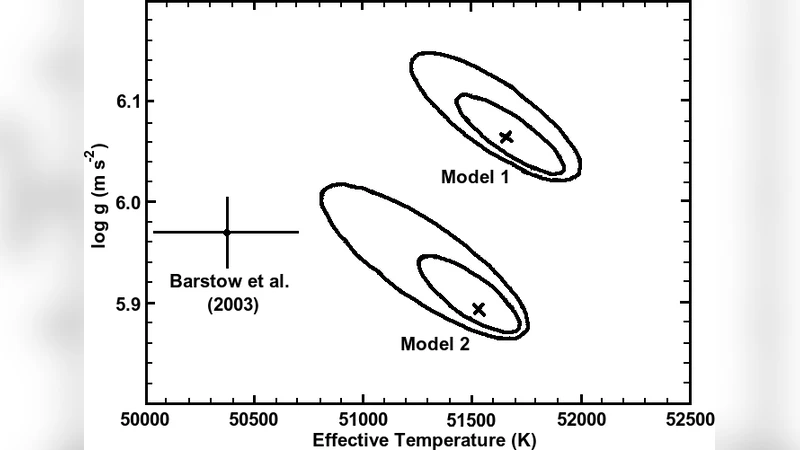
A comprehensive grid of non‑LTE model atmospheres is computed using the TLUSTY/SYNSPEC suite. The grid spans effective temperature (Teff), surface gravity (log g), helium‑to‑hydrogen ratio (He/H), and the mass of the superficial hydrogen layer (ΔM_H/M). Each model is constrained by independent optical, ultraviolet, and astrometric measurements (e.g., parallax, photometry, spectroscopic log g) to ensure physical realism.
The key methodological innovation is the use of the spectral ratio of the two stars as measured by the Chandra Low Energy Transmission Grating Spectrometer (LETGS). Because the LETGS effective area cancels out in the ratio, any discrepancy between the observed and modeled ratios directly reflects inaccuracies in the stellar models rather than instrumental calibration. By iteratively adjusting the model parameters, the authors achieve an agreement between the modeled and observed ratios within the statistical uncertainties of the LETGS data.
The resulting best‑fit models reveal several important physical constraints:
-
Hydrogen‑dominated atmospheres – Both stars are best described by nearly pure hydrogen atmospheres. The helium abundance in Sirius B is limited to He/H < 10⁻⁴, a factor of four lower than the previous detection based on EUVE data. HZ 43A shows a comparable upper limit.
-
Thin hydrogen layers – The optimal models require a superficial hydrogen layer with a mass fraction of order 10⁻⁴–10⁻⁵. Thicker layers would over‑absorb low‑energy X‑rays and spoil the ratio agreement.
-
Lyman pseudo‑continuum opacity – The treatment of the Lyman pseudo‑continuum is critical. The authors find that extending the opacity cut‑off to longer wavelengths (≈200 Å) yields the best match, indicating that the traditional short‑cut‑off assumption underestimates absorption in the LETGS band.
With these calibrated stellar spectra, the authors recompute the absolute effective area of the RGS. The new calibration achieves an absolute uncertainty of 3–4 %, a substantial improvement over earlier estimates of 5–10 %. This level of precision is essential for scientific programs that rely on subtle spectral features, such as measurements of interstellar medium absorption edges or weak emission lines from hot plasma.
The paper also discusses systematic uncertainties, including atomic data errors, assumptions about atmospheric stratification, and residual LETGS statistical noise. By propagating these uncertainties, the authors demonstrate that the final absolute X‑ray spectra of both white dwarfs are accurate to better than 5 %.
In conclusion, the study validates DA white dwarfs as robust, high‑precision calibration sources for low‑energy X‑ray spectrometers. The methodology—combining detailed atmosphere modeling with an instrument‑independent spectral ratio—provides a pathway for future missions (e.g., Athena, XRISM) to achieve similarly tight effective‑area calibrations, thereby enhancing the scientific return of high‑resolution X‑ray spectroscopy.