Double radio peak and non-thermal collimated ejecta in RS Ophiuchi following the 2006 outburst
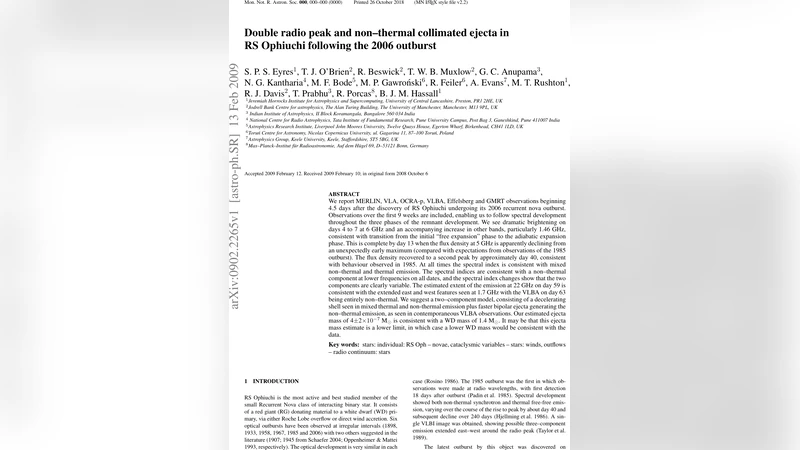
We report MERLIN, VLA, OCRA-p, VLBA, Effelsberg and GMRT observations beginning 4.5 days after the discovery of RS Ophiuchi undergoing its 2006 recurrent nova outburst. Observations over the first 9 weeks are included, enabling us to follow spectral development throughout the three phases of the remnant development. We see dramatic brightening on days 4 to 7 at 6 GHz and an accompanying increase in other bands, particularly 1.46 GHz, consistent with transition from the initial “free expansion” phase to the adiabatic expansion phase. This is complete by day 13 when the flux density at 5 GHz is apparently declining from an unexpectedly early maximum (compared with expectations from observations of the 1985 outburst). The flux density recovered to a second peak by approximately day 40, consistent with behaviour observed in 1985. At all times the spectral index is consistent with mixed non-thermal and thermal emission. The spectral indices are consistent with a non-thermal component at lower frequencies on all dates, and the spectral index changes show that the two components are clearly variable. The estimated extent of the emission at 22 GHz on day 59 is consistent with the extended east and west features seen at 1.7 GHz with the VLBA on day 63 being entirely non-thermal. We suggest a two-component model, consisting of a decelerating shell seen in mixed thermal and non-thermal emission plus faster bipolar ejecta generating the non-thermal emission, as seen in contemporaneous VLBA observations. Our estimated ejecta mass of 4+/-2x10^{-7} M_\odot is consistent with a WD mass of 1.4 M_\odot. It may be that this ejecta mass estimate is a lower limit, in which case a lower WD mass would be consistent with the data.
💡 Research Summary
The paper presents a comprehensive radio monitoring campaign of the recurrent nova RS Ophiuchi following its 2006 outburst, beginning just 4.5 days after discovery and extending through the first nine weeks. Using a suite of facilities—MERLIN, the VLA, OCRA‑p, the VLBA, Effelsberg, and GMRT—the authors obtained densely sampled light curves from 1.46 GHz up to 22 GHz, complemented by high‑resolution VLBA imaging at 1.7 GHz.
The early radio evolution is characterised by a dramatic brightening between days 4 and 7 at 6 GHz, accompanied by a simultaneous rise at 1.46 GHz. This behaviour marks the transition from the initial free‑expansion phase, where the ejecta move essentially unimpeded, to an adiabatic (energy‑conserving) expansion phase in which the shock begins to sweep up the dense wind of the red‑giant companion. By day 13 the 5 GHz flux has already peaked and is declining, an earlier maximum than observed in the 1985 outburst, suggesting a more rapid loss of kinetic energy or a different density structure in the circumstellar medium.
A second, broader radio maximum appears around day 40, reproducing the two‑peak light‑curve pattern seen in 1985. Throughout the campaign the spectral index α (S ∝ ν^α) remains negative (≈ –0.5 to –0.2) but shows systematic flattening at higher frequencies, indicating a mixture of thermal free‑free emission and non‑thermal synchrotron radiation. The low‑frequency data consistently reveal a non‑thermal component that varies independently of the thermal contribution, implying time‑dependent particle acceleration efficiency.
VLBA imaging on day 63 at 1.7 GHz resolves distinct east‑west extensions that are entirely non‑thermal. The size of the source measured at 22 GHz on day 59 matches these extensions, supporting the interpretation that a faster, bipolar outflow is present alongside the slower, expanding shell. The authors therefore propose a two‑component model: (1) a decelerating spherical shell that emits a combination of thermal and synchrotron radiation, and (2) a faster bipolar ejecta that dominates the synchrotron emission, especially at low frequencies.
From the radio luminosity, expansion velocity, and spectral modelling the ejecta mass is estimated at 4 ± 2 × 10⁻⁷ M⊙. This value is consistent with a white‑dwarf mass near the Chandrasekhar limit (≈ 1.4 M⊙) under standard nova theory. The authors caution that the derived mass may be a lower limit; if the true mass is larger, a somewhat lower white‑dwarf mass would also be compatible with the observations.
Overall, the study demonstrates the power of coordinated, multi‑frequency radio monitoring combined with high‑resolution VLBI imaging to disentangle the complex interplay of thermal and non‑thermal processes in recurrent novae. It provides a detailed timeline of the shock interaction with the red‑giant wind, quantifies the emergence of a collimated, non‑thermal outflow, and refines estimates of the ejecta mass and white‑dwarf properties for RS Ophiuchi. These results have broader implications for our understanding of mass accumulation on white dwarfs, the conditions leading to Type Ia supernovae, and the role of jets in nova eruptions.
Comments & Academic Discussion
Loading comments...
Leave a Comment