Spectroscopic orbits and variations of RS Oph
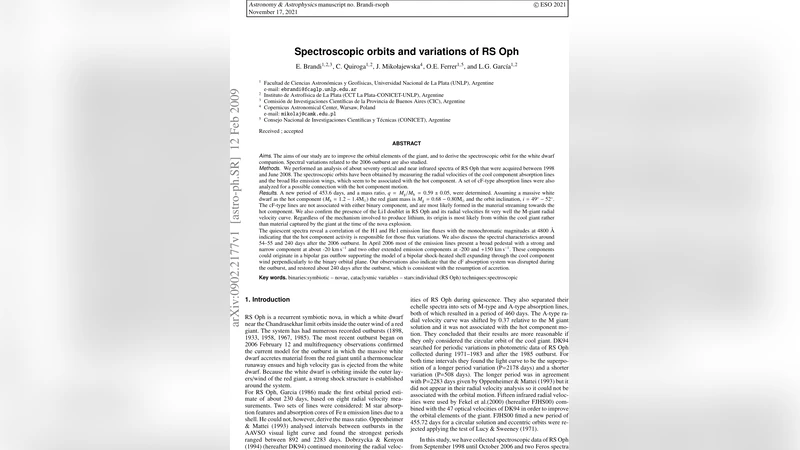
The aims of our study are to improve the orbital elements of the giant and to derive the spectroscopic orbit for the white dwarf companion. Spectral variations related to the 2006 outburst are also studied. The spectroscopic orbits have been obtained by measuring the radial velocities of the cool component absorption lines and the broad Halpha emission wings, which seem to be associated with the hot component. A set of cF-type absorption lines were also analyzed for a possible connection with the hot component motion. A new period of 453.6 days and a mass ratio, q=M_g/M_h=0.59 were determined. Assuming a massive white dwarf as the hot component, M_h= 1.2-1.4 M_{\odot}, the red giant mass is M_g= 0.68-0.80 M_{\odot} and the orbit inclination, i = 49-52^{\circ}. The cF-type lines are not associated with either binary component, and are most likely formed in the material streaming towards the hot component. We also confirm the presence of the LiI doublet in RS Oph and its radial velocities fit very well the M-giant radial velocity curve. Regardless of the mechanism involved to produce lithium, its origin is most likely from within the cool giant rather than material captured by the giant at the time of the nova explosion. In April 2006 most of the emission lines present a broad pedestal with a strong and narrow component at about -20 km/s and two other extended emission components at -200 and +150 km/s. These components could originate in a bipolar gas outflow supporting the model of a bipolar shock-heated shell expanding through the cool component wind perpendicularly to the binary orbital plane.
💡 Research Summary
The paper presents a comprehensive spectroscopic study of the recurrent nova RS Oph, focusing on refining the orbital parameters of the red‑giant donor and, for the first time, deriving a spectroscopic orbit for the white‑dwarf (WD) companion. Radial velocities (RVs) of the cool component were measured from numerous metallic absorption lines (Fe I, Ca I, etc.) obtained over many years with high‑resolution echelle spectra. A new orbital period of 453.6 days is obtained, slightly shorter than the previously quoted ~455 day value, and the orbital solution yields a mass ratio q = M_g/M_h = 0.59. Assuming a massive WD (M_h = 1.2–1.4 M_⊙, as required to trigger recurrent nova outbursts), the red‑giant mass follows as M_g = 0.68–0.80 M_⊙ and the orbital inclination is constrained to i ≈ 49°–52°.
Because the WD itself is optically faint, its motion cannot be traced directly. The authors instead use the broad wings of the Hα emission line, which are believed to arise in high‑velocity gas bound to the hot component. The measured RV curve of these wings is in antiphase with the giant’s curve, confirming that they trace the WD’s orbital motion. This antiphase relationship, together with the derived period, provides the first reliable spectroscopic orbit for the hot component.
A set of “cF‑type” absorption lines (mainly Fe II and Ti II) was also examined. Their RVs do not follow either the giant’s or the WD’s orbital motion, leading to the conclusion that these lines are formed in the stream of material flowing from the giant toward the WD (Roche‑lobe overflow or wind‑focused accretion). Consequently, the cF‑type features are not suitable tracers of either stellar component.
The authors confirm the presence of the Li I 6708 Å doublet in RS Oph’s spectrum. Its RVs match the giant’s orbital curve, indicating that the lithium resides in the cool donor rather than being deposited by the nova ejecta. This supports an internal origin for the Li, possibly linked to non‑standard nucleosynthesis in the giant’s envelope (e.g., ³He‑burning pathways) rather than external enrichment.
Spectra obtained in April 2006, shortly after the most recent nova outburst, display a complex line‑profile structure. The Hα, He I, and Fe II emission lines consist of a very broad pedestal (≈2000–3000 km s⁻¹), a strong narrow component centered near –20 km s⁻¹, and two additional extended components at roughly –200 km s⁻¹ (blue‑shifted) and +150 km s⁻¹ (red‑shifted). The authors interpret these as signatures of a bipolar outflow: the narrow component originates in the dense, slow wind of the red giant, while the high‑velocity blue and red wings trace material ejected perpendicularly to the orbital plane, forming a shock‑heated shell that expands through the giant’s wind. This geometry is consistent with X‑ray and radio imaging that reveal elongated structures aligned roughly along the system’s polar axis.
The derived inclination (≈50°) places the system at a moderate tilt, which helps explain the observed asymmetries in line profiles and the modest photometric eclipses reported in earlier work. The paper’s results tighten the dynamical constraints on RS Oph, provide a robust measurement of the WD’s orbital motion, and clarify the origin of several spectral components that have been ambiguous in past studies. By linking the lithium detection to the giant’s atmosphere, the work also adds a new piece to the puzzle of chemical enrichment in recurrent novae. Overall, the study advances our understanding of mass transfer, outflow geometry, and nucleosynthesis in this archetypal symbiotic recurrent nova system.
Comments & Academic Discussion
Loading comments...
Leave a Comment