Metallicities and ages of stellar populations at a high Galactic latitude field
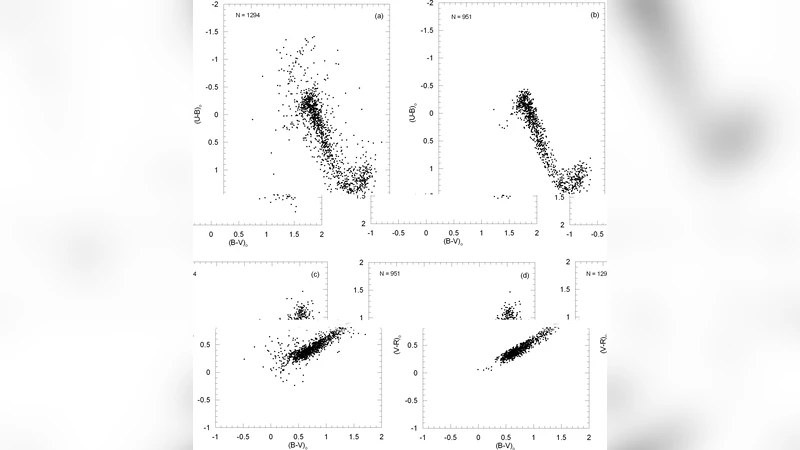
We present an analysis of $UBVRI$ data from the Selected Area SA 141. By applying recalibrated methods of measuring ultraviolet excess (UVX), we approximate abundances and absolute magnitudes for 368 stars over 1.3 square degrees out to distances over 10 kpc. With the density distribution constrained from our previous photometric parallax investigations and with sufficient accounting for the metallicity bias in the UVX method, we are able to compare the vertical abundance distribution to those measured in previous studies. We find that the abundance distribution has an underlying uniform component consistent with previous spectroscopic results that posit a monometallic thick disk and halo with abundances of $[Fe/H]$ = $-$0.8 and $-$1.4, respectively. However, there are a number of outlying data points that may indicate contamination by more metal-rich halo streams. The absence of vertical abundance gradients in the Galactic stellar populations and the possible presence of interloping halo streams would be consistent with expectations from merger models of Galaxy formation. We find that our UVX method has limited sensitivity in exploring the metallicity distribution of the distant Galactic halo, owing to the poor constraint on the $UBV$ properties of very metal-poor stars. The derivation of metallicities from broadband $UBV$ photometry remains fundamentally sound for the exploration of the halo but is in need of both improved calibration and superior data.
💡 Research Summary
The paper presents a detailed photometric analysis of the high‑latitude field SA 141, using broadband $UBVRI$ observations to investigate the metallicities and ages of its stellar populations. The authors begin by assembling a clean sample of 368 stars covering 1.3 square degrees, for which they have accurate $U$, $B$, $V$, $R$, and $I$ magnitudes. Distances are derived through a previously calibrated photometric‑parallax method that relates absolute magnitude to colour indices, allowing the authors to place each star at a heliocentric distance up to and beyond 10 kpc and to compute its vertical height $z$ above the Galactic plane.
The core of the work is a recalibration of the ultraviolet‑excess (UVX) technique, a classic method that exploits the sensitivity of the $(U!-!B)$ colour to metal line blanketing. Traditional UVX calibrations are based largely on nearby, relatively metal‑rich stars and suffer from systematic biases when applied to the metal‑poor halo regime. To overcome this, the authors generate synthetic colours from modern stellar atmosphere libraries (e.g., PHOENIX, MARCS) spanning $-4.0\leq\mathrm{
Comments & Academic Discussion
Loading comments...
Leave a Comment