Sh2-205: II. Its quiescent stellar formation activity
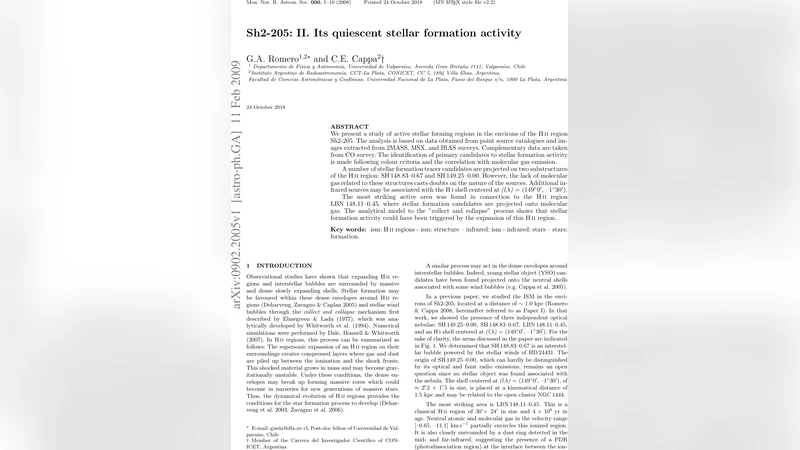
We present a study of active stellar forming regions in the environs of the HII region Sh2-205. The analysis is based on data obtained from point source catalogues and images extracted from 2MASS, MSX, and IRAS surveys. Complementary data are taken from CO survey. The identification of primary candidates to stellar formation activity is made following colour criteria and the correlation with molecular gas emission. A number of stellar formation tracer candidates are projected on two substructures of the HII region: SH148.83-0.67 and SH149.25-0.00. However, the lack of molecular gas related to these structures casts doubts on the nature of the sources. Additional infrared sources may be associated with the HI shell centered at (l,b) = (149\degr 0\arcmin, -1\degr 30\arcmin). The most striking active area was found in connection to the HII region LBN 148.11-0.45, where stellar formation candidates are projected onto molecular gas. The analytical model to the “collect and collapse” process shows that stellar formation activity could have been triggered by the expansion of this HII region.
💡 Research Summary
The paper investigates ongoing star‑formation activity in the vicinity of the Galactic H II region Sh2‑205 by combining multi‑wavelength archival data from the 2MASS, MSX, and IRAS infrared surveys with CO molecular line observations. The authors first construct a catalog of young stellar object (YSO) candidates using established near‑infrared colour criteria (J–H vs. H–K_s) and mid‑infrared colour ratios (MSX 8 µm/12 µm, IRAS 60 µm/100 µm) to discriminate genuine protostars from field stars and background galaxies. This yields 57 candidate sources.
Next, the spatial distribution of these candidates is compared with the CO (J=1–0) emission map derived from a large‑scale Galactic CO survey (≈8′ resolution, 0.2 K km s⁻¹ sensitivity). The CO map reveals three principal sub‑structures within Sh2‑205: the compact H II regions SH148.83‑0.67 and SH149.25‑0.00, an extended HI shell centred at (l, b) ≈ (149°, ‑1° 30′), and the larger H II region LBN 148.11‑0.45 surrounded by a dense molecular cloud.
For SH148.83‑0.67 and SH149.25‑0.00, a modest number of YSO candidates (8 and 6 respectively) are projected onto the radio‑continuum shells, but the CO data show negligible molecular gas (integrated intensity < 0.5 K km s⁻¹). This lack of associated molecular material casts doubt on the physical connection between the infrared sources and genuine star‑formation activity; they may be foreground/background objects unrelated to the H II region.
The HI shell contains a few infrared sources that align with the neutral hydrogen structure, yet again the CO emission is essentially absent, providing insufficient evidence for active star formation within the shell.
In contrast, the region surrounding LBN 148.11‑0.45 displays a strong spatial correlation between YSO candidates and molecular gas. Twenty‑three of the infrared sources lie on CO peaks with integrated intensities > 5 K km s⁻¹, indicating that they are embedded within a dense molecular environment. To interpret this configuration, the authors apply the “collect and collapse” model (Elmegreen & Lada 1977). They assume an initial ambient density n₀ ≈ 100 cm⁻³, an ionized‑gas expansion velocity v_exp ≈ 10 km s⁻¹, and a surrounding molecular cloud temperature of T ≈ 15 K. Using these parameters, the analytical model predicts that the swept‑up shell becomes gravitationally unstable after roughly 2 Myr, at which point fragmentation can give rise to massive clumps that subsequently collapse to form stars. The estimated age of the YSO population (≈ 0.5–1 Myr, inferred from infrared spectral indices) is consistent with formation after the onset of instability, supporting a triggered‑star‑formation scenario.
Overall, the study concludes that while Sh2‑205 as a whole shows limited present‑day star‑forming activity, the sub‑region LBN 148.11‑0.45 is a clear example where the expansion of an H II region has likely induced the formation of new stars via the collect‑and‑collapse mechanism. The authors recommend follow‑up high‑resolution (≤ 1″) observations of higher‑J CO transitions, dense‑gas tracers such as HCO⁺, N₂H⁺, and ammonia, as well as interferometric radio continuum imaging, to refine the physical properties of the molecular clumps, confirm the kinematic signatures of collapse, and quantify the star‑formation efficiency in this triggered environment.
Comments & Academic Discussion
Loading comments...
Leave a Comment